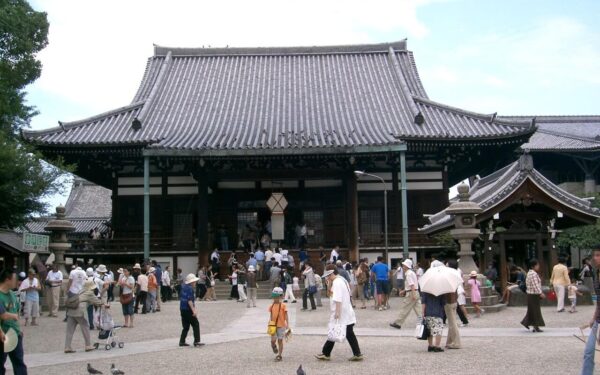
Nunose Shrine
A free, Edo-period shrine in Matsubara with genuine cultural properties and the most artful fortune slips in the Osaka region.
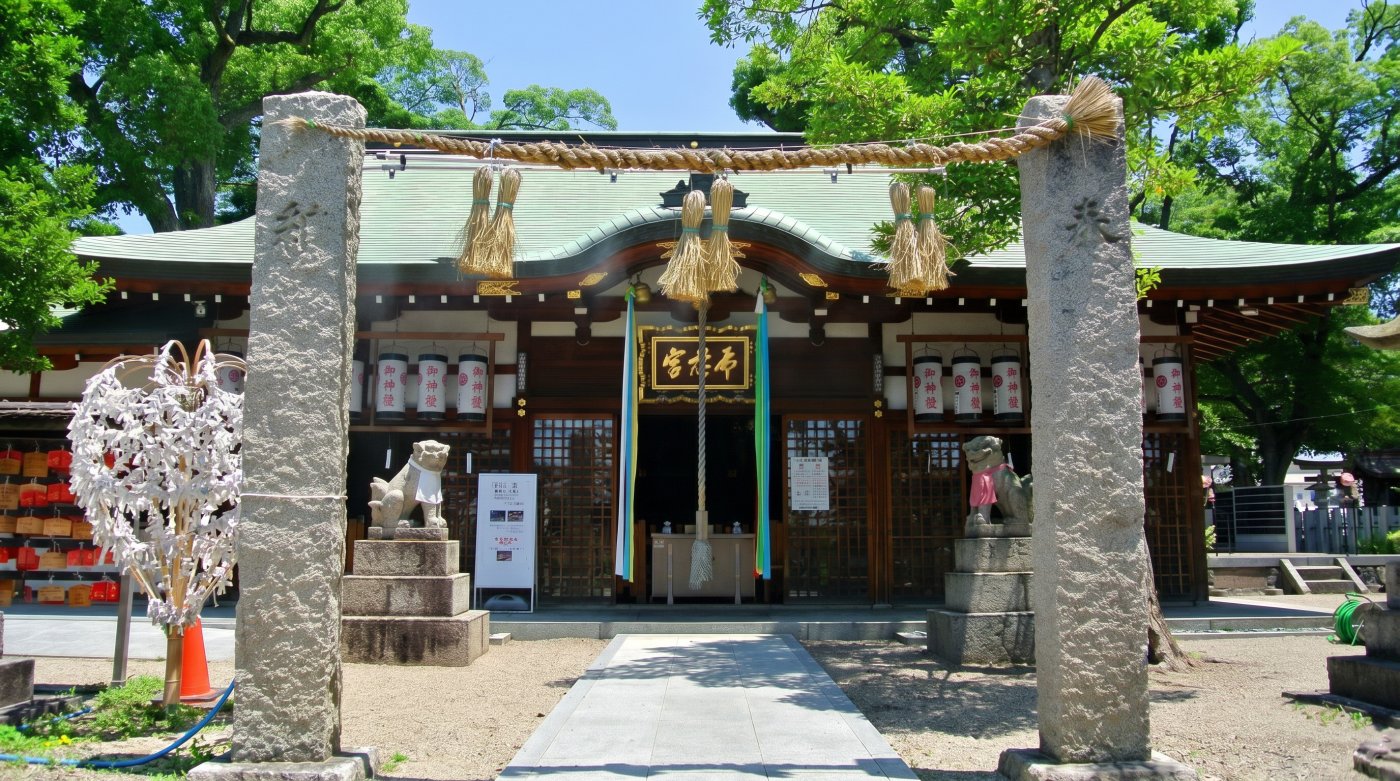





Nunose Shrine — 布忍神社 in Japanese — sits in Matsubara City, a quiet corner of Osaka Prefecture locals affectionately call the “belly button of Osaka.”
Its founding date is lost to history, which somehow makes it feel more authentic, not less.
Three deities are enshrined here: Haya Susanoo no Mikoto, Yae Kotoshironushi no Mikoto, and Takemikazuchio no Mikoto, collectively credited with blessings ranging from recovery from illness to protection from poisonous insects and business prosperity.
The main hall is a designated Tangible Cultural Property of Osaka Prefecture, built in the early Edo period in the elegant ikkensha nagare-zukuri (single-bay flowing) style.
Inside the worship hall, six painted panels known as the “Nunose Hakkei Hengaku” are themselves a designated cultural property of Matsubara City, and a lion mural attributed to Kano Tan’yu adds to the visual weight of the space.
The shrine also displays ema votive plaques offered by prominent cultural figures — a quiet gallery of wishes and gratitude that lines the walls.
What draws younger visitors today is the koi-mikuji: love fortune slips designed in collaboration with contemporary artist Hiroko Ichihara, each one a small art object as much as a divination.
The grounds are compact but serene, with two large torii gates marking your passage in.
Spring is especially atmospheric when the trees soften the austere architecture, and the amulet office opens Tuesday through Sunday from 09:00 to 17:00 — plan accordingly.
Nunose Shrine: Complete Visitor Guide to Osaka’s Edo-Period Sanctuary (2026)
Nunose Shrine (布忍神社) is a free Shinto shrine in Matsubara City that punches well above its modest profile.
The main hall is a designated Tangible Cultural Property of Osaka Prefecture, the love fortune slips are genuinely beautiful art objects, and the grounds stay quiet enough that you can actually hear yourself think.
In this Explore Osaka guide, you’ll find everything you need to plan a visit: what to see, how to get there, and whether it’s worth combining with nearby spots.
Quick Facts of Nunose Shrine
Hide- Official name: Nunose Shrine / 布忍神社 (Nunose Jinja)
- Address: 2-4-11 Kitashinmachi, Matsubara, Osaka 580-0025
- Admission: Free
- Gates open: Daily, approximately 06:00 to 18:00
- Amulet office (omamori counter): Tuesday to Sunday, 09:00 to 17:00; closed Mondays
- Nearest station: Nunose Station (Kintetsu Minami Osaka Line), 5-minute walk west
- Time needed: 30 to 45 minutes
- Best seasons: Spring and Autumn
- Phone: 072-334-7634
- Official website: http://www.eonet.ne.jp/~nunose/
Why Visit Nunose Shrine
Osaka has no shortage of shrines.
What makes Nunose worth the trip out to Matsubara is a combination that’s rare to find in one place: genuine historical architecture, a specific blessing tradition tied to healing and protection, and an omikuji (fortune slip) that you’ll actually want to keep rather than fold up and tie to the nearest tree.
The shrine enshrines three deities: Haya Susanoo no Mikoto, Yae Kotoshironushi no Mikoto, and Takemikazuchio no Mikoto.
Historically, worshippers came here for recovery from illness, protection from poisonous insects and misfortune, safe travel, and business prosperity.
That range of blessings is reflected in the visitor mix today, locals pulling up on bicycles on weekday mornings alongside the occasional traveler who found this place through deliberate research rather than accident.
The shrine also sits along the Takenouchi Kaido, one of Japan’s oldest roads, which adds a layer of historical context to even a short visit.
Matsubara City is sometimes called the “belly button of Osaka” for its position near the geographic center of the prefecture, and Nunose Shrine has been part of that landscape for centuries.
The Cultural Properties That Actually Matter
The main hall (honden) was built in the early Edo period in the ikkensha nagare-zukuri style, a single-bay flowing construction that’s elegant in its proportions and noticeably well-preserved.
Inside the worship hall, six painted panels known as the “Nunose Hakkei Hengaku” are designated cultural properties of Matsubara City, and a lion mural attributed to Kano Tan’yu (a 17th-century painter from the celebrated Kano school) adds considerable artistic weight to the space.
Two large torii gates frame the approach, and ema votive plaques offered by prominent local cultural figures line the walls in a quiet, low-key gallery of wishes.
Trip Essentials
Osaka Travel Add-ons
Equip yourself for the ultimate Osaka adventure with the following add-ons, curated just for you.
Flights to Osaka
Airport Transfer
ICOCA IC Card
Suica IC Card
Osaka Tours
Luggage Storage
Travel Insurance
Data Security

Japan eSIM
Japan SIM Card
Pocket WiFi Rental
Japan eSIM
What to See and Do at Nunose Shrine
The grounds are compact, so you won’t need a map or a plan.
Enter through the outer torii gate, follow the stone path to the inner gate, and you’re already at the worship hall.
But there are a handful of things worth slowing down for.
The Koi-Mikuji Love Fortune Slips
The koi-mikuji are the detail that gets Nunose Shrine onto travel lists it would otherwise never appear on.
These love fortune slips were designed in collaboration with artist Hiroko Ichihara, and they’re genuinely beautiful objects: small, considered in their design, and a real departure from the standard printed paper fortune you find at every major shrine in Japan.
Each one is a divination result and a small keepsake.
Pick one up at the amulet office (open Tuesday to Sunday, 09:00 to 17:00), and keep in mind that if you visit on a Monday, the office is closed.
The Main Hall and Painted Panels
Take a few minutes in front of the honden to look at the architectural detail.
The nagare-zukuri roof style sweeps forward with a satisfying asymmetry, and the fittings show age without looking neglected.
If the inner worship hall is accessible during your visit, the Hakkei Hengaku panels are worth a close look.
Japanese art history fans will appreciate the Kano Tan’yu attribution; everyone else will appreciate that it’s a genuinely atmospheric space that doesn’t try to sell you anything.
The Ema Hall and Grounds
The collection of ema (votive wooden plaques) displayed on the walls includes pieces dedicated by artists, priests, and local figures across generations.
It’s not a formal exhibition, more like a curated accumulation of gratitude.
The shrine grounds also include a small parking area, a stone monument near the bridge over the Nishijo River, and old trees that give the precinct a sense of age without requiring a guidebook to notice.
The Kairin Matsuri Six-Shrine Pilgrimage
Nunose Shrine is one of six shrines included in the Kairin Matsuri pilgrimage circuit in Matsubara, along with Nanguu Taisha, Kashii Jinja, Kawachiamami Jinja, Tsurugaike Jinja, and Shiroishi Jinja.
If you enjoy shrine-hopping, this circuit gives the Matsubara area a cohesive itinerary structure.
None of the six shrines charge admission, and together they can be covered in a half-day with a bicycle or careful walking route planning.
How to Get There
Nunose Shrine sits in Matsubara City, which is not on the Osaka subway network.
You’ll need to use the Kintetsu Minami Osaka Line, which runs south from Osaka Abenobashi Station.
Osaka Abenobashi is directly connected to Tennoji Station, making Tennoji your practical jumping-off point from central Osaka.
From Tennoji or Osaka Abenobashi
Take the Kintetsu Minami Osaka Line from Osaka Abenobashi Station toward Kintetsu Kawachiamami.
Ride for approximately 17 minutes and exit at Nunose Station.
The shrine is a 5-minute walk west from the station exit.
Total door-to-door travel time from Tennoji is around 25 minutes.
From Namba or Shinsaibashi
Take the Osaka Metro Midosuji Line south to Tennoji Station (about 7 minutes), then follow the directions above.
Alternatively, take the Tanimachi Line to Tennoji and transfer.
From Namba, the whole journey runs around 35 to 40 minutes.
By Car
Nunose Shrine has on-site parking, which is useful if you’re combining it with other Matsubara shrines on the pilgrimage circuit.
From central Osaka, the drive takes approximately 20 to 30 minutes depending on traffic.
Practical Tips For Visiting Nunose Shrine
Entry to the shrine grounds is free and genuinely uncomplicated.
There’s no ticket booth, no queuing, and no audio guide system to navigate.
That said, a few specifics will save you a wasted trip.
Opening Hours and the Monday Problem
The grounds themselves are accessible from around 06:00 to 18:00 every day.
But if you want to purchase an omamori, a koi-mikuji love fortune slip, or any other amulet, the office is only open Tuesday through Sunday, 09:00 to 17:00.
Monday visits are fine for the architectural experience and the grounds, but you’ll leave empty-handed in the souvenir department.
For most visitors combining this with other spots, a Tuesday to Sunday visit before 16:30 hits the sweet spot.
When to Visit for the Best Experience
Spring and Autumn are the standout seasons.
In spring, the soft greenery around the approach softens the austere Edo-period architecture in a way that photographs well and feels genuinely atmospheric in person.
Autumn brings the same quality of light and color without the cherry blossom crowds you’d encounter at larger shrines.
Weekday mornings are reliably quiet.
Weekend afternoons can bring small groups of local worshippers, particularly for seasonal festivals, but “crowded” at Nunose Shrine is a relative term compared to, say, Fushimi Inari on a Saturday.
What to Bring
Cash is useful for the amulet office, though amounts are modest.
The koi-mikuji love fortune slips and standard omamori are priced in typical shrine ranges (roughly ¥500 to ¥1,000).
Comfortable walking shoes matter slightly if you’re combining this with the full Kairin Matsuri pilgrimage circuit.
And if you’re visiting in summer, the grounds offer limited shade, so a hat and water make the visit more comfortable.
Photography
Outdoor photography on the grounds is generally fine.
Exercise the usual courtesy inside covered shrine structures and don’t photograph other visitors without permission.
The shrine’s resident priest is reportedly an artist himself (a sculptor), which may explain the openness to creative visitors that several past reviewers have noted.
Nearby Attractions Around Nunose Shrine
Matsubara City is a low-key destination, but combining Nunose Shrine with a couple of nearby stops makes the journey from Osaka genuinely worthwhile.
Kawachiamami Jinja
About a 10-minute walk or one station north on the Kintetsu Minami Osaka Line, Kawachiamami Jinja is another of the six Kairin Matsuri shrines.
It’s a smaller precinct than Nunose but notable for its connection to agricultural blessings and its quiet, leafy setting beside rice paddies.
Osaka Prefecture Chikatsu Asuka Museum
A short bus ride or drive from Matsubara, the Chikatsu Asuka Museum is an Ando Tadao-designed structure set into a hillside above ancient burial mounds.
If you have an interest in Kofun-period history or simply appreciate striking architecture, this is one of the most interesting museums in the greater Osaka area that most visitors completely overlook.
Budget about 90 minutes.
Nanguu Taisha
One of the larger shrines in the Kairin Matsuri circuit, Nanguu Taisha is a 15 to 20 minute drive from Nunose and worth visiting if you’re covering the full pilgrimage route.
The main hall grounds are more extensive than Nunose, with a different aesthetic that provides good contrast for the same day.
Nunose Shrine works well as an afternoon addition to a day based in Tennoji, especially if you’ve already covered Shitennoji Temple and want something genuinely off the tourist circuit.
If you’re still building your Osaka schedule around it, the Osaka itinerary section has route suggestions that combine south Osaka’s less-visited shrines and cultural sites into a coherent day plan.
And if you’re looking for the full picture of things to do in Osaka beyond the central districts, Matsubara’s quiet streets and its handful of remarkable shrines are a solid argument for spending one afternoon outside the tourist footprint.
What's Available
Frequently Asked Questions (FAQs)
Yes, entry to the shrine grounds is completely free.
You can walk through the torii gates and explore the precinct at no cost, from around 06:00 to 18:00 daily.
If you want to purchase an omamori (protective amulet) or one of the famous koi-mikuji love fortune slips, the amulet office is open 09:00 to 17:00, Tuesday through Sunday — it’s closed on Mondays.
No. The current structure dates from 1931 and is a ferroconcrete reconstruction, not the original Toyotomi-era castle.
The original was destroyed during Japan’s feudal conflicts.
The reconstruction is historically detailed and houses a genuine museum, but it is not a surviving historic structure in the way that, for example, Himeji Castle is.
If original castle architecture matters to you, the day trip to Himeji from Osaka is worth adding to your itinerary.
Take the Kintetsu Minami Osaka Line from Osaka Abenobashi Station (connected to Tennoji) and ride for about 17 minutes to Nunose Station — the shrine is a 5-minute walk west from there.
The total journey from Tennoji takes around 25 minutes including the walk.
There’s no direct subway access, so the Kintetsu line is your best and really only practical option.


Editor's Review
Nunose Shrine rewards curiosity.
It doesn’t perform for tourists — the grounds are quiet, the architecture is genuinely old, and the cultural properties inside the worship hall are the kind of thing you’d miss entirely at a more crowded shrine because you’d be too busy queuing for a photo.
The koi-mikuji love fortunes are a legitimate highlight: beautifully designed, and a refreshing example of a shrine embracing contemporary art without losing its character. The trade-off is access.
Matsubara City is not on most Osaka itineraries, and the 5-minute walk from Nunose Station assumes you’ve already navigated the Kintetsu Minami Osaka Line — a minor but real effort.
Go on a weekday morning, avoid Monday if you want the amulet office open, and give yourself 30 to 45 minutes to take it all in without rushing.
Related Attractions
Osaka Museum of History
Osaka Castle
Himejima Shrine
Senkoji Temple
Katsuo-ji Temple
Osaka Tenmangu Shrine
Tennoji Zoo
Harukas 300 Observatory