

Kuromon sits in Chuo Ward between Namba to the west and Nipponbashi to the east, close enough to Osaka’s tourist core to be convenient but just far enough removed to feel like a working part of the city rather than a stage set for visitors.
The district takes its name from the black gate of a long-demolished temple, and the covered market that replaced it has defined the area’s identity for two centuries.
Today the Kuromon district is three distinct zones layered on the same street grid: a food market that still supplies professional chefs, a kitchenware arcade used by restaurants across Japan, and an electronics and pop culture quarter that functions as Osaka’s answer to Akihabara.
The Character of the Kuromon District
Kuromon reads differently depending on the time of day and which street you’re on.
The market end of the district has a working-city energy in the mornings, with deliveries arriving, vendors setting out stock, and the occasional professional buyer moving quickly through the stalls.
By early afternoon things ease off considerably, and the surrounding streets get quieter as market stalls close and lunch crowds thin out.
The streets around Sennichimae Doguyasuji, one block west, carry a different atmosphere entirely: deliberate, unhurried, practical.
People browsing here are looking for something specific, a particular knife weight or a specific style of ramen bowl, and the shops cater accordingly.
There is very little tourist performance in this part of the district.
Den Den Town, running north along Nipponbashi-suji, shifts the mood again toward the enthusiast culture of collectors and hobbyists.
The combination of all three zones in such a compact area is what makes Kuromon worth treating as a destination rather than a market flythrough.
The district skews more local than Dotonbori without requiring any real effort to reach.
Street noise here runs to food vendors and the rumble of delivery crates rather than amplified music from tourist bars.
It suits travelers who want central Osaka access with a quieter operational base, and food-focused visitors who want proximity to the market without paying the premium that comes with a Namba or Shinsaibashi address.
The Three Zones of the Kuromon District
The district is small enough to walk end to end in fifteen minutes, but understanding its three distinct zones helps you plan time here more effectively than treating it as a single undifferentiated area.
Kuromon Ichiba Market
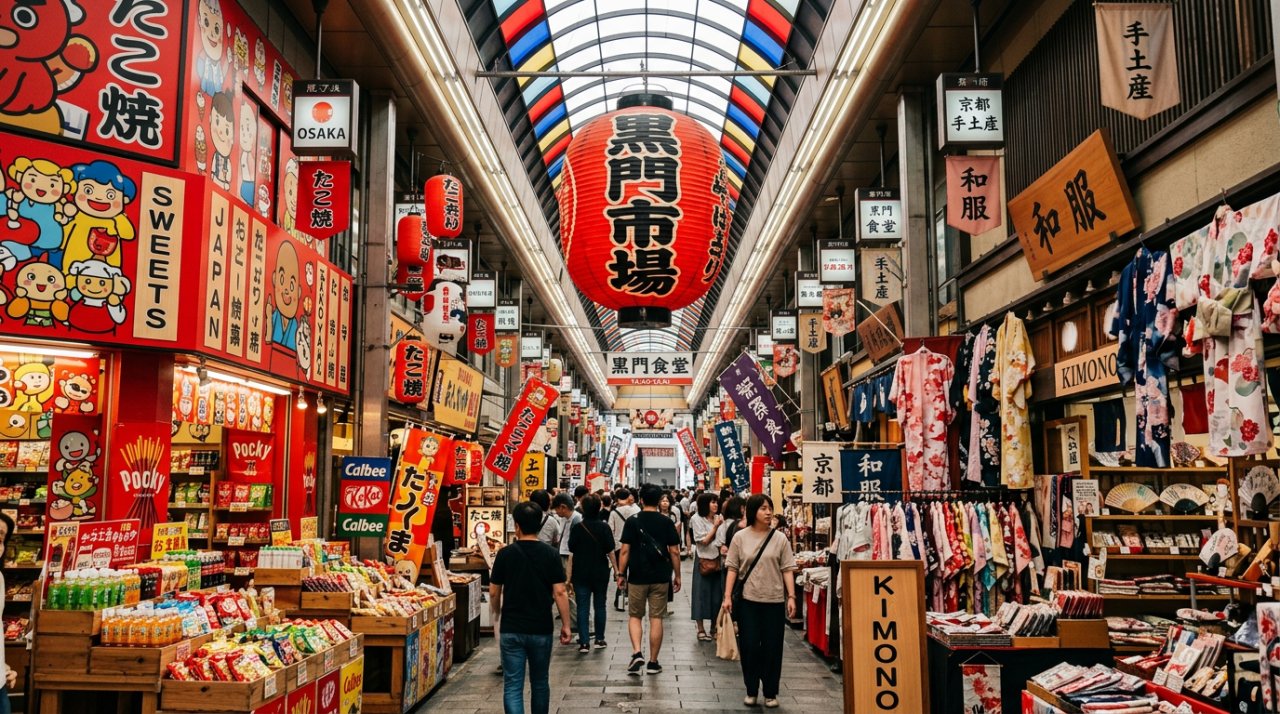
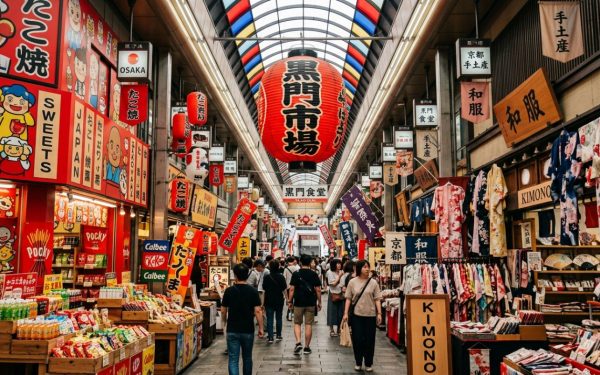
The covered market arcade runs approximately 580 metres through the heart of the district and has been Osaka’s primary fresh food market since the early 19th century.
Around 170 stalls sell fresh tuna, wagyu beef, sea urchin, live shellfish, produce, pickled goods, and prepared street food eaten standing at the counter.
Professional restaurant buyers still move through it early each morning, which keeps quality standards higher than a purely tourist-facing market would maintain.
The market is best visited before noon on weekdays.
Weekend mornings during peak tourist season bring significant crowding in the main arcade, with queues at the most popular tuna and crab stalls stretching 20 to 30 people deep by mid-morning.
It is free to enter and most stalls close between 3:00pm and 6:00pm.
For a full breakdown of what to eat, which stalls to prioritize, and how to make the most of a market visit, the dedicated Kuromon Ichiba Market guide covers the market in detail.
Sennichimae Doguyasuji
One block west of the market, Sennichimae Doguyasuji is a 150-metre covered arcade dedicated entirely to professional and domestic kitchen equipment.
Around 50 to 60 specialist shops sell Japanese chef’s knives, cast iron cookware, ramen bowls, takoyaki plates, bamboo steamers, lacquerware, and the hyper-realistic plastic food replicas called sampuru (サンプル) that appear in restaurant windows across Japan.
The arcade has been supplying Osaka’s restaurant industry since the Meiji era.
Prices are not tourist-inflated in the way souvenir shops near Dotonbori tend to be, and most shop staff are accustomed to international visitors handling merchandise before buying.
Entry-level Japanese chef’s knives start from around 3,000 yen; hand-forged professional blades run well above 30,000 yen.
The sampuru replicas make unusually practical souvenirs given how durable they are.
Most shops open around 10:00am and close by 6:00pm.
The majority close on Wednesdays.
Den Den Town
Nipponbashi-suji running north from Nampabashi toward Sakaihigashi forms what locals call Den Den Town (でんでんタウン), Osaka’s electronics and otaku district.
The shops here cover retro gaming hardware and software, used manga and anime merchandise, second-hand audio equipment, figure collections, and several floors of franchise and niche-title pop culture goods.
Den Den Town is calmer and less commercialized than Tokyo’s Akihabara.
The stock tends toward genuine collector interest rather than tourist-facing merchandise, and the smaller specialty shops on side streets carry inventory that serious collectors travel specifically to find.
If you’re buying electronics for practical use rather than collecting, confirm Japanese power compatibility before purchasing.
For a full guide to navigating Den Den Town including which streets to prioritize and what to look for by category, the Den Den Town guide covers it in full.
Eating in the Kuromon District
The most immediate eating option in the district is the market itself, where fresh seafood, grilled wagyu skewers, and prepared food are sold from counter stalls and eaten standing.
Beyond the market, the surrounding streets have a genuine dining scene that most visitors who come only for the market tend to miss.
The blocks immediately east and south of the market arcade have a cluster of small izakayas and seafood restaurants that open from around 5:00pm and serve the after-work and evening crowd.
These are local-facing establishments with prices calibrated for regulars rather than tourists: grilled fish sets and cold beer at a standing bar typically run 1,500 to 2,500 yen per person including drinks.
Sennichimae-dori, the main east-west road bordering the district to the south, carries a concentration of ramen shops, teishoku set-meal restaurants, and udon counters with lunch sets running 700 to 1,200 yen.
Nothing here is destination dining, but it is honest, filling, and priced for the neighborhood.
For a broader picture of what Osaka’s food culture looks like across the city, the Osaka food guide covers every major cuisine type and neighborhood by neighborhood eating recommendations.
Staying in the Kuromon District
The Kuromon area offers solid value for visitors who want a central Osaka base without paying Dotonbori or Shinsaibashi prices.
The location puts you within a 10-minute walk of Namba Station, which connects to the Midosuji Line, the Kintetsu Nara Line, and the Nankai Airport Line simultaneously.
Accommodation options across budget tiers are available within a five-minute walk of the market entrance.
- Mid-range: Business hotels in the Kuromon and Nipponbashi area generally run 8,000 to 16,000 yen per night for a private double room. The OneFive Osaka Namba-Kuromon, less than two minutes from the market entrance, sits at the lower end of this range and represents strong location-to-price value for central Osaka.
- Upper mid-range: The Dormy Inn Namba, around a 10-minute walk from the market near Ebisucho Station, adds an in-house hot spring bath (onsen) at a price point of 12,000 to 18,000 yen per night. Unusual at this price bracket and worth the slight distance trade-off if the onsen matters to you.
- Budget: Several capsule hotels and small guesthouses operate within a five-minute radius of the market at 3,000 to 5,000 yen per night. Quality varies more than at branded properties; reading recent reviews before booking is worth the few minutes it takes.
For a full comparison of Osaka accommodation options across every neighborhood and budget tier, the where to stay in Osaka guide covers the full picture.
Getting to the Kuromon District
- Nipponbashi Station (日本橋駅) on the Osaka Metro Sennichimae Line and Kintetsu Osaka Line is the most direct access point. Exit 5 puts you approximately a three-minute walk from the market entrance.
- Namba Station is a flat 10-minute walk west along Sennichimae-dori, served by the Midosuji Line, Sennichimae Line, Yotsubashi Line, Kintetsu, and Nankai lines. If you’re arriving from Kansai International Airport on the Nankai Rapi:t (38 minutes, 1,430 yen), Namba is your arrival station and the walk to Kuromon is straightforward.
- Shinsaibashi Station is approximately 12 minutes on foot heading southeast from Exit 6, useful if you’re coming from the Shinsaibashi shopping district.
Once you’re in the district, everything is on foot.
The walk from the market entrance to Sennichimae Doguyasuji takes three minutes.
Den Den Town is eight minutes north along Nipponbashi-suji. Hozenji Yokocho
and the back lanes of Namba are five minutes west.
The grid is flat, compact, and well-signposted in both Japanese and English.
Kuromon District and the Wider Osaka Visit
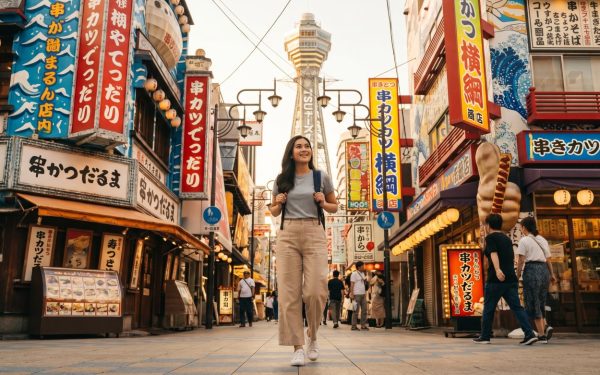
The Kuromon district pairs naturally with a Namba day given the walking proximity, and the 15-minute walk south to Shinsekai makes a logical afternoon extension after a morning at the market.
The combination of Kuromon in the morning, lunch on Sennichimae-dori, and Shinsekai in the afternoon with kushikatsu for dinner covers a coherent slice of southern-central Osaka without requiring any transport.
For structuring this into a full itinerary, the Osaka itinerary guide covers day-by-day plans that incorporate the Kuromon area alongside the rest of the city.