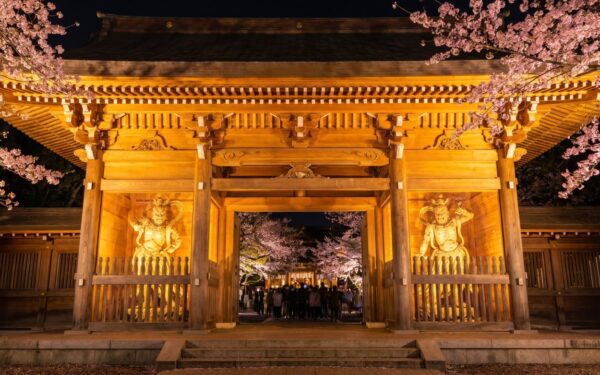
Shitennoji Temple
Japan's oldest state-founded Buddhist temple, built by Prince Shotoku in 593 AD.
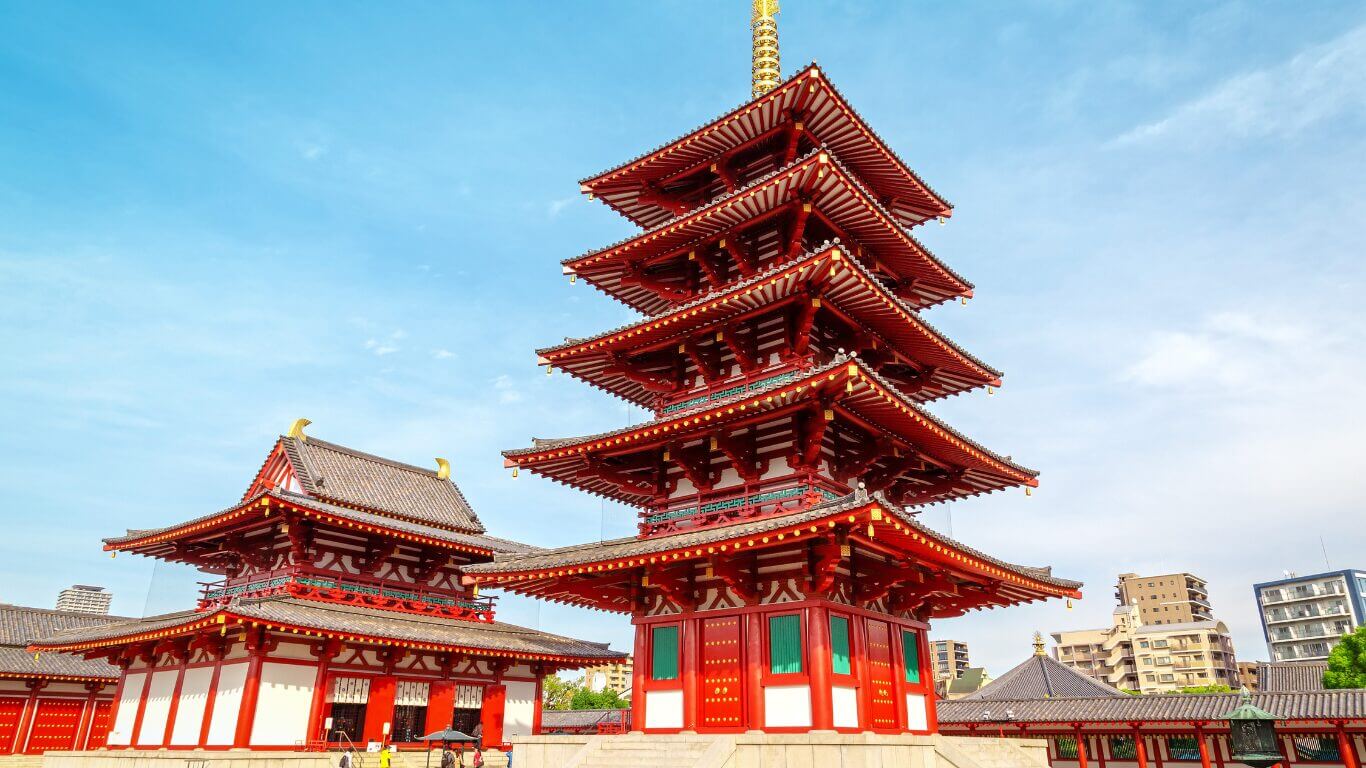
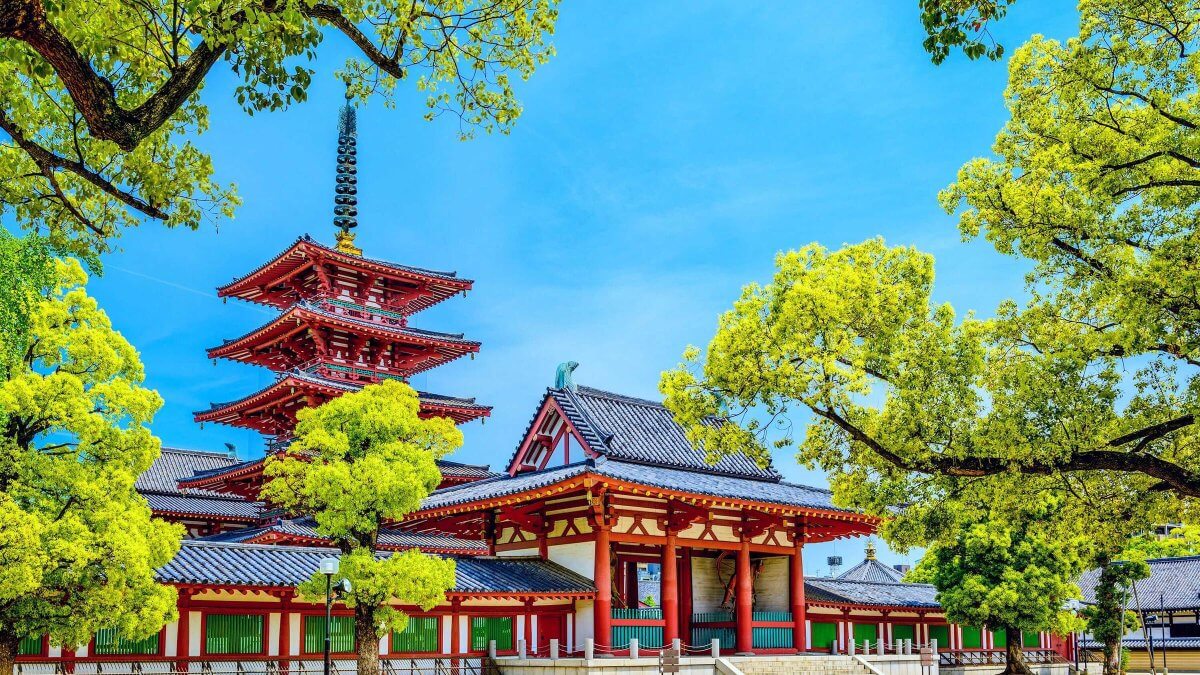








Shitennoji (四天王寺) is not just old — it’s the origin point.
Founded in 593 AD by Prince Shotoku, it holds the distinction of being Japan’s first officially state-established Buddhist temple, predating even Kyoto’s most celebrated shrines.
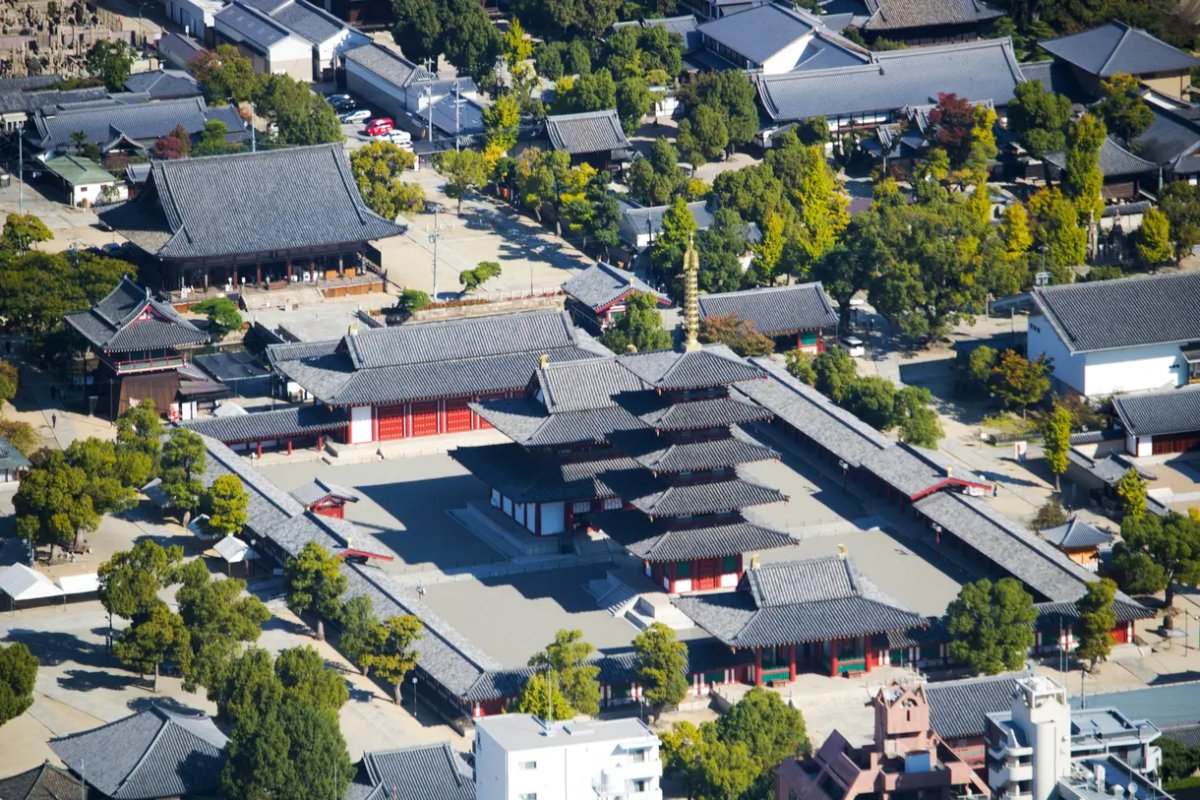
The architecture follows a strict south-to-north axis: a massive stone torii gate, the Gokuraku-jodo (Pure Land) Garden, the central compound with its five-storey pagoda, and the Golden Hall, all arranged in a layout that set the standard for Buddhist temple construction across the entire country.
Walking through the Chushin Garan (Central Temple Complex), you’re stepping into a reconstruction that has been rebuilt numerous times over fourteen centuries — most recently after World War II — yet the atmosphere carries genuine weight.
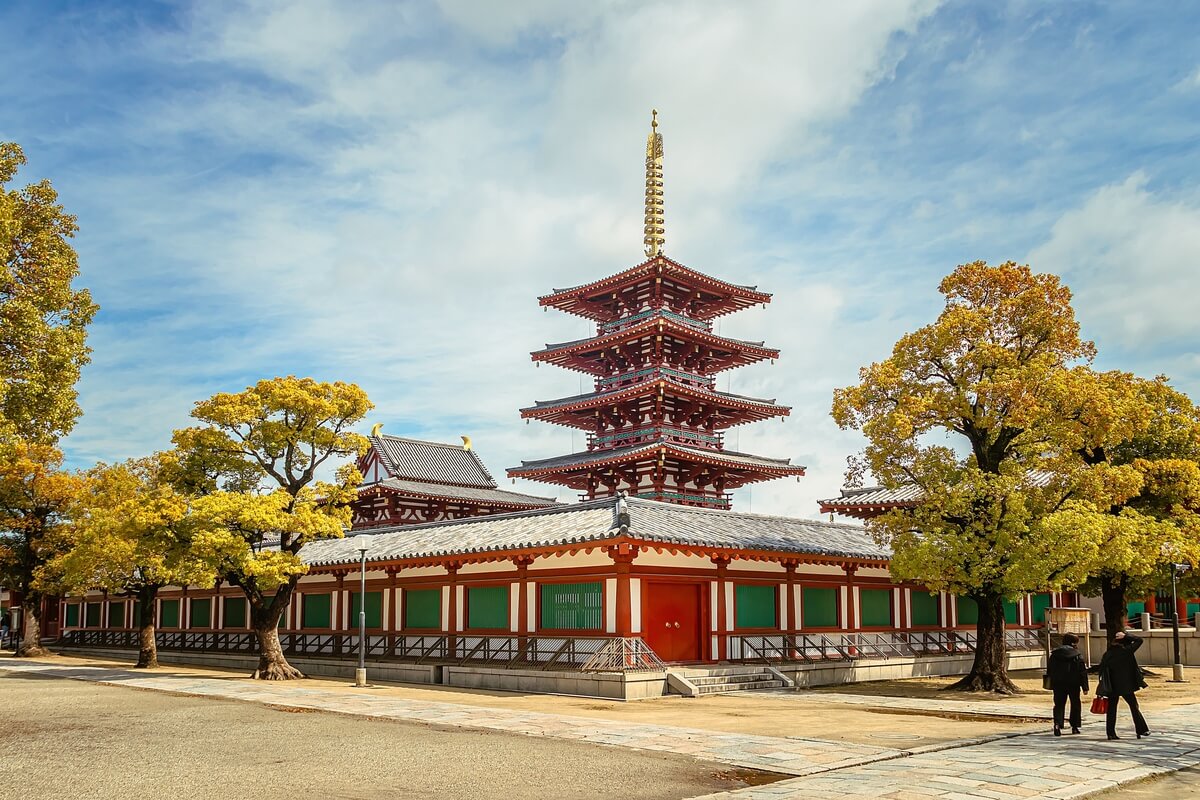
The vermilion pillars and white plastered walls are vivid against any sky, and on the 21st of each month, the temple grounds come alive with a flea market that draws antique hunters and curious locals in equal measure.
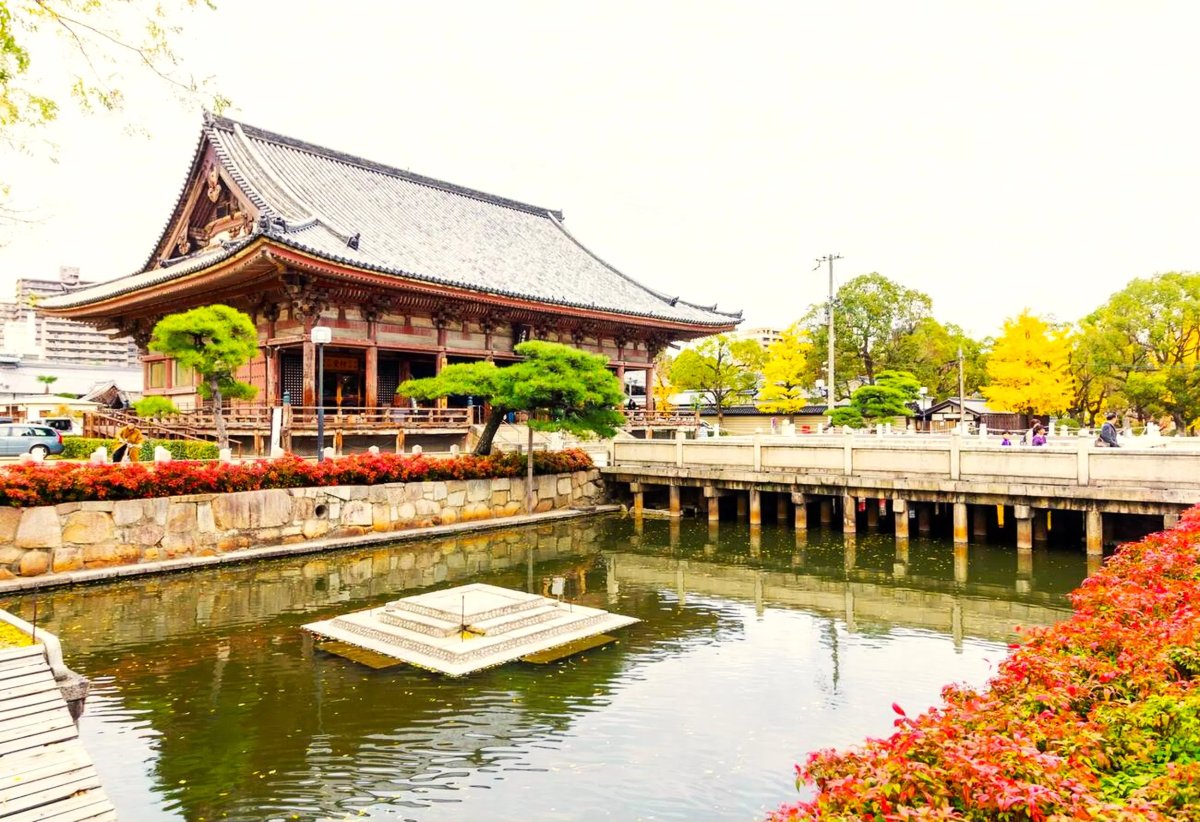
The Gokuraku-jodo Garden, a separate ticketed area (also included with Osaka Amazing Pass), wraps a tranquil pond landscape around a stone replica of the Western Pure Land — genuinely peaceful rather than performatively so.
Spring brings plum and cherry blossoms; autumn turns the garden’s maples into a slow burn of orange and red.
Come on a weekday morning if you want the pagoda courtyard mostly to yourself.
Shitennoji Temple: Osaka’s Oldest Buddhist Temple Guide
Shitennoji Temple (四天王寺) is Osaka’s oldest Buddhist temple and, by most accounts, the first state-established Buddhist temple in all of Japan.
Prince Shotoku founded it in 593 AD, and the layout he chose, a strict south-to-north axis running from gate to pagoda to main hall, became the template that Buddhist architects across the country would follow for centuries.
In this Explore Osaka guide, you’ll find everything you need to visit confidently: admission prices, opening hours, transport directions, and the specific things worth your time once you’re inside.
Quick Facts
Hide- Address: 1-11-18 Shitennoji, Tennoji Ward, Osaka 543-0051
- Opening hours: 8:30 to 16:30 (Apr to Sep); 8:30 to 16:00 (Oct to Mar)
- Admission: Outer grounds free; Central Complex ¥300 (adults); Gokuraku-jodo Garden ¥300 (adults); Treasure House ¥500 (adults)
- Nearest station: Shitennoji-mae Yuhigaoka Station (Osaka Metro Tanimachi Line), 5-min walk
- Time needed: 1.5 to 3 hours
- Best seasons: Spring (cherry blossoms), Autumn (maple foliage), plus the 21st of every month for the flea market
- Osaka Amazing Pass: Included (Central Complex and Garden)
- Official website: www.shitennoji.or.jp
Why Visit Shitennoji Temple
Most temples in Japan are old. This one is the original reference point for what “old Buddhist temple” even means in Japan.
The founding story matters here more than at most sites. In 587 AD, Prince Shotoku prayed to the Four Heavenly Kings (Shitennno) for victory in a battle to defend Buddhism’s place in Japanese society.
When his side prevailed, he built this temple to honour his vow, choosing Osaka over the imperial capital because the city’s western-facing port represented the gateway through which Buddhism had arrived from the Korean peninsula and, before that, from China.
That geographical logic is still visible today: the main gate faces west, towards the setting sun and, symbolically, the Pure Land of Amida Buddha.
The complex has burned down and been rebuilt numerous times, most recently after Allied bombing in 1945.
The current structures are concrete reconstructions completed in 1963, which some visitors find disappointing.
But the site’s energy and spatial logic are entirely genuine, and the stone torii gate at the outer entrance, a rarity at a Buddhist temple and a nod to Japan’s pre-Buddhist religious landscape, signals that something historically layered is happening here.
What to See and Do at Shitennoji Temple
The grounds divide into three distinct zones, each ticketed separately.
You can visit the outer precincts for free at any hour, which already gives you access to the stone torii, the approach paths, and several smaller sub-temples scattered around the perimeter.
The Central Temple Complex (Chushin Garan)
The ¥300 inner compound is where the architectural centrepiece sits.
You enter through the Nandaimon (Great South Gate) and walk north past the Gokuraku-mon (Gate of Pure Land) into an open stone courtyard where the five-storey pagoda rises 32 metres against the sky.
The vermilion and white colour scheme is sharp and deliberate, and the courtyard is rarely as crowded as comparable sites in Kyoto, which makes photography considerably less frustrating.
The Five-Storey Pagoda
The pagoda is the visual heart of the complex.
On certain dates, the interior is open to visitors and houses sacred relics said to include bones of the Buddha himself, though the main draw is simply standing at its base and looking up at the tiered eaves.
The Golden Hall (Kondo) to the north houses a statue of Kuse Kannon, the form of the bodhisattva particularly associated with Prince Shotoku, and the Lecture Hall (Kodo) beyond it completes the north-south axis.
The Gokuraku-jodo Garden
The garden costs an additional ¥300 but is worth the extra spend, particularly in mid-November when the maple trees turn deep amber and red.
It’s a kaiyushiki strolling garden, meaning you follow a loop path around a central pond, passing stone lanterns, a miniature stone recreation of the Western Pure Land, and a covered corridor that bridges two sections of the garden.
The pace here is genuinely slow, and on a weekday morning you can walk the full circuit in near-silence.
Note that the garden closes on the 1st through 10th of most months (with exceptions in April, August, December, and January), so check the calendar before planning your visit around it.
The Monthly Flea Market
On the 21st of every month, the entire temple precinct fills with vendors selling antiques, ceramics, vintage kimono, lacquerware, and a fair amount of junk that’s charming anyway.
This is the Daishi-san no Ichi market, and it draws a genuinely local crowd.
If your travel dates align with the 21st, rearrange your itinerary to get here early, ideally by 9:00.
The market runs through the afternoon, but the best pieces go fast and the energy is highest in the morning hours.
The Treasure House (Homotsukan)
The Treasure House sits to the northwest of the main compound and holds a rotating collection of religious art, sculptures, and artefacts associated with the temple’s history.
Admission is ¥500 separately.
It’s worth visiting if you have a strong interest in Buddhist iconography; otherwise, the main compound and garden will occupy most visitors fully.
Getting to Shitennoji Temple: Transportation Options
Shitennoji Temple sits in the Tennoji district, on the south side of central Osaka, and it’s well connected by both subway and train.
By Osaka Metro
By Osaka Metro, the most direct option is the Tanimachi Line to Shitennoji-mae Yuhigaoka Station (T26).
Use Exit 4, turn left, and the west gate of the temple is a 5-minute walk.
From Tanimachi 4-chome Station (where the Chuo and Tanimachi lines intersect), the journey takes about 8 minutes.
By JR or Other Metro Lines
Tennoji Station is served by the JR Osaka Loop Line, the Midosuji Line (M23), and the Tanimachi Line (T27).
It’s a 12-minute walk north through the neighbourhood to reach the temple’s south gate.
The walk is flat and straightforward.
From Namba, take the Midosuji Line to Tennoji (3 stops, about 7 minutes on the train) and walk from there.
By Bus
Osaka City Bus routes 62 and 103 stop at Shitennoji-mae, a 3-minute walk from the west gate.
Bus travel takes longer than the subway but covers useful routes from parts of the city not on the Metro grid.
Practical Tips for Your Visit to Shitennoji Temple Osaka
The temple grounds are open and walkable at no cost even outside official inner compound hours.
If you’re an early riser, the outer paths and stone torii gate at dawn are worth the detour.
Tickets and payment: Buy inner compound tickets at the small booth just inside the main gate.
Cash is accepted; IC card payment is also available at most ticket points.
If you have the Osaka Amazing Pass, present it here to enter the Central Complex and the Garden without paying separately.
Crowds and timing: Shitennoji is significantly less crowded than Osaka Castle or Fushimi Inari in Kyoto, which makes it a reliable choice on any day of the week.
That said, weekends during cherry blossom season (late March to early April) and the Taishi-e memorial service held in April and November draw noticeably larger crowds.
A weekday morning visit between 9:00 and 11:00 is consistently the quietest window.
What to wear and bring: There are no strict dress codes, but you’re entering an active place of worship, so dressing modestly is appropriate.
The stone courtyards are uneven in places, so flat, comfortable shoes are a practical choice.
A small umbrella is worth carrying in rainy season (mid-June to mid-July), as the covered corridors in the garden offer only partial shelter.
Photography: Photography is permitted throughout the outer grounds and the garden.
Inside the Golden Hall and certain inner chambers, photography restrictions apply; signs are posted clearly at each entrance.
Nearby Attractions
Tennoji is one of Osaka’s more rewarding districts for combining several sites in a single half-day or full-day itinerary.
The Osaka food guide is worth consulting before you go, because the area around Tennoji Station has a surprisingly good range of lunch options, from kushikatsu counters to proper ramen shops.
Tennoji Park and the Osaka City Museum of Fine Arts
A short walk south of Shitennoji, Tennoji Park is a broad green space that connects to the Osaka City Museum of Fine Arts (Osaka Shiritsu Bijutsukan).
The museum holds a respectable collection of East Asian art, including Buddhist sculpture and Chinese bronzes that contextualise what you’ve just seen at the temple.
Entry is ¥300 for the permanent collection.
Shinsekai
The retro entertainment district of Shinsekai is a 10-minute walk southwest of the temple, built in the early 20th century and still radiating a particular kind of cheerful scruffiness.
It’s famous for kushikatsu (battered and deep-fried skewers) and the Tsutenkaku Tower, a communications tower that now functions primarily as a viewing platform and local icon.
The contrast between the ancient solemnity of Shitennoji and the neon-soaked streets of Shinsekai is part of what makes this neighbourhood so enjoyable to explore on foot.
Abeno Harukas
Japan’s tallest skyscraper as of its completion in 2014, Abeno Harukas rises 300 metres directly above Tennoji Station. While there, you can visit the Harukas 300 Observatory.
The observation deck on the 60th floor offers a wide panorama over the city, and on clear days you can see as far as the Akashi Kaikyo Bridge.
Entry to the top floor is ¥2,000 for adults.
Isshinji Temple
About 5 minutes south of Shitennoji on foot, Isshinji Temple is architecturally striking in a completely different way: the main hall is a modern structure built in black steel and concrete, and the temple is known for producing Buddha statues made from the cremated remains of the deceased.
It’s an unusual and genuinely moving place to visit, especially back-to-back with the classical architecture of Shitennoji.
Planning the Rest of Your Osaka Trip
Shitennoji works well as the anchor of a full morning in Tennoji, followed by lunch in Shinsekai and an afternoon at Abeno Harukas or a cross-city journey to Dotonbori for the evening.
If you’re still putting your days together, the Osaka itineraries section of the site has structured day-by-day plans that factor in travel time between districts.
For a broader overview of what the city offers beyond individual attractions, the things to do in Osaka page is a good next stop.
What's Available
Frequently Asked Questions
The outer grounds are free to enter at any time of day, so you can walk around the perimeter and appreciate the stone torii gate and exterior architecture without spending a yen.
Admission to the Central Temple Complex (Chushin Garan) costs ¥300 for adults, while the Gokuraku-jodo Garden is an additional ¥300, and the Treasure House is ¥500.
If you have the Osaka Amazing Pass, entry to both the Central Complex and the Garden is included at no extra cost.
No. The current structure dates from 1931 and is a ferroconcrete reconstruction, not the original Toyotomi-era castle.
The original was destroyed during Japan’s feudal conflicts.
The reconstruction is historically detailed and houses a genuine museum, but it is not a surviving historic structure in the way that, for example, Himeji Castle is.
If original castle architecture matters to you, the day trip to Himeji from Osaka is worth adding to your itinerary.
The easiest route is the Osaka Metro Tanimachi Line to Shitennoji-mae Yuhigaoka Station (T26), which puts you at the temple’s west gate within a 5-minute walk via Exit 4.
Alternatively, Tennoji Station — served by JR and multiple Metro lines — is about a 12-minute walk north through a pleasant neighbourhood.
From Namba, the journey takes roughly 15 minutes by Metro with one stop change at Tanimachi 9-chome.
Editor's Review
Shitennoji earns its place on any Osaka itinerary not through spectacle but through sheer staying power.
The five-storey pagoda framed against a clear sky is one of those views that actually delivers — no filters required.
The ¥300 entry to the Central Complex is one of the best-value cultural experiences in the city, and the Gokuraku-jodo Garden punches above its weight in autumn when the maples get serious about colour.
The 21st-of-the-month flea market (known as Daishi-san no Ichi) is the insider move — hundreds of vendors spread across the grounds selling antiques, ceramics, vintage kimono, and general curiosities.
It draws a genuinely local crowd, and if you time your visit around it, the temple transforms into something far more animated than a typical temple tour.
Best suited for history enthusiasts, architecture fans, and anyone who enjoys a slow, contemplative morning with good photo opportunities.
Related Attractions
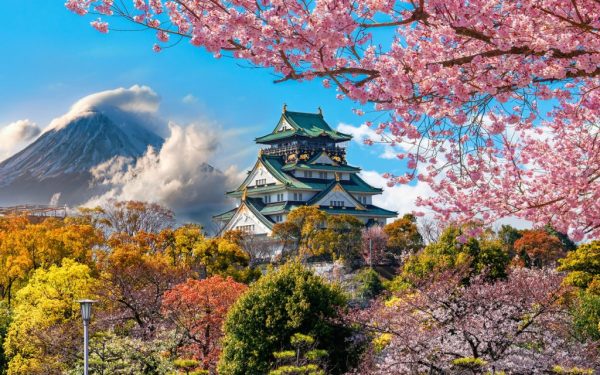
Osaka Castle
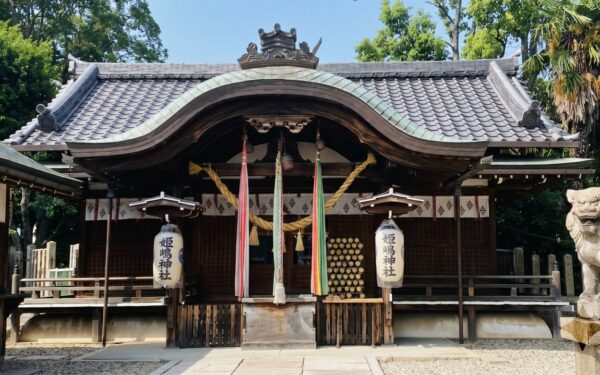
Himejima Shrine
Nunose Shrine
Tennoji Park
Namba Yasaka Shrine
Katsuo-ji Temple
teamLab Botanical Garden Osaka
Osaka Tenmangu Shrine