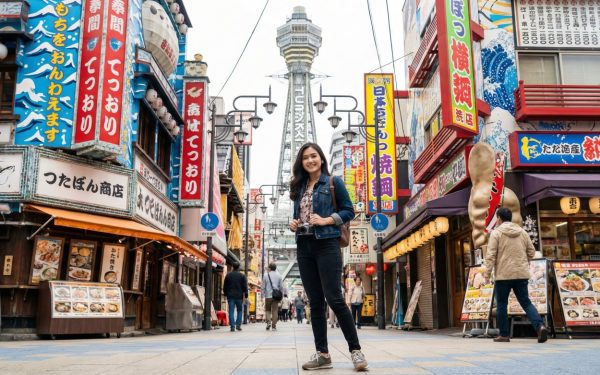


Shinsekai is a historic entertainment district located in Naniwa Ward, Osaka, directly south of Tennoji Station and flanked by Tennoji Park to the east and Tsutenkaku Tower to the north.
The name translates to “New World,” a reference to its original development in 1912 as a modern entertainment zone modelled partly on Paris and partly on New York’s Coney Island.
That ambition faded over the following decades, leaving behind a neighbourhood character that is now defined by low-rise retro shopfronts, vintage game parlours, and a remarkable density of kushikatsu restaurants.
Tsutenkaku Tower, first built in 1912 and reconstructed in 1956, serves as the visual anchor of the district and offers an observation deck with views across southern Osaka.
Shinsekai sits within walking distance of Tennoji Zoo, the Abeno Harukas skyscraper (Japan’s tallest building), and the Tennoji area shopping and transit hub.
Shinsekai Guide: Retro Osaka and the Best Kushikatsu in the City
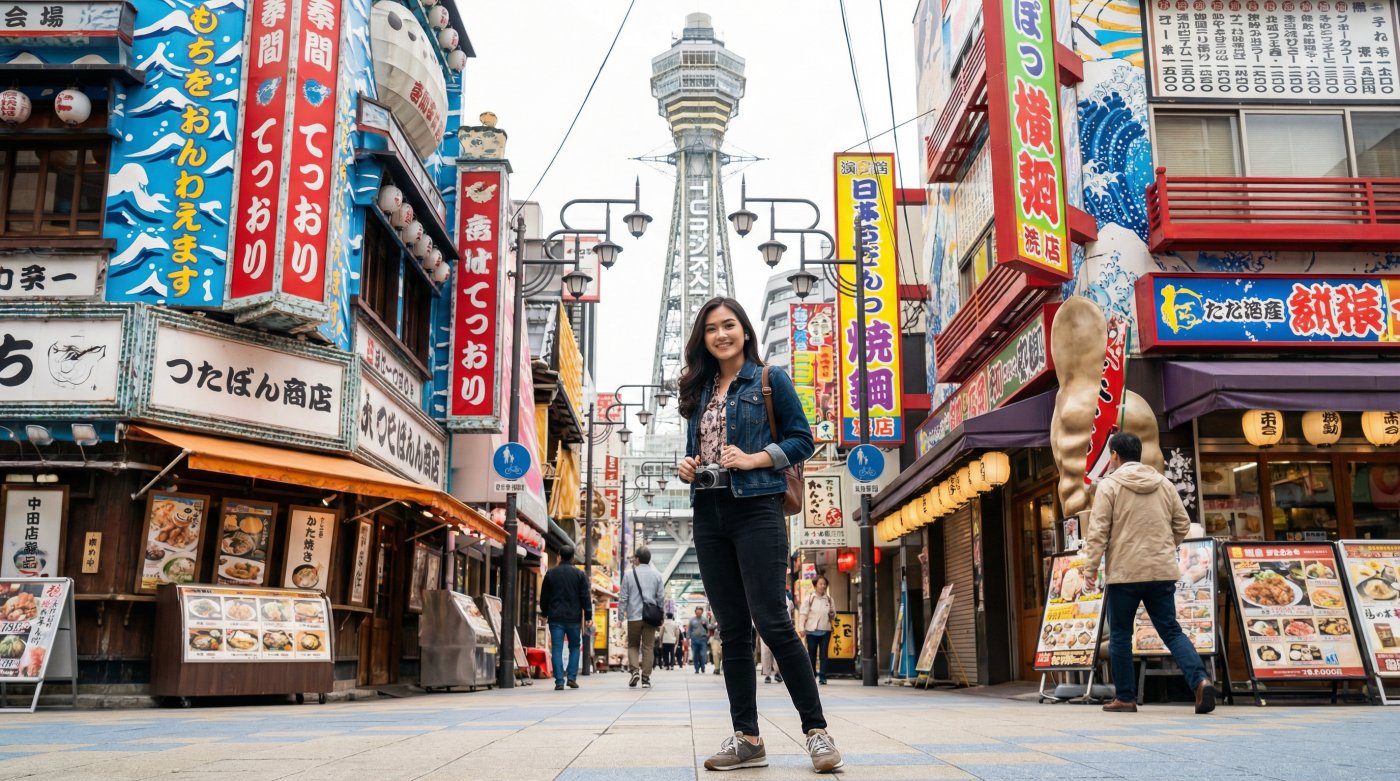
Shinsekai is the neighborhood that time half-forgot, and that’s exactly what makes it worth your afternoon. Wedged between Tennoji and the Namba corridor in southern Osaka, this compact retro district is built around Tsutenkaku Tower (通天閣), a warren of kushikatsu (deep-fried skewer) restaurants, and old-school shogi parlors that have barely changed since the 1960s.
It’s loud, greasy in the best possible sense, and one of the few corners of central Osaka that still feels genuinely lived-in rather than curated for Instagram. In this Explore Osaka guide, you’ll find everything you need to spend a few hours — or a full evening — doing Shinsekai properly.
Shinsekai at a Glance
- Best for: Solo travelers, food lovers, retro culture enthusiasts, anyone on a tighter budget
- Nearest stations: Dobutsuen-mae (Midosuji and Sakaisuji subway lines), Shin-Imamiya (JR Osaka Loop Line and Nankai Line), Tsutenkaku (Hankai Tram)
- Walkability: High — the core area is easily covered on foot in 30 to 45 minutes
- Best time to visit: Late afternoon into evening, when the neon signs light up; avoid Sunday lunch crowds if you dislike queues
Getting to Know Shinsekai
Shinsekai (新世界) translates directly as “New World,” a name that made perfect sense when the neighborhood was first developed in 1912. The plan was deliberately ambitious: the southern half was modeled on Paris, complete with radiating boulevards converging on Tsutenkaku Tower, while the northern half imitated New York’s Coney Island amusement park, Lunapark.
The original Tsutenkaku Tower, built in 1912 and inspired by the Eiffel Tower, was demolished for scrap metal during World War II. The current tower — rebuilt in 1956 and standing 103 meters tall — is the one you see today, wrapped in a Hitachi advertisement that has become as much a part of the skyline as the structure itself.
A Neighborhood That Refused to Gentrify
After the war, Shinsekai slid into decline and became known as one of Osaka’s rougher patches through the 1970s and 1980s. That reputation has largely evaporated, but the neighborhood kept its working-class texture.
The streets are narrow and slightly chaotic. Plastic food samples crowd the restaurant windows.
Fugu (blowfish) signs and billiken (a luck god originally from American folk art, adopted by Shinsekai as its mascot) statues appear on almost every corner. You’re not going to find a craft cocktail bar or a minimalist ramen shop here.
What you will find is authenticity, at prices that feel like a different era compared to Dotonbori a few minutes north.
The Layout: Three Streets Worth Knowing
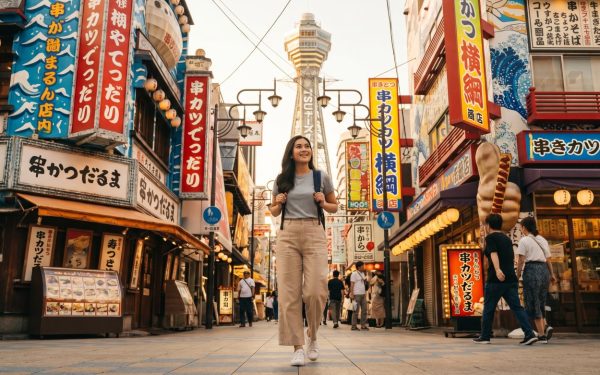
The neighborhood is small — roughly 600 meters across — and most of what matters clusters around three axes. Tsutenkaku Honmachi is the pedestrianized street running directly south from the tower, lined wall-to-wall with kushikatsu shops and souvenir stalls. Janjan Yokocho
(ジャンジャン横丁), the narrow covered arcade heading south from Shin-Imamiya station, is older, quieter, and more local — this is where you’ll find shogi players at tiny tables and standing bars that open at noon. Ebisu-higashi (恵美須東) is the residential fringe, worth a short detour if you want to see Shinsekai beyond the tourist drag.
Top Things to Do in Shinsekai
Shinsekai is not a place you visit for a long list of ticketed attractions. You visit to eat, walk, absorb, and maybe climb a tower.
That said, there are a handful of specific spots that anchor any visit to the Shinsekai area — and a few that are genuinely worth building time around.
Tsutenkaku Tower (通天閣)
The rebuilt 1956 tower is the neighborhood’s obvious centerpiece. At 103 meters, it’s not the tallest structure in Osaka by any measure, but the view from the Special Observatory on the 5th floor puts the entire Abeno and Tennoji skyline in front of you, with Abeno Harukas — Japan’s second-tallest skyscraper at 300 meters — visible to the southeast.
The main observatory on the 4th floor costs ¥1,000 for adults (¥500 for children aged 4 to 6), while the Special Observatory adds ¥300 on top. Opening hours run daily from 10:00 to 20:00 (last entry 19:30), though hours can extend on weekends.
Lines move reasonably fast on weekdays; weekends in spring and autumn can push wait times to 25 or 30 minutes. One practical note: a billiken statue sits in the observatory, and rubbing the soles of his feet is the official Shinsekai good-luck ritual.
Whether that does anything for your fortune is debatable, but it’s a genuinely fun detail.
Janjan Yokocho (ジャンジャン横丁)
This 180-meter covered arcade running south from Shin-Imamiya station is the Shinsekai that tourists often walk past without realizing it. The name comes from the old jangan jangan sound of the shamisen (a three-stringed instrument) that used to play here.
Today it’s a tight corridor of cheap eateries, standing bars, and shogi (Japanese chess) parlors where retired men concentrate over boards with an intensity that suggests the fate of nations. Drinks run ¥400 to ¥600.
Plates of horumon (offal), takoyaki, and grilled skewers appear at prices you’d struggle to match elsewhere in central Osaka. Come here after you’ve done the tower and the main kushikatsu strip — it’s a useful gear change.
Spa World (スパワールド)
A 24-hour public bath complex spread across 11 floors, Spa World is one of those places that looks absurd on paper and completely makes sense once you’re inside. The building contains two main bathing zones — one decorated to imitate European bath culture (Roman, Greek, Finnish), the other imitating Asian styles (Bali, China, Persia) — plus multiple indoor and outdoor pools, a waterpark section, and overnight lodging.
Admission for adults is ¥1,500 for a regular daytime visit (¥1,000 for children), with midnight to 5:00 AM covered by a separate ¥1,900 late-night rate. Towel rental is ¥100.
It’s 5 minutes on foot from Tsutenkaku. If you’re spending a full day in the area or arriving after a long travel day, this is worth a detour.
Just note that tattoos remain prohibited in the bathing areas.
Shinsekai Retro Street and the Billiken Trail
Beyond the main drag, Shinsekai repays slow wandering. The billiken figure (ビリケン) appears in every conceivable form — stuffed toys, keyrings, sake bottles, noren curtains over restaurant doors.
The original Billiken came from American artist Florence Pretz’s 1908 design, but Shinsekai adopted him so completely that he’s now inseparable from the neighborhood’s identity. Look up as you walk: the advertising signs stacked on buildings, some running the full height of a four-story facade, give the streetscape a layered quality that’s best appreciated without the camera between your face and the scene.
Where to Eat in Shinsekai
The honest answer to “where should I eat in Shinsekai” is: anywhere that has a queue and cash-only sign on the door. But that’s not particularly useful guidance, so here’s a breakdown of what to eat and where to find it.
For a wider look at what the rest of the city offers, the Osaka food guide covers everything from street snacks to kaiseki.
Kushikatsu: The Neighborhood’s Signature Dish
Kushikatsu (串カツ) is the dish Shinsekai is built around. The format is simple: proteins and vegetables threaded on bamboo skewers, coated in a light panko batter, and deep-fried in oil until the crust is thin and crisp.
Each table gets a shared pot of brown dipping sauce (a Worcestershire-adjacent blend with a slightly sweet edge) and a rule that is enforced with near-religious seriousness: no double dipping. You dip once.
If you want more sauce, there’s a small pile of cabbage on every table — use a leaf to scoop the sauce onto the skewer. Skewers typically run ¥100 to ¥200 each, so a filling meal of 10 to 15 skewers comes to ¥1,500 to ¥3,000 depending on what you order.
Daruma (だるま): The Name Everyone Knows
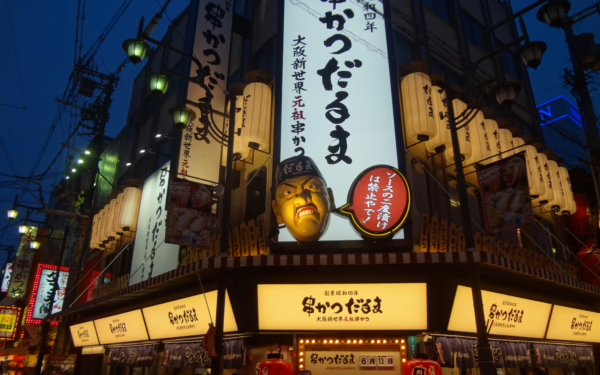
Kushikatsu Daruma, officially Ganso Kushikatsu Daruma (元祖串カツだるま), is the chain that turned Shinsekai kushikatsu into a brand. Founded in 1929, the original location is right on Tsutenkaku Honmachi, identifiable by the cartoon daruma (a round Japanese good-luck doll) figure above the entrance.
There are now multiple Daruma branches across Osaka, including outposts in Namba and Shin-Osaka station, but the Shinsekai location carries the original atmosphere — shared tables, fast turnover, and staff who will call you out on the double-dipping rule if you test it. Cash only at the original location.
Expect a queue of 15 to 30 minutes on weekend evenings.
Beyond Daruma: Other Solid Options
Daruma gets most of the tourist attention, but the parallel side streets hold other longtime operators worth trying. Yaekatsu, a few minutes’ walk from the main drag, has been running since 1947 and uses a slightly lighter batter that lets the ingredients speak more clearly — the renkon (lotus root) and uzura (quail egg) skewers are particularly good here. Tengu
(天狗), on Tsutenkaku Honmachi, goes heavier on the batter and caters to a more local crowd; the set menus are an efficient way to try a range of skewers without ordering one by one.
Janjan Yokocho Eating and Standing Bars
The arcade’s food stalls serve horumon yaki (grilled offal), tachinomi (standing drink) spots with cold beer from ¥350, and a few older teishoku (set meal) shops that offer rice, miso soup, pickles, and a main protein for under ¥700. This isn’t destination dining.
It’s a glimpse at how the neighborhood has been feeding itself since the postwar years, and that context makes it more interesting than the food alone would justify.
Where to Stay in Shinsekai
Shinsekai itself has a handful of accommodation options, and the broader Tennoji area expands your choices considerably without putting you much further from the neighborhood’s streets.
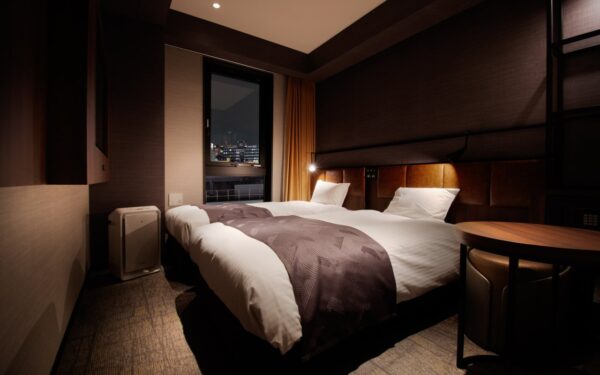
Cross Hotel Osaka (budget-mid range, from around ¥8,000 per night) sits near Namba but is a 15-minute subway ride from Shinsekai. A better location choice is the Dormy Inn Namba Premium (mid-range, from around ¥10,000 per night), which includes an onsen bath floor and positions you between Dotonbori and Shinsekai with easy access to both.
For staying directly in the area, Hana Hostel Osaka (budget, from ¥2,500 per dorm bed) is a clean and well-run option two minutes from Dobutsuen-mae station, with private rooms available for solo and couple travelers. If you’d rather assess a wider range of options across the city before committing, the where to stay in Osaka guide breaks down every major neighborhood by price tier and travel style.
Getting There and Getting Around
Shinsekai sits in Osaka’s Naniwa and Nishinariku districts, directly south of the city center. Getting here is straightforward from most parts of Osaka.
By subway: The most direct route is the Midosuji Line (red line) to Dobutsuen-mae (動物園前), which drops you on the northern edge of Shinsekai. From Namba, that’s a single stop — about 3 minutes.
From Umeda, it’s 10 minutes. The Sakaisuji Line also serves Dobutsuen-mae from the east.
By JR: Shin-Imamiya station on the JR Osaka Loop Line is the southeastern entry point and is useful if you’re coming from Tennoji (one stop, 3 minutes) or connecting from the Nankai Line for Kansai Airport.
By Hankai Tram: The Hankai Tramway (阪堺電車) — Osaka’s last surviving tram network — stops at Ebisucho station, two minutes’ walk from Tsutenkaku. If you’re coming from Tennoji, this is a pleasantly slow and local way to cover the distance.
Getting around: Walk. The core Shinsekai area is compact enough that every point of interest is within a 10-minute radius of the tower.
For nearby neighborhoods, Tennoji Park and the Abeno Harukas skyscraper are a 15-minute walk east. The Kuromon Ichiba market in Kuromon is about 20 minutes north on foot or one subway stop.
Practical Tips and Best Time to Visit
Shinsekai is open to visitors year-round, and unlike some Osaka attractions, it doesn’t have a single peak season that makes everything miserable. That said, timing still matters.
The best time to visit is late afternoon, from around 16:00, when the light drops and the neon starts to earn its keep. The restaurants fill up from 18:00 onward, which means queues outside the more popular kushikatsu shops.
If you want to eat at Daruma without a significant wait, aim for a 17:00 or 17:30 arrival on a weekday. Weekend evenings from October through December are consistently the busiest — the combination of cool weather and incoming domestic tourism creates queues of 40 minutes or more at the top spots.
Summer (July to August) is hot and humid, with temperatures regularly hitting 35°C. Shinsekai’s covered arcades help, but it’s still uncomfortable midday. Spring (late March to April)
and autumn (October to November) offer the most comfortable walking weather, and cherry blossoms in nearby Tennoji Park make the area particularly lively in late March.
A few practical notes worth keeping in mind:
- Many Shinsekai restaurants and stalls are cash only, particularly the older establishments in Janjan Yokocho. Carry ¥3,000 to ¥5,000 in cash minimum.
- The neighborhood is generally safe, but Janjan Yokocho and the streets around Shin-Imamiya get noticeably quieter and less tourist-oriented after 22:00. That’s fine for most visitors, but worth knowing.
- Tsutenkaku Tower gets crowded on weekends. If you want to go up, a weekday morning visit (opens at 10:00) gets you the observatory largely to yourself.
- Spa World is 24 hours but does partial closures for cleaning between 08:45 and 10:00 on certain mornings. Check the official schedule before a very early visit.
- Shinsekai is not a large neighborhood. Most visitors cover it comfortably in 2.5 to 3 hours, including a tower visit and a sit-down kushikatsu meal. If you’re building a wider south Osaka day, pair it with Tennoji Zoo (¥500 admission, adjacent to the neighborhood) and the free Tennoji Park gardens.
Planning your full Osaka schedule around Shinsekai? The Osaka itinerary section covers how to combine the south of the city with Dotonbori, Namba, and beyond without doubling back unnecessarily.
Shinsekai is the part of Osaka that doesn't apologize for what it is. The food is fried, the signs are loud, and the streets smell of broth and hot oil at 18:00 on a Tuesday. For anyone who has spent a day in the polished shopping corridors of Shinsaibashi or the tourist-dense banks of the Dotonbori canal, a few hours in Shinsekai functions as a useful recalibration. Osaka built its reputation on food, directness, and a certain indifference to presentation over substance. Shinsekai still demonstrates all three.