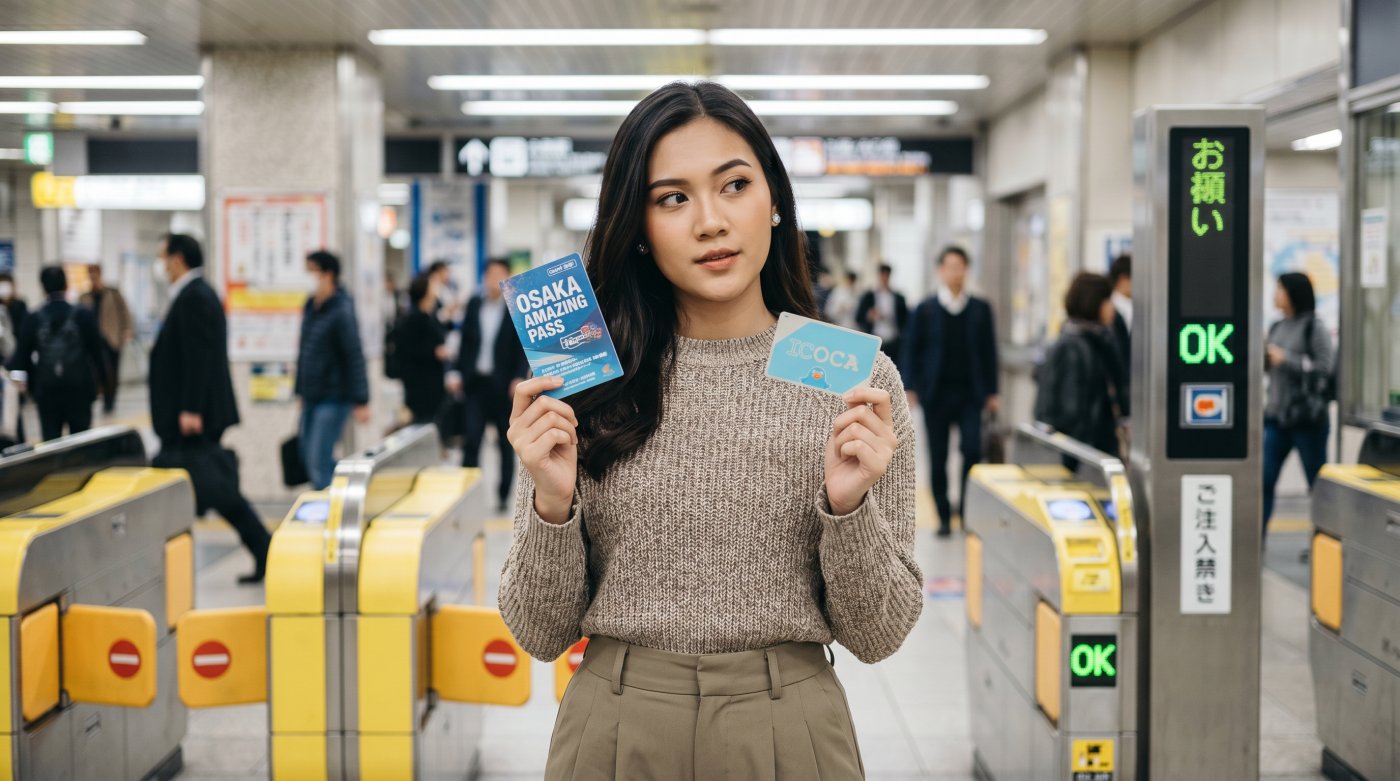





The Osaka Amazing Pass and the ICOCA card are built for different types of days. The pass gives you free entry to around 40 attractions and unlimited Osaka Metro rides for ¥3,500. The ICOCA card charges per ride but works on JR lines, across Japan, and at every convenience store. Most visitors staying three or more days in Osaka end up carrying both.
The Osaka Amazing Pass and the ICOCA card are not competing products. They solve two different problems, and confusing one for the other is one of the most common planning mistakes first-time visitors make.
In this Explore Osaka guide, we break down what each one actually does, what it costs in 2026, and which one makes sense for your specific trip.
Both are worth having under the right conditions. Neither one replaces the other completely.
TL;DR
Hide- The Osaka Amazing Pass costs ¥3,500 for one day and ¥5,000 for two consecutive days, and includes free entry to roughly 40 attractions plus unlimited Osaka Metro and city bus rides
- The ICOCA card costs ¥2,000 upfront, which includes a ¥500 refundable deposit and ¥1,500 of preloaded credit, and charges per ride with no free admissions attached
- The Amazing Pass does not cover any JR-operated lines, meaning day trips to Kyoto, Nara, or Kobe require separate payment or an IC card regardless of which pass you hold
- The pass breaks even at three or more paid attractions from the free list in a single day; visitors hitting four or five spots can save ¥1,500 or more compared to paying separately
- The ICOCA card is the stronger choice for slower-paced days, JR travel, or convenience spending since it works at train gates, taxis, vending machines, and convenience stores across Japan
- Suica and Pasmo are interchangeable with ICOCA throughout Osaka, so there is no need to buy a separate card if you already own one from a previous Japan trip
- The two passes are not mutually exclusive: the most practical approach for a multi-day Osaka trip is the Amazing Pass for dedicated sightseeing days and the ICOCA card for everything else
What the Osaka Amazing Pass Actually Covers
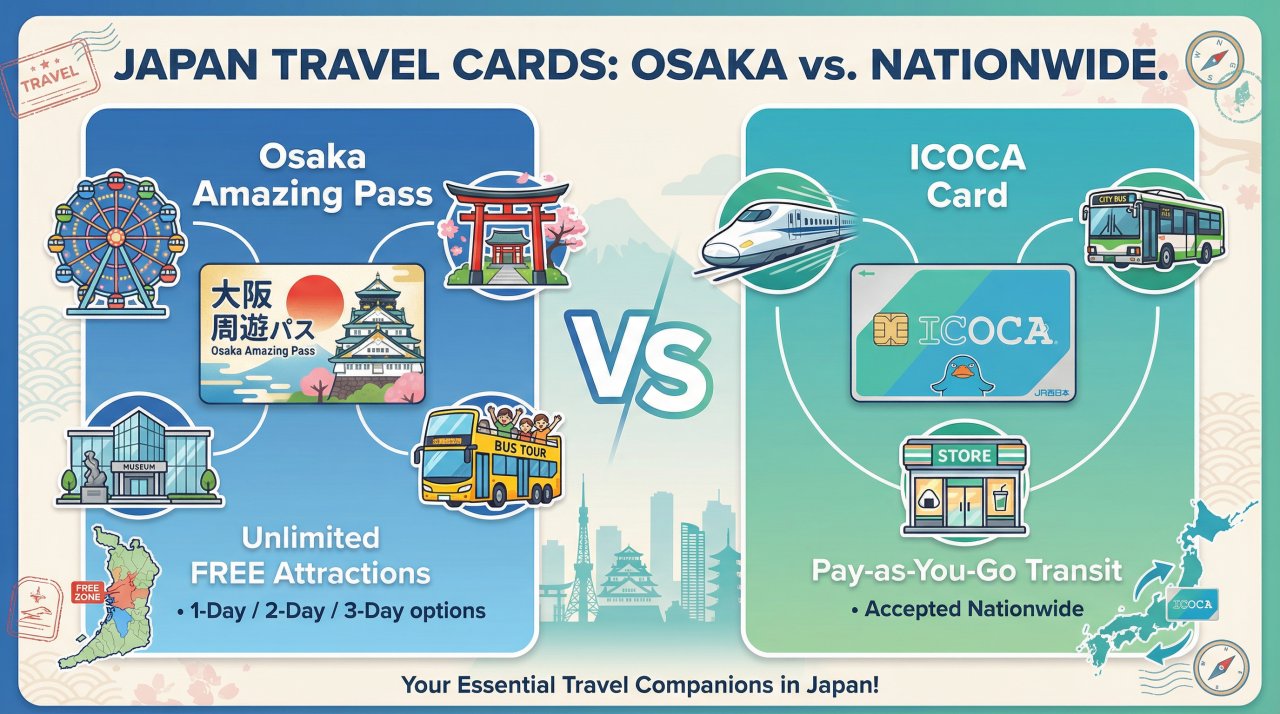
The pass comes in two options: a 1-day pass for ¥3,500 and a 2-day pass for ¥5,000, valid for two consecutive calendar days.
There’s also a Monorail Version at ¥4,300 that adds Osaka Monorail access and two extra attractions, which makes sense if you’re arriving or departing via Kansai International Airport and want to use the pass for that journey too.
As of 2026, the pass is fully digital. No physical card exists anymore.
After purchase, you receive a QR code on your phone with two components: one for transport gates and one for attraction entry.
The pass activates from 3:00 AM on the day you start using it and expires at 2:59 AM the following morning, so starting early genuinely matters.
Transport covered: unlimited rides on Osaka Metro (大阪メトロ), Osaka City Bus, and designated private rail lines. Transport not covered: any JR-operated line, including the Osaka Loop Line.
That exclusion matters more than most people realize, and we’ll get to it shortly.
Essential Osaka Travel Passes
Powered by KlookThe passes worth buying before you land — curated for first-timers.
Osaka Amazing Pass
Unlimited subway + free entry to 40+ attractions. The only pass most visitors actually need.
Osaka e-Pass
Attractions-only digital pass. Pair with a Metro Pass if skipping the Amazing Pass.
Osaka Metro Pass
1 or 2-day unlimited Metro rides. Best standalone transit value if you already have an attractions pass.
JR West Kansai Area Pass
Unlimited JR trains for 1–4 days. Covers Kyoto, Nara, Kobe, and Himeji from Osaka.
JR Haruka Express
KIX to Umeda/Shin-Osaka in ~50 min. Best if staying in Umeda or heading straight to Kyoto.
Nankai Rapi:t Express
KIX to Namba in 34 min, reserved seat. Better if staying in Namba or Shinsaibashi.
Free Attractions Included with the Pass
The headline feature is free entry to roughly 40 sightseeing spots. The list changes periodically, so checking the official pass website before buying is worth the two minutes.
As of 2026, the most valuable inclusions are:
- Osaka Castle Museum in Osaka-jo Park (¥600 standard admission)
- Umeda Sky Building Kuchu Teien Observatory in Umeda (¥1,500 standard admission)
- Tsutenkaku Tower in Shinsekai (¥800 to ¥1,000 depending on floor)
- Tombori River Cruise in Dotonbori (¥1,000 standard fare)
- Tempozan Giant Ferris Wheel (¥900 standard admission)
- HEP Five Ferris Wheel in Umeda (¥600 standard admission)
- Around 50 additional spots offering discounts or small perks for pass holders
One notable exclusion: the Osaka Aquarium Kaiyukan is not on the free list. At ¥2,400 for adults, that’s a separate ticket regardless of which pass you carry.
Is the Osaka Amazing Pass Worth the Price?
The math works in your favor if you visit at least three paid attractions from the list in a single day. A single Osaka Metro ride costs between ¥180 and ¥370 depending on distance.
Osaka Amazing Pass — the one pass worth buying
Unlimited subway rides plus free entry to 40+ attractions including Osaka Castle, Umeda Sky Building, and the Dotonbori River Cruise. If you're spending more than a day sightseeing, it pays for itself before lunch.
Five Metro trips in a day adds up to roughly ¥1,100. Stack two mid-range attractions on top of that, and you’ve cleared the ¥3,500 cost before lunch.
One thing to account for: some attractions have seasonal restrictions. The Osaka Castle River Cruise, for instance, is sometimes excluded from the pass during cherry blossom season due to crowd volume.
If your visit falls in late March or early April, verify the current list carefully.
Osaka Amazing Pass: What a Realistic Savings Day Looks Like
Here’s a straightforward example based on standard admission prices:
| Activity | Without Pass |
|---|---|
| Osaka Metro rides (5 trips) | ¥1,100 |
| Osaka Castle Museum | ¥600 |
| Umeda Sky Building Observatory | ¥1,500 |
| Tombori River Cruise | ¥1,000 |
| Tsutenkaku Tower | ¥800 |
| Total paid separately | ¥5,000 |
| 1-Day Pass cost | ¥3,500 |
| Saving | ¥1,500 |
That’s a conservative day. Visitors who add the HEP Five Ferris Wheel and a couple of museum stops can save closer to ¥3,000 on a single day.
The ICOCA Card: Flexible but Not Free
The ICOCA card is a rechargeable contactless IC card issued by JR West (JR西日本). It works on a tap-in, tap-out system identical to Oyster in London or EZ-Link in Singapore.
For Singaporeans, we have written a dedicated page for you to travel to Osaka from Singapore.
You pay for every ride individually, and there are no free attractions attached.
Cost: ¥2,000 upfront. That includes a ¥500 refundable deposit and ¥1,500 of preloaded transit credit.
You can top it up at ticket machines in any JR West or Osaka Metro station, and at convenience stores including 7-Eleven, Lawson, and FamilyMart. The maximum stored balance is ¥20,000.
When you leave Japan, you can return the card at a JR West ticket office and recover the ¥500 deposit, minus a ¥220 handling fee.
Where the ICOCA Card Works
This is where the ICOCA card wins the flexibility argument decisively:
- All Osaka Metro lines
- All JR West lines in the Kansai region, including the Osaka Loop Line
- Hankyu, Hanshin, Keihan, Nankai, and Kintetsu private railways
- Most Kansai regional buses
- Taxis that accept IC cards
- Convenience stores, vending machines, and many restaurants throughout Japan
That last category is genuinely useful. No more fishing for ¥100 coins at a kiosk.
The ICOCA card covers your morning coffee, afternoon vending machine water, and evening takoyaki at a walk-up stall.
It also works identically to Suica and Pasmo, meaning if you already have either of those from a Tokyo trip, you don’t need an ICOCA card at all.
Head-to-Head: Pass vs. Card
| Feature | Osaka Amazing Pass | ICOCA Card |
|---|---|---|
| Price | ¥3,500 (1-day) / ¥5,000 (2-day) | ¥2,000 (¥500 refundable deposit) |
| JR Lines | Not covered | Covered |
| Osaka Metro | Unlimited | Pay per ride |
| Free Attractions | ~40 included | None |
| Works Outside Osaka | No | Yes, across Japan |
| Convenience Store Use | No | Yes |
| Fully Digital | Yes (QR code) | Physical card (or mobile Suica equivalent) |
| Refundable | No | Yes (deposit minus ¥220 fee) |
| Best For | Packed sightseeing days | Flexible, day-trip-heavy travel |
The passes are not mutually exclusive. Plenty of visitors carry both: the Amazing Pass for dedicated sightseeing days, the ICOCA card for JR trips and daily convenience spending.
Which One Should You Actually Buy?
There’s no universal answer, but there’s almost always a clear answer once you know your itinerary.
Buy the Osaka Amazing Pass if:
- You’re planning at least one full day focused on sightseeing with 3 or more free-list attractions
- You’re staying near a Metro station and won’t need JR lines on that day
- You want a fixed daily cost with no per-ride surprises
- You prefer a morning-to-night schedule covering multiple neighborhoods
Get the ICOCA card if:
- You’re taking JR day trips to Kyoto, Nara, or Kobe on any day of your trip
- Your pace is slow and you’d rather see fewer spots more thoroughly
- You want one card that works seamlessly across all of Japan, not just Osaka
- You’re spending most of a day in a single neighborhood like Dotonbori without much transit
Get both if:
- You have 3 or more days in Osaka and plan a mix of packed sightseeing days and slower JR travel days
- You want the ICOCA card for airport transit and daily purchases, with the Amazing Pass for the days when you’re hitting attractions hard
The mistake to avoid: assuming the Osaka Amazing Pass covers your JR day trip to Kyoto. It doesn’t.
A single JR ticket from Osaka to Kyoto costs around ¥580 each way. That’s a separate charge every time, pass or no pass.
A practical rule: if you’ll visit 3 or more paid spots from the free list on a given day, the Amazing Pass saves you money.
If your day involves JR travel or just one or two attractions, skip it and use the ICOCA card.
The right call comes down to one question: are you running from attraction to attraction all day, or are you moving slowly and mixing Osaka with JR-based side trips?
Once you answer that honestly, the choice is obvious.
If you want help building the day-by-day schedule that actually earns back your pass cost, the Osaka itineraries section has ready-made plans by pace and budget.
For a full rundown of what’s worth your time in the city, the guide to things to do in Osaka covers everything from the iconic stops to the ones most visitors overlook.