Practical Tips for Visiting Osaka: Money, Safety, Etiquette and More
Osaka is one of the most foreigner-friendly cities in Japan, and most practical concerns that first-time visitors worry about turn out to be smaller problems than expected.
That said, a few specifics about Japanese travel — cash culture, transport passes, etiquette, and connectivity — are worth understanding before you arrive rather than figuring out jet-lagged at the airport.
This guide covers the ground-level practicalities so you can focus on the parts that actually matter.
For broader context on planning your trip, the Osaka travel guide covers the city’s main areas, top attractions, and how to structure your time from arrival to departure.
Cash vs. Card: Japan Is Still Largely Cash-Based
Japan’s cashless adoption is improving, particularly in large cities, but Osaka still runs primarily on cash in many situations you’ll encounter daily. Smaller restaurants, ramen shops, izakayas, street food vendors, most temples and shrines, local supermarkets, and a significant number of taxis accept only cash. Assuming your card will work everywhere will cause problems.
Carry at least 10,000 to 15,000 yen in cash at all times during your visit. That covers a day’s meals, a couple of transport rides, and one or two entrance fees without scrambling.
Where to get yen in Osaka
The most reliable and fee-efficient places to withdraw yen are Japan Post ATMs and 7-Eleven ATMs.
Both accept foreign Visa, Mastercard, and most international debit cards. Convenience store ATMs (7-Eleven, Lawson, FamilyMart) are open 24 hours and found on nearly every block in central Osaka.
Airport ATMs at Kansai International Airport work well for arrival withdrawals.
Bank ATMs in Japan often do not accept foreign cards at all, so avoid them unless specifically labeled as international.
Currency exchange counters exist at the airport and at a few tourist-area shops, but ATM rates are generally better.
Notify your bank before travel that you’re using your card in Japan. Some banks flag Japanese ATM withdrawals as suspicious activity and freeze cards without warning.
Connectivity: SIM Cards and Pocket Wi-Fi
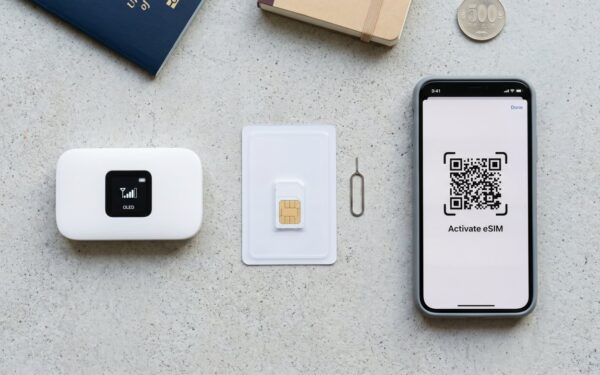
Staying connected in Osaka is straightforward. The two main options are a tourist SIM card and a pocket Wi-Fi router. Both are available for pickup at Kansai International Airport arrivals, and both work well. The right choice depends on your group size and usage patterns.
Tourist SIM cards
A tourist SIM gives your phone a Japanese data connection directly. Cards are available from providers including IIJmio, Docomo, and SoftBank.
Data-only SIMs for tourists typically run 1,500 to 2,500 yen for 7 to 15 days of use, with no voice calling included.
If you need to make calls within Japan, look for SIMs with a data and voice option or use apps like LINE and WhatsApp instead.
Insert the SIM at the airport, follow the included setup guide, and you’re online within a few minutes. Make sure your phone is unlocked before traveling.
Pocket Wi-Fi routers
A pocket Wi-Fi router creates a personal Wi-Fi hotspot that multiple devices can connect to simultaneously. It’s the better option for couples, families, or anyone with a tablet as well as a phone.
Rental costs are approximately 300 to 600 yen per day depending on the provider and data plan. Routers can be picked up and returned at the airport or delivered to your hotel.
The main drawback is carrying an extra device that needs charging. Battery life on most pocket Wi-Fi units runs eight to twelve hours on a full charge.
Free Wi-Fi in Osaka
Osaka Free Wi-Fi is available at major Metro stations, tourist information centers, and many convenience stores.
It requires a one-time registration with an email address. Coverage is adequate for basic navigation and messaging but not reliable enough to depend on as your sole connection.
The Best Time to Visit Osaka
Osaka is a year-round destination, but the timing of your visit has a real impact on what you’ll experience and how comfortable the trip is.
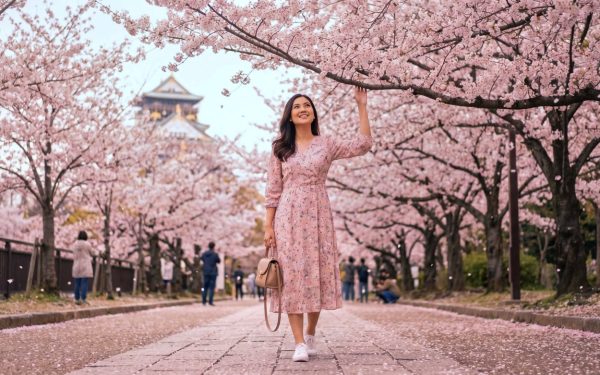
- Spring (late March to early May) is the most popular season, driven largely by cherry blossom season in late March and early April. Osaka Castle Park and the Okawa River are two of the best blossom-viewing spots in the city. The weather is mild, with daytime temperatures between 14 and 20 degrees Celsius. Crowds and hotel prices peak during Golden Week (late April to early May), when domestic tourism volumes are at their highest.
- Autumn (October to November) is the second peak season and arguably the most comfortable time to visit. Temperatures run 15 to 22 degrees Celsius, humidity drops sharply, and the maple foliage in parks and temple gardens turns well. Fewer international tourists visit in autumn than in spring, which translates to shorter queues at popular attractions.
- Summer (June to September) is challenging. June brings the tsuyu (rainy season) with frequent heavy rain and high humidity. July and August are hot and intensely humid, with daytime temperatures regularly reaching 35 degrees Celsius. Typhoon season runs from August through September. The city is still fully functional and the food is excellent, but the physical discomfort of outdoor sightseeing is significant. If you visit in summer, plan indoor activities for the hottest hours of the day.
- Winter (December to February) is mild by Japanese standards, with temperatures rarely dropping below 3 degrees Celsius. Osaka doesn’t get significant snowfall. The Midosuji Illumination, a winter light display along Osaka’s main boulevard, runs from November through January and draws large evening crowds. Prices are generally lower in winter outside of the New Year period (December 29 to January 3), when domestic travel volumes spike and many local businesses close.
Read our comprehensive best time to visit Osaka guide for more detailed information.
Etiquette: What to Know Before You Go
Japan’s social etiquette is detailed but not difficult to follow once you understand the underlying logic. Most of it comes down to consideration for shared spaces.
On trains and public transport
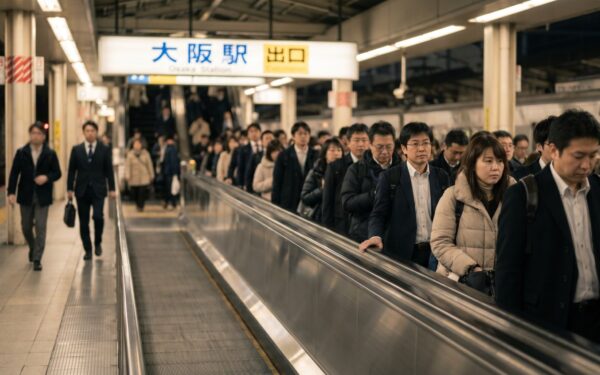
Talking on the phone while on a train is considered rude and almost nobody does it. Calls should be kept brief and quiet, or stepped off the train to handle. Eating on local trains and Metro services is also frowned upon, though eating on long-distance shinkansen is accepted. Priority seating near train doors is reserved for elderly passengers, pregnant women, and people with injuries. Give up the seat without being asked.
Queuing on platforms is taken seriously. Yellow lines on the platform mark where to stand, and passengers board in orderly single-file lines on either side of the doors after letting alighting passengers exit first.
In restaurants
Many smaller restaurants in Osaka require you to remove shoes at the entrance and sit on tatami mats. A small step up at the door with shoe storage nearby is the signal. When in doubt, look at what the other diners are doing.
Tipping is not practiced in Japan and can cause genuine discomfort if attempted. Leave no tip at restaurants, for taxi drivers, or for hotel staff. The price on the bill is what you pay.
Pointing at menu photos to order is completely acceptable and very common. Most restaurants in tourist-heavy areas of Osaka have photo menus, plastic food models in the window, or both. If you can’t communicate a dietary restriction verbally, writing it down or showing a translation on your phone is a practical solution.
At temples and shrines
Most temples and shrines in Osaka welcome visitors of all faiths. Remove hats before entering main halls. Photography is usually permitted in grounds but restricted or prohibited inside the main worship hall itself. Signs indicate where photography is not allowed.
At shrines with a temizuya (water purification basin near the entrance), the standard practice is to rinse both hands with the ladle before proceeding. It’s a gesture of purification, not mandatory for non-worshippers, but observed widely.
Safety in Osaka
Osaka is a very safe city by any international standard. Violent crime against tourists is extremely rare. The main practical safety concerns are far more mundane.
- Pickpocketing is low-risk in Japan compared to most major tourist cities in Europe or Southeast Asia, but Dotonbori on weekend evenings and crowded train platforms during peak hours are the contexts where it occasionally happens. Keep bags in front of you in heavy crowds.
- Traffic moves on the left in Japan. Pedestrians from the UK and Australia adapt immediately; visitors from countries where traffic moves on the right need a moment at every crossing. Look right first when crossing a one-way street, then left. At unmarked crossings, assume cars will not yield.
- Typhoons affect Osaka between August and October. The Japan Meteorological Agency (jma.go.jp) provides English-language typhoon tracking. Most typhoons that reach the Kansai region weaken significantly before landfall, but some cause transport shutdowns, flight cancellations, and flooding. If a typhoon warning is issued during your visit, follow local media guidance and your hotel’s advice.
- Earthquakes are a fact of life in Japan. Osaka experiences minor tremors regularly. In the event of a stronger earthquake, the standard guidance is to take cover under a table or doorframe, stay away from glass, and wait for shaking to stop before moving. Your hotel will have evacuation procedures posted in rooms.
The Japan Visitor Hotline (050-3816-2787) operates 24 hours in English, Chinese, Korean, and Japanese and can assist with emergencies, lost property, and travel-related problems.
Budgeting for Osaka
Osaka has a reputation as an affordable Japanese city, and that reputation is earned, particularly on food. Street food and casual restaurant meals represent some of the best value eating in Japan.
A realistic daily budget breaks down roughly as follows:
- Budget traveler (capsule hotel, street food, public transport): 5,000 to 8,000 yen per day. Capsule hotels in Namba start from 2,500 yen per night. A full day of eating well at takoyaki stalls, ramen shops, and convenience store meals runs 1,500 to 2,500 yen.
- Mid-range traveler (business hotel, mix of restaurants, transport pass): 12,000 to 20,000 yen per day. A decent business hotel near Shinsaibashi or Namba costs 8,000 to 14,000 yen per night. Sit-down meals at mid-range restaurants run 1,000 to 3,000 yen per meal.
- Comfortable traveler (boutique hotel, varied dining, paid attractions): 25,000 to 40,000 yen per day. This range covers a well-located four-star hotel, three restaurant meals per day including one decent dinner, transport, and two or three paid attraction entries.
The where to stay in Osaka guide covers accommodation pricing in more detail, including which neighborhoods offer the best value by category.
Food costs deserve their own note: Osaka’s best food ranges from 200-yen takoyaki to multi-course kaiseki that runs 20,000 yen per person. The city rewards curiosity at every price point, and some of the most satisfying meals cost under 1,000 yen.
Language: How Much Japanese Do You Need?
Almost none, practically speaking. Osaka is a major international tourist destination with English-language signage at stations, English menus in tourist-area restaurants, and Google Translate handling most gaps competently.
That said, learning a handful of Japanese phrases earns goodwill from locals and makes some interactions noticeably easier.
- Sumimasen (excuse me / sorry): Use this to get a server’s attention, apologize for bumping into someone, or start any interaction where you need help. It’s the single most useful word in Japan.
- Ikura desu ka? (How much is it?): Useful when there’s no visible price or a price tag in kanji you can’t read.
- Eigo no menyu wa arimasu ka? (Do you have an English menu?): Works more often than you’d expect outside the tourist zones.
- Arigatou gozaimasu (Thank you very much): Use it constantly. It’s always appropriate.
For more details, read the comprehensive Japanese travel phrases.
Useful Apps to Download Before You Leave
- Google Maps: Transit routing works accurately in Osaka. Download the Kansai region offline map before you arrive so it works without data.
- Google Translate: The camera translation feature reads Japanese menus and signs in real time. A genuine game-changer for ordering at restaurants with no photo menus.
- GO (taxi app): Book and pay for taxis in English. Available on iOS and Android.
- Hyperdia or Jorudan: More detailed transit options than Google Maps, particularly for comparing fares across competing rail companies. Useful for the getting around Osaka logistics.
- PayPay: Japan’s dominant QR payment app. Many small restaurants and shops that don’t accept foreign cards do accept PayPay. Linking a foreign Visa or Mastercard is possible with some setup effort but works once configured.