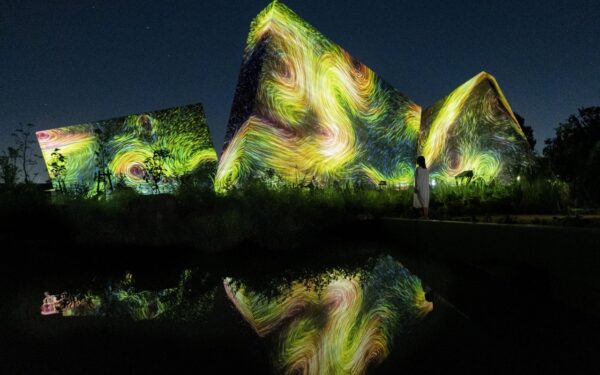
Kids Plaza Osaka
Japan's first full-scale children's museum, where hands-on discovery spans five floors of science, culture, and creative play.









Kids Plaza Osaka (キッズプラザ大阪) is Japan’s first comprehensive children’s museum, opened in 1997 inside a building shared with Kansai TV (Kantele) in Kita-ku’s Ogimachi district.
It holds the distinction of being Japan’s sole member of ACM, the Association of Children’s Museums — which tells you something about how seriously this place takes its mission.
Five floors of immersive, curriculum-adjacent content await, designed for children up to about junior high school age, though adults will find themselves unexpectedly entertained.
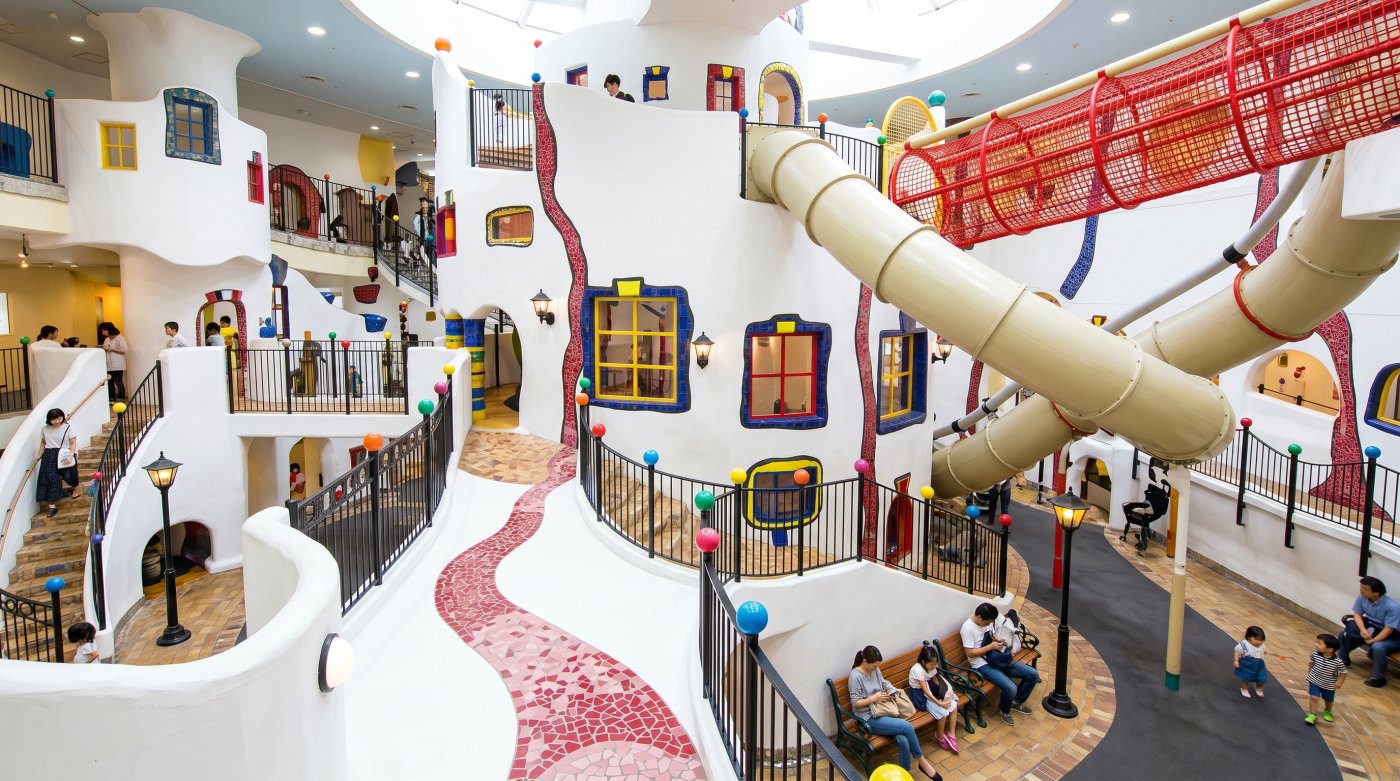
The fourth floor’s centrepiece is “Children’s Town,” a multi-level urban labyrinth designed by Austrian artist Friedensreich Hundertwasser — colourful, curved, deliberately disorienting, and genuinely unlike anything else in Osaka.
Alongside it is “Kids Street,” a role-play zone where children take on jobs as postmen, supermarket cashiers, and police officers.
The fifth floor pivots toward science and world cultures: you can step inside a giant soap bubble, explore the mechanics of the human body, and try musical instruments from dozens of countries.
The third floor houses a working TV studio, where kids direct, cast, and broadcast their own mini-productions using Kantele’s professional equipment.
Weekday mornings often see local school groups filling the floors, so if you want breathing room, aim for weekday afternoons or weekend visits after 13:00.
The museum allows same-day re-entry from the third floor exit, meaning you can duck out for lunch at the nearby Tenjinbashisuji shopping arcade and return without paying again.
Plan for at least three hours; four is more realistic if your children are thorough.
Kids Plaza Osaka: The Complete Family Guide (2026)
Kids Plaza Osaka (キッズプラザ大阪) is Japan’s first comprehensive children’s museum, and after nearly thirty years it still has no direct rival.
Five floors of interactive exhibits in Kita-ku’s Ogimachi district are designed for children up to junior high school age, though the building’s architecture alone gives adults enough to process.
Admission is ¥1,500 for adults, ¥800 for school-age children, and ¥500 for preschoolers aged 3–6.
Key Highlights
Hide- Address: 2-1-7 Ogimachi, Kita Ward, Osaka (〒530-0025)
- Hours: 9:30–17:00 (last entry 16:15); closed the 2nd and 3rd Monday of each month (also the 4th Monday in August and Dec 28–Jan 2)
- Admission: ¥1,500 adults / ¥800 children (elementary–junior high) / ¥500 preschoolers (3–5) / free under age 3 / ¥700 seniors 65+
- Nearest station: Ogimachi Station, Osaka Metro Sakaisuji Line, Exit 2 (1-min walk)
- Time needed: 3–4 hours minimum
- Best seasons: Year-round (indoor attraction)
- Official website: www.kidsplaza.or.jp
What makes Kids Plaza Osaka genuinely different from other children’s museums
Most children’s museums in Japan are pleasant, pastel-coloured, and entirely forgettable by the time you’re back on the train.
Kids Plaza Osaka is not those things.
The building itself is partly co-occupied by Kansai TV (Kantele), which explains why the museum’s third floor contains a broadcast-quality television studio that children can actually use.
The museum is the sole Japanese member of ACM (the Association of Children’s Museums), the international body that sets standards for child-centred learning facilities.
The Austrian artist Friedensreich Hundertwasser, who designed the fourth-floor labyrinth called Children’s Town, was not interested in straight lines or sensible surfaces.
The result is a multi-level urban maze of curves, asymmetric staircases, tile mosaics, and unexpected textures that is architecturally unlike anything else in Umeda or, for that matter, in most of Osaka.
Trip Essentials
Osaka Travel Add-ons
Equip yourself for the ultimate Osaka adventure with the following add-ons, curated just for you.
Flights to Osaka
Airport Transfer
ICOCA IC Card
Suica IC Card
Osaka Tours
Luggage Storage
Travel Insurance
Data Security

Japan eSIM
Japan SIM Card
Pocket WiFi Rental
Japan eSIM
Floor by floor: what your kids will actually do here
The museum runs from the second floor up to the sixth.
Each floor has a distinct theme, which means you can budget your time based on your children’s ages rather than wandering and backtracking.
Second floor: Kids Street and the baby zone
Kids Street is a role-play district where children take on jobs: postal worker, supermarket cashier, police officer, hospital staff.
The costumes are provided and the props are convincing enough that the immersion holds, at least for primary school ages and younger.
Adjacent to Kids Street is a separate soft-play zone for children aged 0–6, kept physically separate from older children so toddlers have space without chaos.
If you have a child under three, this floor is your anchor.
Third floor: the Kantele TV studio
The third floor pivots toward media literacy and creative performance.
Using professional equipment shared with Kantele’s broadcast facilities, children can sit in the director’s chair, operate cameras, and produce short live-to-screen programmes.
Slots for the studio fill up quickly on weekends and during school holidays, so check the day’s schedule at the information desk near the entrance when you arrive, before heading to any other floor.
The science communication exhibits on this floor, covering light, sound, and basic physics, are solid supplements but the studio is the draw.
Fourth floor: Children’s Town and Kids’ World
Children’s Town is the centrepiece of the whole museum.
Hundertwasser’s design is genuinely disorienting in the way that good playgrounds should be: there is no obvious correct route through the maze, the staircases change proportion unpredictably, and the colour palette runs to deep ochre, sea green, and cobalt.
Children between roughly four and twelve years old tend to enter and vanish for 40 minutes.
Kids’ World, on the same floor, covers international cultures through instruments, costumes, and artefacts from dozens of countries.
Fifth floor: science and the human body
The fifth floor takes on biology and physics.
A walk-through model of the human body, a giant soap bubble chamber where you can step inside a metre-wide bubble, and exhibits on electricity and the mechanics of everyday machines populate this floor.
The soap bubble station in particular draws a consistent queue from about 11:00 onward, so hitting it first thing in the morning, or after lunch during school hours, reduces the wait from 15 minutes to near zero.
Sixth floor: workshop studio
The sixth floor houses a rotating craft workshop programme.
The schedule changes monthly, so check the museum’s website before you visit to see what’s on.
Workshops often include pottery, simple engineering challenges, and seasonal crafts tied to Japanese festivals.
Most workshops are included in the entry price; a small number have a supplementary fee of ¥200–¥400.
Honest assessment: who should go and who can skip it
Kids Plaza Osaka is genuinely worth the entry price if you have children aged 3 to 12.
The exhibits are dense enough to hold attention for a full half-day, the building’s design keeps things visually interesting even during transitions between floors, and the TV studio experience has no equivalent anywhere nearby.
Teenagers will exhaust the museum’s material in under two hours and are unlikely to find it worth the full adult admission.
Couples or solo travellers without children can appreciate the architecture and the cultural curiosity of watching the TV studio operate, but it’s a short visit.
For families based near Umeda or in the Kita district, it’s close enough to revisit on a second afternoon without committing a full day.
One caveat: the museum is not included in the Osaka Amazing Pass, so budget the admission cost separately from any transport passes you carry.
Getting to Kids Plaza Osaka without second-guessing yourself
The museum’s best practical feature is its location: it is almost impossible to arrive at Ogimachi Station on the Osaka Metro Sakaisuji Line and miss it.
Take Exit 2, turn left, and the building is in front of you within about 60 seconds.
The Sakaisuji Line connects directly from Namba in approximately 12 minutes and from Shinsaibashi in about 10.
If you’re coming from Tennoji or the southern side of the city, the JR Osaka Loop Line to Temma Station puts you about a 3-minute walk away to the west.
Tenjimbashisuji Rokuchome Station (Osaka Metro Tanimachi Line and Sakaisuji Line) adds a 5-minute walk from the north.
The museum has no dedicated car park of its own.
If you’re driving, the nearest coin parking is on the north side of Ogimachi Park, a 3-minute walk, but on weekends and public holidays those spaces fill by 10:00.
Tickets, crowds, and the re-entry trick most visitors miss
Tickets are sold at the entrance on the day.
There is no advance online purchase through the museum’s own system, though Klook sells same-day admission tickets that can reduce queue time at the counter during peak periods.
The ticket desk closes 45 minutes before closing time, so a 16:15 last-entry deadline is firm.
Weekday mornings between 9:30 and 11:30 regularly see school group visits.
Local primary schools book field trips throughout the academic year, and the museum can feel crowded on the Children’s Town and Kids’ Street floors during those hours.
Weekday afternoons after 13:00 are noticeably quieter.
If you visit on a weekend, arriving before 10:00 gives you 30–40 minutes before the bulk of weekend visitors arrives.
The re-entry policy is the single most useful practical fact here.
Kids Plaza Osaka allows same-day re-entry through the third-floor exit, provided you keep your ticket stub.
This means you can walk five minutes along Tenjinbashisuji, one of Japan’s longest covered shopping arcades, grab lunch, and return in the afternoon without paying again.
Plan around it.
What’s within easy reach of the museum
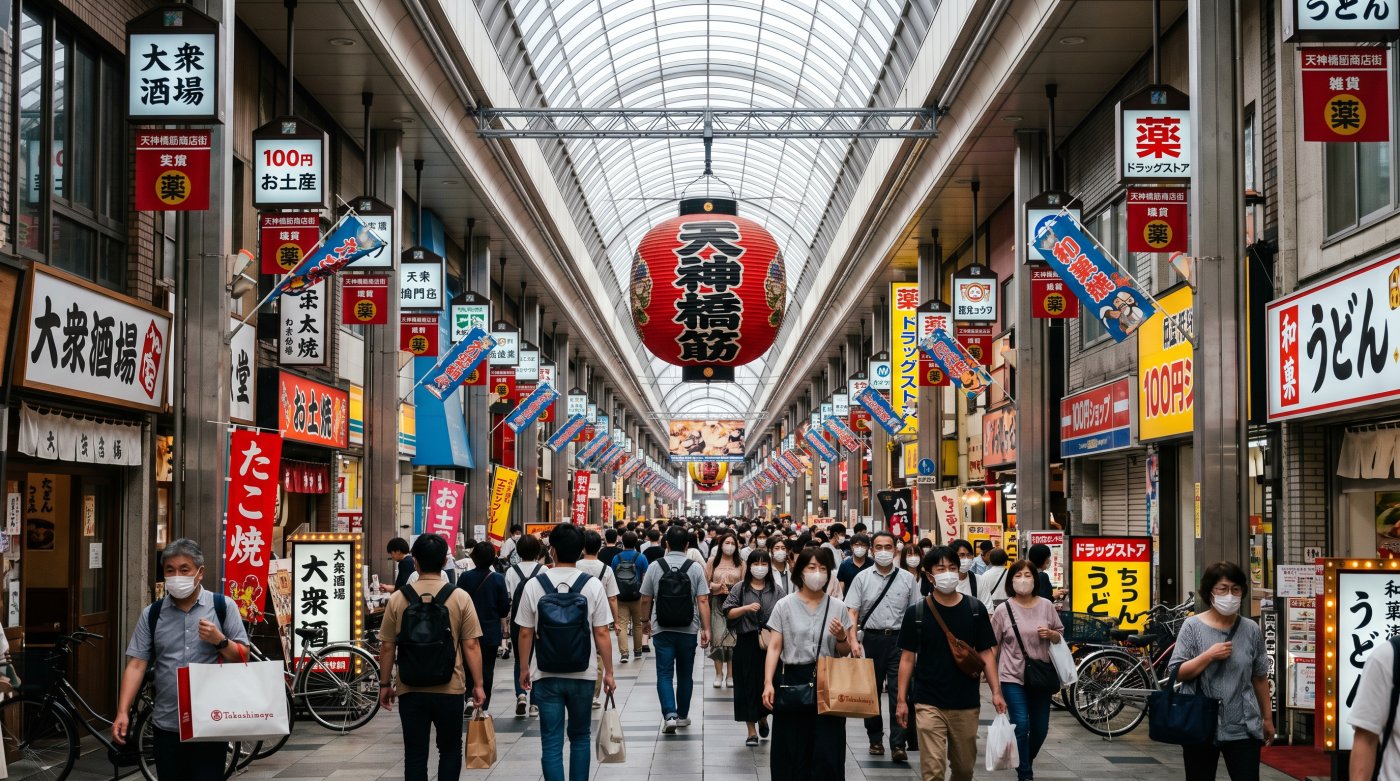
Kids Plaza Osaka sits at the northern end of Tenjinbashisuji Shotengai, a covered shopping arcade stretching roughly 2.6 kilometres from Temma to Tenjimbashisuji Rokuchome, lined with takoyaki stalls, ramen shops, and 100-yen stores.
It’s a practical lunch option rather than a destination, but the proximity makes timing easy.
Ogimachi Park, a 2-minute walk north of the museum, has a quiet lawn and shaded benches that work well for a picnic or a break with younger children between floors.
Tenmangu Shrine (Osaka Temmangu), the 10th-century Shinto shrine associated with Michizane Sugawara, is a 10-minute walk south and worth a brief stop if you have the time.
For families staying in Umeda and looking to fill the rest of a family-oriented day, the things to do in Osaka archive has filtered options by age suitability and area.
Practical notes before you go
- Re-entry: Same-day only; keep your stub. Exit via the third floor.
- Strollers: Permitted throughout. Coin lockers are available on-site for larger bags.
- Language: English signage covers the majority of exhibits. Staff can communicate in basic English.
- Payment: IC cards (Suica, ICOCA) accepted at the ticket counter. Cash also accepted.
- Photography: Permitted in most areas. A small number of exhibits restrict photography; signage marks these clearly.
- Accessibility: The building is wheelchair accessible, with lifts serving all floors.
Worth knowing before your first visit
Kids Plaza Osaka is the kind of attraction that rewards a little pre-planning and punishes none.
Arrive early to secure a TV studio slot, use the re-entry policy to avoid a rushed afternoon, and check the sixth-floor workshop calendar before you book your date.
If you’re building a wider Osaka trip around family-friendly stops, the Osaka itineraries section has suggested routes that combine this museum with Osaka Bay attractions and other Kita-area sights into a manageable two to three day framework.
What's Available
Frequently Asked Questions (FAQs) About Kids Plaza Osaka
Admission is ¥1,500 for adults (age 16 and over), ¥800 for children aged 7–15 (elementary and junior high school students), and ¥500 for infants aged 3–6.
Children aged 0–2 enter free, and seniors aged 65 and over pay a reduced rate of ¥700 with valid ID.
Some afternoon time slots may offer discounted rates, so it’s worth checking the official website before your visit.
No. The current structure dates from 1931 and is a ferroconcrete reconstruction, not the original Toyotomi-era castle.
The original was destroyed during Japan’s feudal conflicts.
The reconstruction is historically detailed and houses a genuine museum, but it is not a surviving historic structure in the way that, for example, Himeji Castle is.
If original castle architecture matters to you, the day trip to Himeji from Osaka is worth adding to your itinerary.
The easiest route is via Ogimachi Station on the Osaka Metro Sakaisuji Line — the museum is right at Exit 2, about a one-minute walk.
Alternatively, Temma Station on the JR Osaka Loop Line is a three-minute walk to the west.
The museum sits just off the famous Tenjinbashisuji shopping arcade, making it easy to combine with lunch or shopping before your same-day re-entry in the afternoon.
Kids Plaza Osaka is not included in the Osaka Amazing Pass. You’ll pay full admission separately: ¥1,500 for adults, ¥800 for elementary and junior high school students, and ¥500 for preschoolers aged 3–5.
Children under three enter free, and seniors aged 65 and over receive a reduced rate of ¥700 with valid ID.
Some afternoon time slots may carry discounted pricing, so check the museum’s official website at www.kidsplaza.or.jp before your visit.
Three days gives you a solid, honest first impression of Tokyo across three or four distinct neighborhoods, several food cultures, and the major cultural landmarks, with room to wander.
What it won’t give you is day trips to Nikko or Kamakura, quieter residential neighborhoods, or the repeat-visit familiarity that makes Tokyo truly click.
Think of a 3-day trip as the research phase for your second trip.
Take the Osaka Metro Sakaisuji Line from Namba Station northbound toward Tengachaya or Kitasenri.
Ride for four stops to Ogimachi Station, a journey of about 12 minutes.
Use Exit 2 and the museum entrance is visible within one minute of stepping onto the street.
No transfers needed.
From Shinsaibashi, the same line takes approximately 10 minutes and two stops



Editor's Review
Kids Plaza Osaka punches well above its weight.
The Hundertwasser-designed Children’s Town alone justifies the entry price — it’s architecturally bizarre in the best possible way, and children tear through it with the kind of frantic energy that suggests the designer understood kids better than most adults do.
The science floor is genuinely educational without being the kind of educational that makes children yawn.
The TV studio on the third floor is an underrated gem: watching a seven-year-old confidently anchor a fake news broadcast is oddly moving.
That said, this museum is best suited to children aged 3 to 12; teenagers will exhaust its offerings in under two hours.
One tip worth knowing — afternoon visits on weekdays sidestep the school group rush almost entirely, and you may even catch a discounted afternoon ticket rate.
Related Attractions
Nakaza Kuidaore Building
Tsuyuno Tenjinsya (Ohatsu Tenjin)
Osaka Science Museum

Kema Sakuranomiya Park
HEP FIVE Ferris Wheel
Osaka Museum of Housing and Living
Himejima Shrine
Osaka Museum of History