Open-Air Museum of Old Japanese Farm Houses
Japan's first open-air folk house museum, preserving eleven authentic Edo-period farmhouses from across the country.
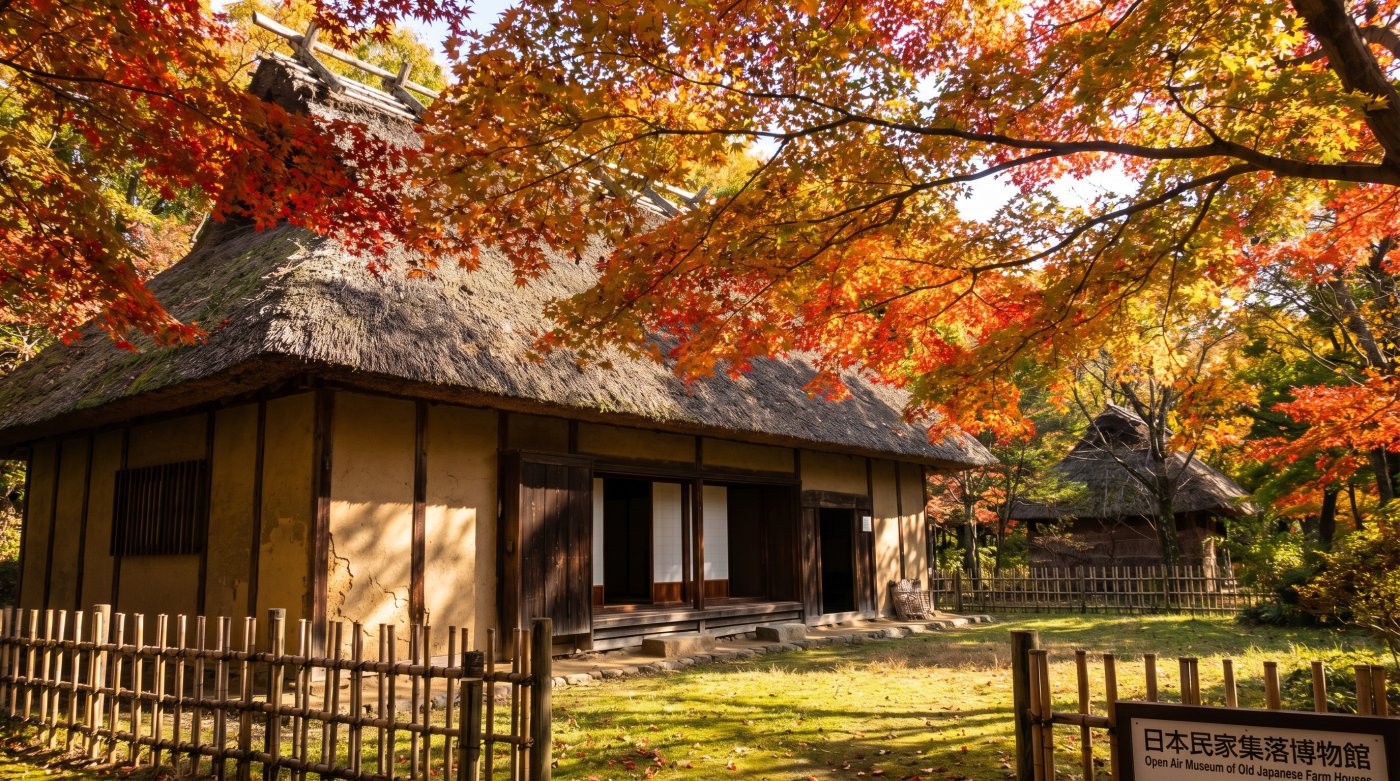





Opened in 1956 as Japan’s first open-air folk house museum, the Open-Air Museum of Old Japanese Farm Houses (日本民家集落博物館) brings together eleven historic farmhouses, physically relocated from regions across Japan — from the steep-roofed gasshō-zukuri of Shirakawa-gō to the thatched dwellings of Kyushu and the Ryukyu Islands.
Each structure is a designated cultural property, and several have been classified as Important Tangible Folk Cultural Assets.
You are not looking at replicas. These are the real things, dismantled beam by beam and rebuilt on the green grounds of Hattori Ryokuchi Park in Toyonaka.
Walking through the museum feels less like a history lesson and more like wandering into another century.
You can step inside many of the farmhouses, peer into their dark, smoky interiors, and get a tactile sense of how rural Japanese families cooked, slept, and worked through harsh winters and scorching summers.
The contrast between the massive thatched roofs overhead and the low, intimate interiors below never quite loses its impact. Seasonal events — silk-weaving demonstrations, bamboo craft workshops, traditional performance concerts — give the site a living, breathing quality that static exhibits simply cannot match.
Spring is genuinely spectacular here, with cherry blossoms framing the thatched roofs in a way that feels almost theatrical. Autumn foliage runs a close second.
The museum sits deep within Osaka Prefecture’s largest park, so combining the visit with a stroll through Hattori Ryokuchi Park is an easy call.
Arrive when the gates open at 9:30am on a weekday — you may well have the whole place to yourself, which is the best way to experience it.
Open Air Museum of Old Japanese Farm Houses is one of the easiest ways to see traditional Japan without leaving the Osaka area.
In Toyonaka’s Hattori Ryokuchi Park, you can walk among preserved rural homes from across the country, step inside several of them, and get a much sharper sense of everyday life than you would from a conventional museum.
Open Air Museum of Old Japanese Farm Houses: A Calm, Surprisingly Rich Half-Day in North Osaka
Open Air Museum of Old Japanese Farm Houses is one of the best places near Osaka to see traditional rural architecture up close, without taking a long detour into the countryside.
In Toyonaka, inside Hattori Ryokuchi Park, this open-air museum gathers historic homes from across Japan, lets you step inside several of them, and gives you a much clearer sense of how people actually lived than a glass-case city museum ever could.
In this Explore Osaka guide, you’ll get the key facts, what to see, how to get there, when to go, and whether it’s worth your time if your Osaka schedule is already trying to bully you.
Quick Facts of Open Air Museum of Old Japanese Farm Houses
Hide- Official name: Open-Air Museum of Old Japanese Farm Houses, Nihon Minka Shuraku Hakubutsukan (日本民家集落博物館)
- Address: 1-2 Hattori Ryokuchi, Toyonaka, Osaka 561-0873
- Hours: 9:30 to 17:00, last entry 16:30, closed Mondays, or Tuesday if Monday is a public holiday
- Admission: Adults ¥500, high school students ¥300, elementary and junior high students ¥200, infants free
- Nearest station: Ryokuchi-koen Station, about 15 minutes on foot
- Time needed: About 1.5 to 2.5 hours
- Best seasons: Spring and autumn, though it works year-round
- Official website: https://www.occh.or.jp/minka/
Why Visit Open Air Museum of Old Japanese Farm Houses
If you like places that actually show you something, rather than just asking you to admire a famous name, this museum earns its spot.
Opened in 1956 as Japan’s first open-air folk house museum, it preserves historic homes moved from different regions of the country, including houses from Iwate, Gifu, Osaka, and Amami Oshima, all gathered inside a 36,000 square meter site in Hattori Ryokuchi Park.
What makes it work is the contrast.
You are still within easy reach of central Osaka, yet a few minutes after entering, the city noise fades, the paths curve through trees, and thatched roofs start rising in front of you like a set from a period drama that forgot to become fake.
It feels thoughtful rather than theatrical, which is rarer than it should be.
This is also a smart pick if your trip already includes major urban sights and you want a quieter counterbalance.
After time in commercial areas like Umeda or the neon-heavy entertainment zones that dominate many lists of things to do in Osaka, this museum offers texture, space, and actual historical atmosphere.
Open Air Museum of Old Japanese Farm Houses for history lovers
The museum is especially rewarding if you care about how ordinary people lived, not just how elites built castles and temples.
The houses date broadly from the 17th to the 19th centuries, and each one reflects local climate, available materials, social customs, and plain old survival logic, which, inconveniently for modern design trends, turns out to matter.
You can see how steep roofs handled heavy snow in mountain regions, how raised storehouses protected food and belongings in warmer southern areas, and how interior hearths, workspaces, and sleeping arrangements were shaped by family structure and labor.
That kind of detail gives you context that deepens visits to more famous places later, including landmark sites in the wider Osaka travel guide at Explore Osaka.
A calmer alternative to headline attractions
Not every Osaka day needs to be crowded, timed to the minute, or built around queue management.
If you’re the sort of person who enjoys wandering, reading signs, peeking into dim wooden interiors, and noticing soot-blackened beams overhead, this place feels generous.
It also works well for repeat visitors who have already covered the city’s biggest names.
If you still want one classic historical stop in your itinerary, Osaka Castle is the obvious anchor, but this museum gives you something more intimate, slower, and, frankly, less selfie-driven.
Trip Essentials
Osaka Travel Add-ons
Equip yourself for the ultimate Osaka adventure with the following add-ons, curated just for you.
Flights to Osaka
Airport Transfer
ICOCA IC Card
Suica IC Card
Osaka Tours
Luggage Storage
Travel Insurance
Data Security

Japan eSIM
Japan SIM Card
Pocket WiFi Rental
Japan eSIM
What to See and Do at Open Air Museum of Old Japanese Farm Houses
The main appeal is simple: you walk among relocated homes from across Japan and compare how architecture changes from region to region.
Instead of staring at one building from a rope barrier, you move through an entire miniature landscape of vernacular design, with pathways, trees, and enough breathing room to let the details register.
Regional houses from across Japan
The collection includes around a dozen traditional structures, often described as 11 or 12 depending on how materials and display buildings are counted, representing different parts of Japan from the far north to the southern islands.
One of the most striking is the gassho-zukuri farmhouse from Hida-Shirakawa in Gifu Prefecture, with its steep thatched roof built to shed heavy snow and create usable attic space.
Other houses show very different solutions.
You can compare the curved form of a magariya farmhouse from Nambu in Iwate, rural merchant and farming structures from Osaka Prefecture itself, and elevated storage buildings from Amami Oshima that remind you just how varied Japan becomes once you stop flattening it into one postcard version of “traditional.”
Open Air Museum of Old Japanese Farm Houses highlights you should not rush past
Start with the larger northern houses first, especially if you arrive early and want the strongest visual payoff while the grounds are quiet.
The Shirakawa house deserves time, not a quick photo, because the roof structure, joinery, and interior scale are what make it memorable.
Then pay attention to the smaller details people tend to breeze past, tools by the hearth, floor levels, window size, storehouse placement, and the way entrances are arranged around work rather than decoration.
Rural design is practical to the point of bluntness, which is part of its charm.
Interiors, tools, and everyday life
Several buildings allow you to step inside, and that changes the experience completely.
Outside, the houses are handsome.
Inside, they become legible, smoky ceilings, low light, thick beams, packed-earth floors, raised tatami areas, and layouts that make you think about winter, cooking, storage, family labor, and how much modern insulation has spoiled you.
The museum also displays household tools and implements tied to farming, weaving, storage, and domestic life.
None of it feels overproduced, which helps.
You are not being herded through a sensory gimmick, just given enough information to understand what you are seeing.
Seasonal atmosphere in Hattori Ryokuchi Park
Because the museum sits within Hattori Ryokuchi, the setting matters as much as the buildings.
In spring, cherry blossoms soften the heavy rooflines and make the site feel almost improbably elegant for a collection of working farmhouses.
In autumn, the dry leaves, cooler air, and muted light suit the wood and thatch even better.
The park itself is worth a walk before or after your visit, especially if you want a slower half-day.
This part of Toyonaka feels very different from the denser Osaka neighborhoods most first-time visitors focus on, and that contrast is exactly why the outing works.
Workshops and occasional cultural events
The museum is not just a static collection of old buildings.
It also hosts seasonal hands-on programs and demonstrations, including traditional craft activities and heritage-focused events, though the schedule changes, so it is worth checking the official site before you go.
If an event lines up with your visit, great.
If not, the museum still holds its own.
The buildings are the point, and they are strong enough to carry the day without a performance schedule trying to flatter your attention span.
Getting There
Getting to the museum is straightforward, and that’s part of its appeal.
You do not need a long regional rail journey or complicated transfer chain to get a solid historical experience here.
From central Osaka, the easiest route is to take the Osaka Metro Midosuji Line, which continues onto the Kita-Osaka Kyuko line, to Ryokuchi-koen Station.
From there, it is about a 15-minute walk through or along Hattori Ryokuchi Park to the museum entrance, depending on which exit and path you take.
If you are starting from the Umeda area, the ride is easy and usually takes around 15 minutes to the station, then the walk adds another 15 minutes.
You can also reach the museum from Sone Station on the Hankyu Takarazuka Line, but that approach is roughly a 30-minute walk, so it is less convenient unless it happens to fit your day better.
Taxis are an option, particularly if you are traveling with small children or visiting in summer heat, when Osaka has the charming habit of turning a short walk into a damp personal crisis.
Still, for most people, the train route is the sensible choice.
Practical Tips When Visiting Open Air Museum of Old Japanese Farm Houses
A little planning makes this museum significantly better, mostly because the site rewards quiet, time, and decent weather.
It is not difficult, but it does benefit from timing.
Tickets, timing, and crowd levels
Adult admission is just ¥500, which is frankly generous for what you get.
Opening hours are 9:30 to 17:00, with last entry at 16:30, and the museum is closed on Mondays, or on Tuesday if Monday falls on a public holiday.
Try to arrive in the first hour after opening if you want the best atmosphere and photos.
Weekdays are notably calmer than weekends, and spring weekends, especially when cherry blossoms are out, can attract more local visitors than the museum’s usual sleepy rhythm suggests.
What to wear and bring
Wear shoes you can comfortably walk in for a couple of hours.
Paths are manageable, but this is still an outdoor museum inside a large park, so you will do more walking than the phrase “just a folk house museum” may imply.
Bring water in summer, a light layer in cooler months, and enough phone battery for photos and map use.
If you enjoy reading exhibit information, give yourself more time than you think, because this is one of those places where a “quick look” quietly becomes two hours.
Is it worth visiting with kids or on a short trip?
Yes, with caveats.
Kids who like open space, old houses, and room to roam often do well here, but children expecting rides, screens, or constant stimulation may decide history has personally offended them.
For short trips, this place works best if you have already seen your top priority city sights and want something more reflective.
It fits especially well into a two-day or three-day Osaka itinerary that mixes central neighborhoods with one or two quieter excursions.
Food planning before or after your visit
The museum itself is not a destination for a major meal, so plan lunch around your transit route.
You could eat before heading north, pick something up near the station area, or return to central Osaka afterward and use an Osaka food guide to choose somewhere more rewarding than the nearest convenience-store fallback.
If you’re deciding where to base yourself for easy day-to-day transport, this outing is another reason many visitors find the north side practical.
The full where to stay in Osaka breakdown is useful if you want smoother access to both central districts and places like Toyonaka.
Attractions Worth Visiting Near the Open Air Museum of Old Japanese Farm Houses
The museum works best as part of a relaxed half-day in northern Osaka rather than a frantic single-stop mission.
The area around it gives you a few easy add-ons without forcing you into a huge detour.
Hattori Ryokuchi Park
This is the obvious companion stop because the museum sits inside it.
The park is large, leafy, and good for a slow stroll, a picnic, or just resetting your brain after a dense run of urban sightseeing.
Japan Folk Crafts Museum Osaka
Also located in Hattori Ryokuchi Park, this smaller museum focuses on folk crafts and traditional objects.
If you enjoy material culture, textiles, pottery, and practical beauty rather than just architecture, pairing the two makes sense.
Expo ’70 Commemorative Park
A short train or taxi ride away, Expo ’70 Commemorative Park gives you a very different kind of cultural landscape, with broad grounds, seasonal flowers, and the Tower of the Sun nearby.
It is a good contrast if you want to move from premodern domestic life to postwar Japanese futurism in the same day, which is a very Japan sentence to be able to write.
Umeda for dinner and city contrast
If you head back south after your visit, Umeda makes an easy landing point for dinner, shopping, or skyline views.
After a few quiet hours among dark timber interiors and thatched roofs, the polished station complexes and underground food halls feel almost comically modern, but in a satisfying way.
Open Air Museum of Old Japanese Farm Houses is one of the easiest ways to add depth to your Osaka trip without overcomplicating it.
If you want a day that balances history, greenery, and a slower rhythm, work it into your plan, then use a broader planning a trip to Osaka resource to connect it with the rest of the city.
What's Available
Frequently Asked Questions
The museum opens at 9:30am and closes at 5:00pm daily, with last admission at 4:30pm. It is closed every Monday — or Tuesday when Monday falls on a public holiday — and shuts completely from December 27 through January 4.
Admission is ¥500 for adults, ¥300 for high school students, and ¥200 for elementary and junior high school students. Infants enter free.
No. The current structure dates from 1931 and is a ferroconcrete reconstruction, not the original Toyotomi-era castle.
The original was destroyed during Japan’s feudal conflicts.
The reconstruction is historically detailed and houses a genuine museum, but it is not a surviving historic structure in the way that, for example, Himeji Castle is.
If original castle architecture matters to you, the day trip to Himeji from Osaka is worth adding to your itinerary.
The easiest route is the Osaka Metro Midosuji Line to Ryokuchi-koen Station via the Kita-Osaka Kyuko Railway — a direct connection from Umeda that takes around 15 minutes.
From Ryokuchi-koen Station, exit through the west gate and walk approximately one kilometre (about 15 minutes) into Hattori Ryokuchi Park to reach the museum entrance.
Alternatively, Sone Station on the Hankyu Takarazuka Line is about 30 minutes on foot heading east.


Editor's Review
For ¥500 — less than a convenience store bento — you get access to eleven centuries-old farmhouses that were quite literally picked up from remote corners of Japan and reassembled here.
That’s an absurd amount of history per yen. The gasshō-zukuri structure from the Shirakawa-gō region alone justifies the trip; standing beneath that colossal thatched roof, you understand immediately why the whole village is a UNESCO World Heritage Site.
The museum does skew quiet and unhurried, which is either a feature or a bug depending on what you want from a day out.
There’s no flashy multimedia here — just old wood, dim interiors, and the occasional volunteer who can answer your questions in Japanese.
The lack of crowds, though, is legitimately rare in the Osaka tourism circuit and worth treating as the luxury it is.
Go on a weekday in spring or autumn, walk slowly, and read every information panel.
Related Attractions
Tenjinbashisuji Shopping Street
Himejima Shrine
Kema Sakuranomiya Park
Umeda Sky Building
Tsuyuno Tenjinsya (Ohatsu Tenjin)
Osaka Museum of History

LUCUA SOUTH
Osaka Castle