

DAY TRIP
Day Trip to Tottori from Osaka: The Complete Guide 2026
Just 2.5 hours from Osaka and you're standing on Japan's only sand dunes with the Sea of Japan behind you
Read more →Thirty-five minutes from Namba: ancient temples, 1,200 deer, and Japan's largest bronze Buddha
Nara is 35 minutes from Osaka-Namba on the Kintetsu Nara Line, and it earns a full day. Over 1,200 sika deer roam freely through a UNESCO World Heritage park flanked by temples dating back to 710 AD. Five hours on the ground gets you Todai-ji's bronze Great Buddha, the stone lantern corridors of Kasuga Taisha, and at least one deer in your personal space. You'll be back in Osaka for dinner.
Arrive at Kintetsu Nara Station and stash any excess luggage in the coin lockers on the ground floor. The tourist information counter near the exit has free maps and English-language guides. Every major attraction is within a 20-minute walk, so skip the bus.
Kofuku-ji sits five minutes from the station and its five-story pagoda is the first thing you'll spot on the skyline. The complex dates to 669 AD and served as the clan temple of the powerful Fujiwara family. Allow 30 minutes to walk the grounds; the pagoda exterior and pond area are free.
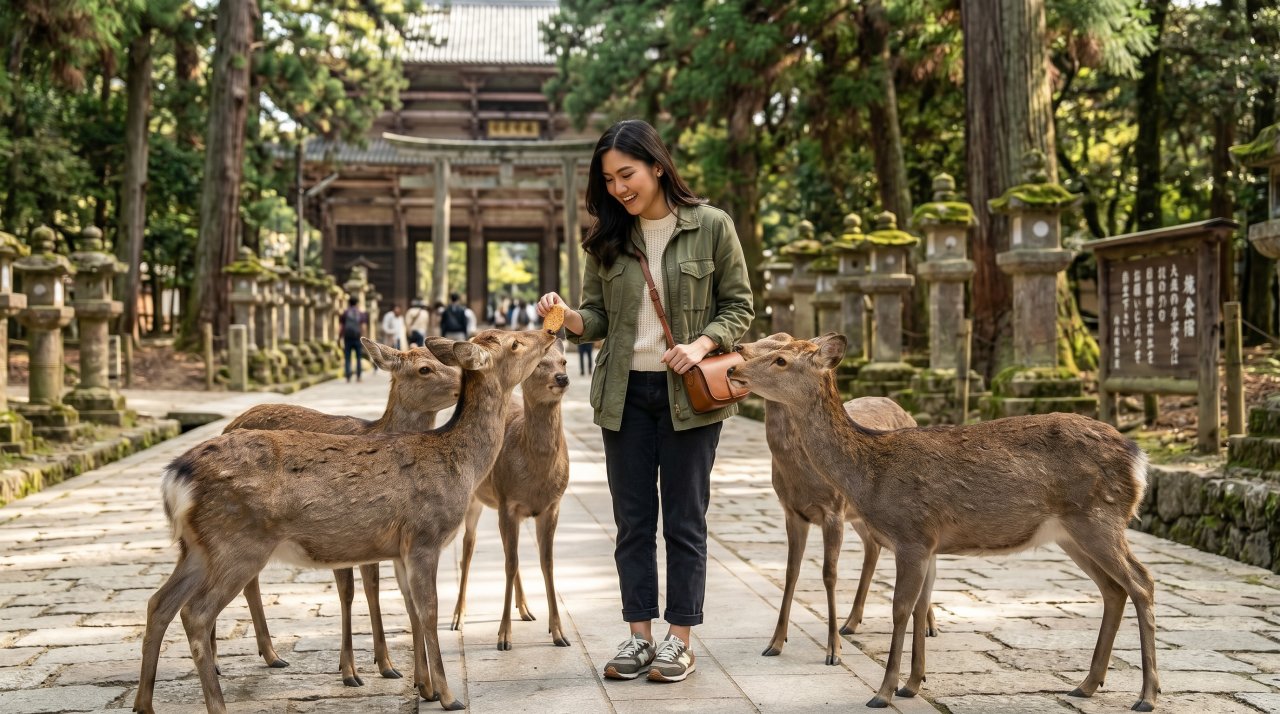
More than 1,200 sika deer roam freely through the park and have been considered sacred since the 8th century. Pick up a pack of shika senbei (deer crackers) for ¥200 from one of the vendors scattered along the path and prepare for an immediate, uninvited audience. Budget 30 to 45 minutes here before continuing toward Todai-ji.
The Daibutsuden (Great Buddha Hall) is the largest wooden building in the world and houses a bronze Vairocana Buddha standing 14.98 metres tall, cast in 752 AD. Entry costs ¥800 for adults. Budget at least an hour - the hall itself, the Nandaimon Gate (free, flanked by two 8-metre guardian statues), and the surrounding grounds all deserve time.
Head back toward the station and into Higashimuki Shopping Street for lunch. Kakinoha-zushi (sushi wrapped in persimmon leaves) is the regional specialty, sold at small restaurants and takeaway counters throughout the arcade. Budget ¥1,000 to ¥1,500 for a sit-down set meal.
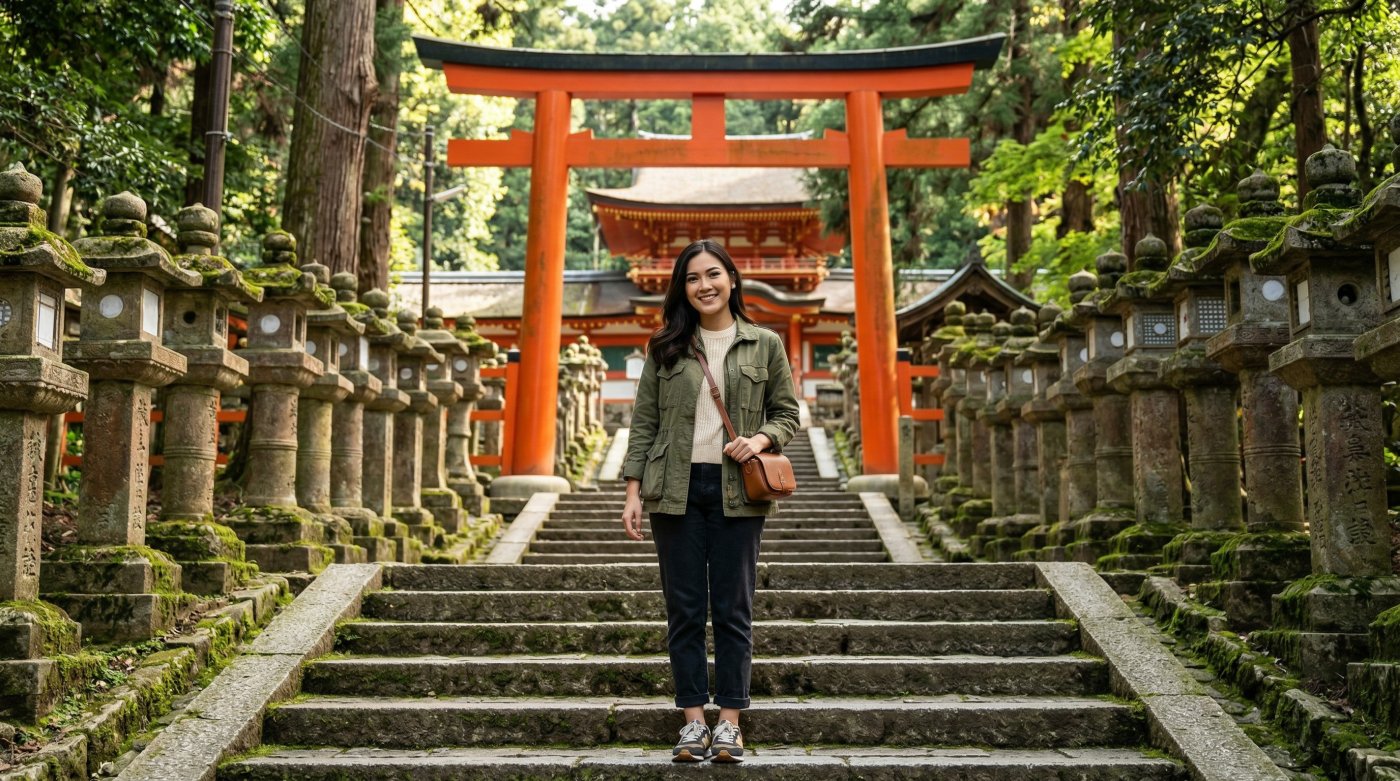
The 15-minute approach to Kasuga Taisha runs through cedar forest lined with over 3,000 stone and bronze lanterns, and it is genuinely one of the better walks in Kansai. The outer grounds are free; the inner main sanctuary (Honden) charges ¥700 for adults. The shrine dates to 768 AD and is one of eight Nara UNESCO World Heritage sites.
Yoshikien is a compact traditional garden with three distinct sections - a pond garden, a moss garden, and a tea-ceremony garden - that most visitors cover in 30 to 45 minutes. Entry is free for foreign visitors on presentation of a passport. Isuien Garden sits directly next door and charges ¥1,200 if you want the more polished experience with borrowed scenery views toward Todai-ji.
Head back to Kintetsu Nara Station for the return trip to Osaka-Namba. Rapid Express trains run roughly every 10 to 15 minutes with no advance reservation needed. Departing at 16:30 puts you back in Namba by 17:05, well ahead of the dinner rush.
| Route | Line | Duration | Cost |
|---|---|---|---|
| Kintetsu Nara Line Rapid Express RECOMMENDED | Kintetsu Railway | 35 min | |
| Kintetsu Nara Line Limited Express | Kintetsu Railway | 30 min | |
| JR Yamatoji Line Rapid Service | JR West | 45 min |
All stops on this itinerary pinned for easy reference.
Day Trip to Nara from Osaka: The Complete Guide (2026]) – Nara is 36 minutes from Osaka-Namba on the Kintetsu Nara Line, and it earns a full day.
Over 1,200 sika deer roam freely through a UNESCO World Heritage park flanked by temples dating back to 710 AD.
Five hours on the ground gets you Todai-ji’s bronze Great Buddha, the stone lantern corridors of Kasuga Taisha, and at least one deer in your personal space.
You’ll be back in Osaka for dinner.
Most Osaka day trips ask you to choose between speed and payoff.
Nara is the exception.
The train ride is short, the attractions are tightly clustered within walking distance of the station, and the city has been mostly frozen in time since the 8th century – which makes the whole experience feel a little surreal.
You are 40 minutes from one of Asia’s busiest urban corridors, and then suddenly you are sharing a stone path with a thousand-year-old deer lineage and temples that predate Notre-Dame by five centuries.
This trip suits first-time visitors who want genuine history without the logistical headache, and couples looking for something a bit different from the usual Osaka circuit.
It also works well for anyone who finds Japan’s modern cities slightly overwhelming – Nara moves at a noticeably slower pace, and the scale is human.
The main attractions in Nara Park span roughly two kilometers end-to-end, so you are never far from something worth stopping for.
The people who might not get the most out of it are travelers who have already done three or four days in Kyoto on the same trip and are developing temple fatigue, or hardcore foodies who measure trips by the density of great restaurants.
Nara’s food options are decent but limited compared to Osaka’s.
If either of those describes you, this guide will still be useful – but manage expectations accordingly.
Three rail options connect Osaka to Nara, and they differ enough in cost, departure station, and travel time that the right choice depends on where you are staying and whether you are carrying a JR Pass.
The good news is that all three are simple: no transfers, no complicated ticketing, and trains run frequently enough that you do not need to plan around a specific departure.
This is the recommended route for most visitors.
Trains depart from Osaka-Namba Station on the Kintetsu Nara Line and reach Kintetsu Nara Station in around 35 to 36 minutes, dropping you off almost directly at the entrance to the park and temple area.
The fare is ¥680 one way, making it the fastest and cheapest option for anyone not holding a JR Pass.
Trains run roughly every 10 to 15 minutes, so there is no need to rush for a specific service.
The Limited Express on the same Kintetsu Nara Line cuts the journey to around 30 minutes, but the reserved seat surcharge brings the fare to ¥1,300 one way.
You save about five minutes and get a guaranteed seat – useful during Golden Week or the cherry blossom peak when the Rapid Express fills up.
Outside of those windows, it is hard to justify the price difference for a five-minute gain.
If you are staying near Umeda and carrying a Japan Rail Pass, the JR Yamatoji Line Rapid Service is the logical pick.
Trains depart from JR Osaka Station and arrive at JR Nara Station in around 45 minutes, with the ¥840 fare fully covered by the pass.
The tradeoff is that JR Nara Station sits slightly further from the main attractions than Kintetsu Nara Station, adding a few extra minutes of walking at the start of your day.
For most visitors without a JR Pass, the Kintetsu Rapid Express from Namba is the clear winner: faster, cheaper, and better positioned at the other end.
If you have a JR Pass and are staying in the Umeda area, use the JR Yamatoji service and save the ¥840 fare.
The Limited Express is worth the upgrade only during peak-season weekends when a confirmed seat makes a real difference.
Nara has no genuinely bad season, but spring and autumn are the ones worth planning around.
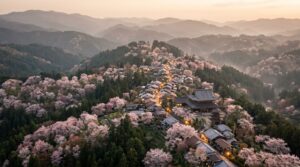
Late March to mid-April brings cherry blossoms across the 660-hectare park, with deer wandering through pink canopies against a backdrop of ancient wooden temples – it is one of those scenes that looks like it has been staged.
Temperatures sit between 15 and 20°C, the days are long, and this is when most visitors feel most rewarded for making the trip.
The flip side is that the crowds match the scenery: popular spots like Todai-ji and Kasuga Taisha fill up fast, especially on weekends.
Autumn (October to late November) runs it close as the best season to visit.
Maple and ginkgo trees across the park turn amber and red from mid-October onward, and the deer’s thick winter coats make them noticeably more photogenic.
Early October also brings the Shika no Tsunokiri ceremony, the traditional antler-cutting ritual that has been part of Nara’s calendar since 1671.
If you are choosing between spring and autumn and crowds are a concern, late October tends to be slightly less congested than the cherry blossom peak.
Summer visits are viable but demanding.
Japan’s heat and humidity from late June through August make a full day of outdoor walking exhausting by early afternoon, and you will want to build more rest stops into the itinerary.
Winter is genuinely underrated: the park is far quieter, temperatures hover around 7 to 10°C (cold but manageable with layers), and the stone lanterns along the Kasuga Taisha approach look particularly atmospheric in low winter light.
The logical approach is to work roughly northwest to southeast across the park: start at Kofuku-ji near the station, move through Nara Park toward Todai-ji, then continue to Kasuga Taisha and the gardens before looping back for lunch and the return trip.
This keeps the routing efficient and gets you to the biggest crowd-magnet, Todai-ji, in the late-morning window just before the midday tour groups descend.
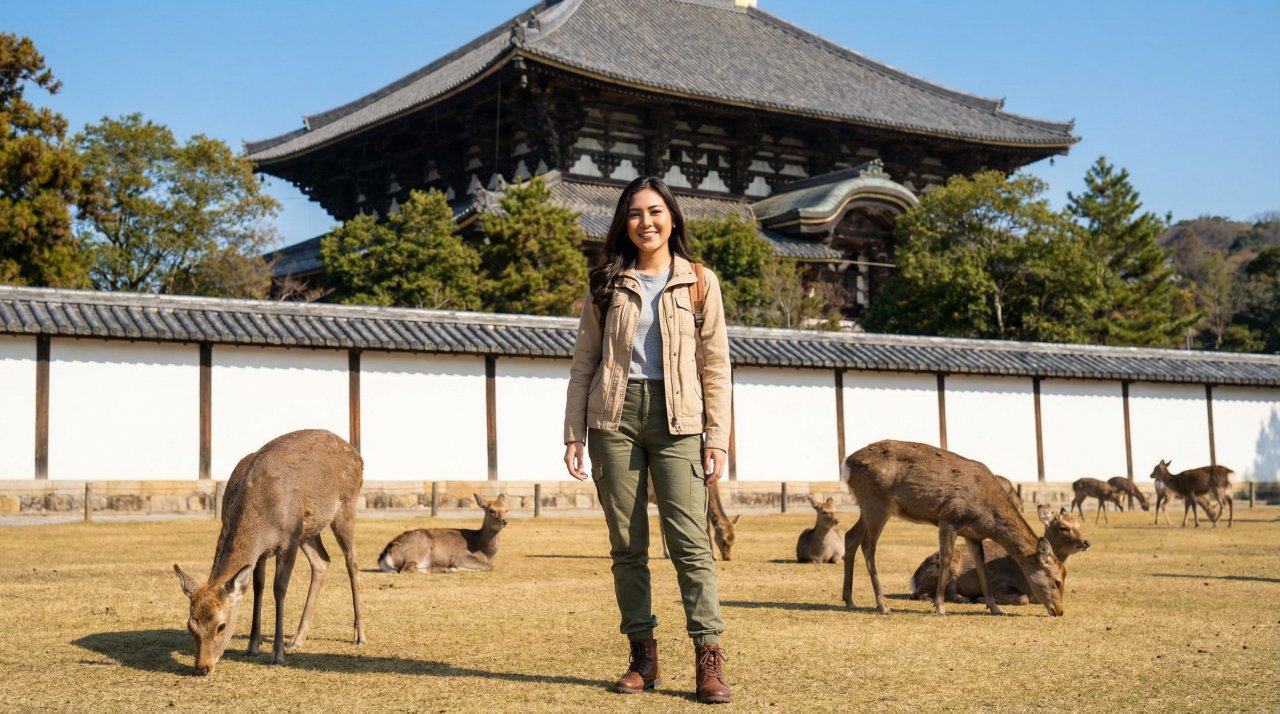
Arrive at Kintetsu Nara Station around 9:00 and grab a coffee from one of the cafes near the exit before you start walking.
Coin lockers on the ground floor of the station are useful for any bags you would rather not carry around the park; use them early on weekends, as they fill up by mid-morning.
Five minutes from the station brings you to Kofuku-ji Temple, where the five-story pagoda rises above the trees and over the adjacent Sarusawa Pond.
The complex dates to 669 AD and served as the Fujiwara clan’s political power base for centuries.
The grounds are free, and the pagoda from the pond side is one of the cleaner photo opportunities of the morning before the crowds arrive.
The Central Golden Hall is ¥700 if you want to go inside; the grounds alone are worth 30 minutes.
Nara Park begins almost immediately past Kofuku-ji, and the deer will find you before you find them.
Pick up a pack of shika senbei (deer crackers) for ¥200 from one of the vendor carts scattered along the path – these are specially formulated for deer and the only food you should offer them.
A piece of technique worth knowing: hold a cracker overhead and the deer bows, trained over centuries of being treated as sacred messengers of the gods.
Keep the bag out of sight when you are done, or the next five minutes of your life will be eventful.
By 11:00, you should be at Todai-ji Temple.
The Daibutsuden (Great Buddha Hall) is the largest wooden building in the world, and the bronze Vairocana Buddha inside stands 14.98 metres tall – cast in 752 AD and largely original.
Entry is ¥800 for adults.
Budget at least an hour: the hall itself, the Nandaimon Gate (free, flanked by two 8-metre guardian statues), and the surrounding grounds all reward unhurried attention.
There is also a wooden pillar inside with a small square hole at its base, roughly 37 cm wide and said to match the size of the Great Buddha’s nostril.
Watching adults attempt to crawl through it is free entertainment.
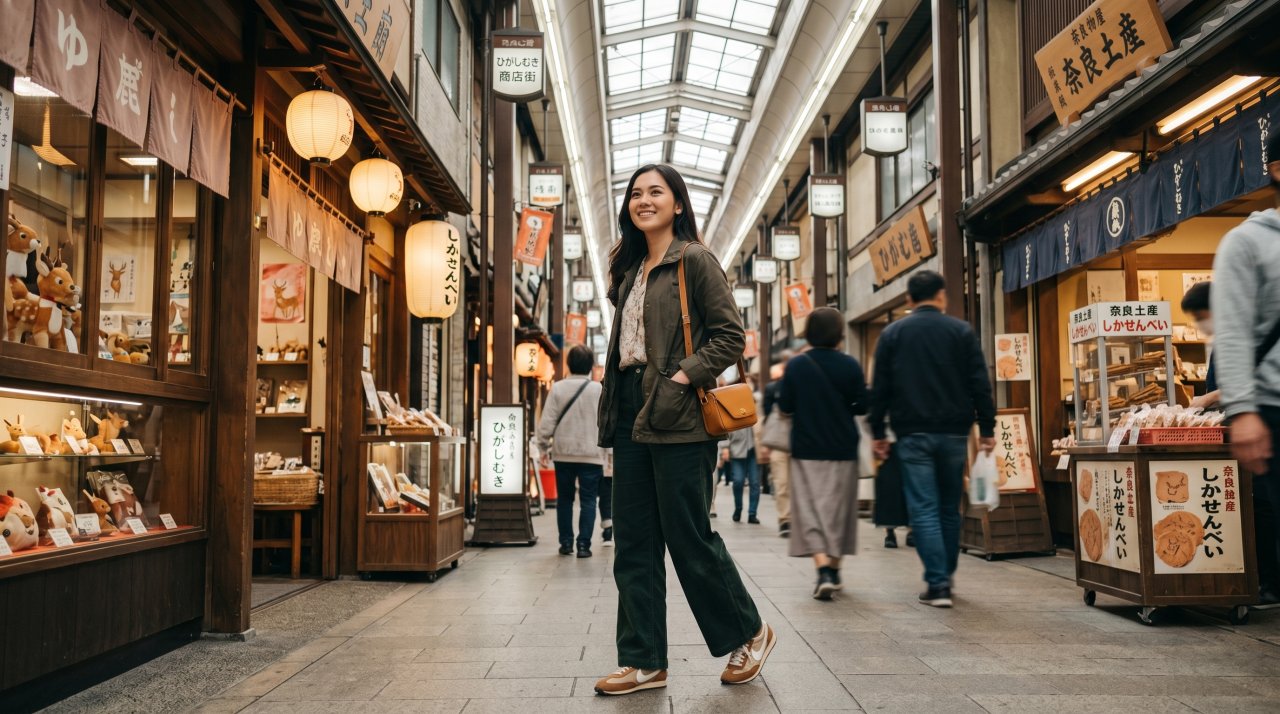
By 12:30, head back in the direction of the station and into Higashimuki Shopping Street for lunch.
Kakinoha-zushi – sushi wrapped in persimmon leaves – is the regional dish worth eating here rather than somewhere else.
The leaves subtly season the rice and fish through a slow fermentation process, and the result tastes genuinely different from what you will find in Osaka.
Most small restaurants along Higashimuki offer set lunches in the ¥1,000 to ¥1,500 range.
If you pass Nakatanidou, stop for a fresh kinako mochi (¥200); the shop does live pounding demonstrations outside that are worth a two-minute pause.
After lunch, head southeast toward Kasuga Taisha Shrine.
The approach along the stone lantern-lined path through the cedar forest takes about 15 minutes on foot and is one of the better walks in the Kansai region – over 3,000 stone and bronze lanterns line the route, lit twice a year during the Mantoro festivals in February and August.
The outer grounds are free; the inner sanctuary (Honden) charges ¥700 for adults.
The shrine dates to 768 AD and, along with Todai-ji and the park itself, forms part of Nara’s UNESCO World Heritage designation.
Around 15:00, stop at Yoshikien Garden on the walk back through the park.
This compact traditional garden covers three distinct sections – a pond garden, a moss garden, and a tea-ceremony garden – and most visitors cover all three in 30 to 45 minutes.
Best of all, entry is free for foreign visitors with a passport.
If you want something more polished, Isuien Garden sits directly next door for ¥1,200 and offers borrowed scenery views toward Todai-ji that are particularly good in the afternoon light.
By 16:30, start making your way back to Kintetsu Nara Station.
Rapid Express trains to Namba depart every 10 to 15 minutes with no reservation needed, so there is no pressure to catch a specific service.
Departing around 16:30 puts you back in Namba area by 17:05 – well ahead of the dinner rush.
If you are still deciding where to eat, the Osaka food guide covers everything from street food in Dotonbori to sit-down kaiseki across every price range.
Nara’s food scene is modest by Japanese standards, but it has two regional dishes genuinely worth eating here.
Kakinoha-zushi is the one to prioritize: sushi wrapped in aromatic persimmon leaves that have been allowed to impart their tannins into the vinegared rice over hours.
It is a preservation method turned culinary tradition, and the result is sushi that is slightly firmer and more fragrant than the standard variety.
You will find it at dedicated restaurants and takeaway counters throughout Higashimuki Shopping Street and the lanes around the station.
The other specialty worth trying is Miwa somen – thin, handmade wheat noodles served cold with a dipping broth.
Nara Prefecture has produced somen for over 1,300 years, and the variety from Miwa town is widely regarded as among the best in Japan.
Several restaurants near the park serve it, and it is a good call on warm days when you want something light.
One honest note on expectations: Nara’s food scene does not compete with Osaka’s for depth or variety.
Osaka is one of the world’s great food cities, and if culinary exploration is a high priority for your trip, a dedicated evening in Dotonbori will give you more than a full day of dining in Nara.
The kakinoha-zushi is genuinely worth eating here.
Nara is just not a food destination.
Nara is one of the more affordable full days you will spend in Japan.
The combination of a free deer park, a short train ride at ¥680 each way, and reasonably priced temple entry means a complete day comes in well under ¥7,000 for most people.
The baseline estimate is ¥5,000 to ¥7,000 per person, depending on how many paid attractions you visit.
The Kintetsu Nara Line Rapid Express costs ¥680 each way, putting round-trip transport at ¥1,360.
If you upgrade to the Limited Express for one leg, budget ¥1,300 for that direction and ¥680 for the return: ¥1,980 round trip.
JR Pass holders pay ¥840 each way without the pass, or nothing if it is active.
A realistic mid-range combination covering Todai-ji and Kasuga Taisha inner sanctuary totals ¥1,500.
Add Isuien Garden and you are at ¥2,700 for attractions.
Budget ¥1,000 to ¥1,500 for a set lunch, ¥200 for shika senbei (deer crackers), and ¥500 to ¥800 for coffee and a mochi snack.
Total food and drink comes to roughly ¥1,700 to ¥2,500.
A typical day covering the main temples, the inner Kasuga Taisha sanctuary, lunch, deer crackers, and a couple of coffees lands at ¥5,000 to ¥6,500 per person without a JR Pass.
Add Isuien Garden, a souvenir, or the Limited Express upgrade and the upper end reaches ¥7,500.
It is a full, well-rounded day at a price that will not sting.
Leave Osaka by 8:30 at the latest if you want to cover the main attractions without feeling rushed.
The first Rapid Express trains from Namba depart before 6:00 AM, and being at Kofuku-ji before 9:30 puts you ahead of the tour group wave that rolls into Todai-ji from around 10:00 onward.
The difference between arriving at the Great Buddha Hall at 9:30 versus 11:30 is visible in how much space you have in front of the statue.
Wear comfortable walking shoes.
The full itinerary from station to Kofuku-ji, through the park to Todai-ji, down to Kasuga Taisha, and back via the gardens covers 6 to 8 kilometers over the course of the day.
Most of the terrain is flat, but the approach to Kasuga Taisha involves uneven stone paths that can get slippery after rain.
Bring a light waterproof layer if the forecast looks uncertain – getting caught in a downpour at Todai-ji with no cover is a miserable way to end an otherwise good day.
One thing that most guides skip: Nara’s deer are wild animals that occasionally bite, headbutt, and pull at bags they believe contain crackers.
The deer feeding is a genuine highlight of any Japan trip, but keep your cracker bag closed until you are actively feeding, and do not turn your back on a deer that has spotted you holding one.
Children need close supervision around the more assertive deer near the main feeding areas.
This is not a scare warning – most encounters are politely transactional – but knowing this beforehand is better than finding out mid-snack.
For first and second-time visitors to Japan, yes – without much qualification.
Nara delivers something rare on the Kansai day-trip circuit: a UNESCO World Heritage site you can walk through in a single day, with world-class historical architecture, a landscape that has not been modernized beyond recognition, and a central experience (the deer) that makes the whole thing feel unlike anywhere else.
The combination of easy access from Osaka and genuine depth puts it near the top of any Kansai side-trip list.
The honest caveats are worth stating.
If you have already spent three or four days in Kyoto on this trip, some of Nara’s temples will blend into the same mental category as the previous dozen.
The Great Buddha is impressive at scale, and the park is unlike anything in Kyoto, but if you are running low on patience for ancient shrines, a day trip to Himeji for the castle or Kobe for the waterfront offers a sharper change of scene.
If you are still in the planning stage and trying to figure out how Nara fits into the broader picture, the Osaka trip itinerary page maps out how to combine day trips efficiently without backtracking.
For days you decide to stay in the city, the full list of things to do in Osaka covers everything from the obvious landmarks to the neighborhoods most first-timers miss.
Nara works well as either a full day or a tight half-day if the schedule is packed – but it earns the full version.
The fastest practical option is the Kintetsu Nara Line Rapid Express from Osaka-Namba Station, which reaches Kintetsu Nara Station in approximately 35 minutes for ¥680 one way. A Limited Express on the same line takes around 30 minutes but costs ¥1,300.If you are travelling from JR Osaka Station and hold a Japan Rail Pass, the JR Yamatoji Line Rapid Service runs to JR Nara Station in 45 minutes at ¥840 without a pass – and is fully covered by the pass if you have one.
Nara is one of the highest-return day trips from Osaka relative to the effort involved. The city served as Japan’s first permanent capital from 710 to 784 AD, and its UNESCO World Heritage park holds some of the country’s oldest surviving wooden architecture alongside over 1,200 freely roaming deer.The Kintetsu Rapid Express from Namba takes about 35 minutes, which means even a half-day visit covers the main draws. Most first-timers prefer 5 to 6 hours on the ground to take in Todai-ji, Kasuga Taisha Shrine, and the park at a pace that doesn’t feel rushed.
The Japan Rail Pass is valid on the JR Yamatoji Line Rapid Service from JR Osaka Station to JR Nara Station, a 45-minute journey. The pass is not valid on Kintetsu Railways, which operates the faster 35-minute Rapid Express from Osaka-Namba.If you hold a JR Pass and are visiting Nara as a standalone day trip, the JR route makes financial sense. Without a pass, the Kintetsu Nara Line from Namba is faster and, at ¥680, cheaper than the ¥840 JR fare.
Entry to the Daibutsuden (Great Buddha Hall) at Todai-ji costs ¥800 per adult. Children aged 6 to 12 pay ¥400. The outer grounds, the Nandaimon Gate, and the approach path are all free to walk through.A joint pass covering both the Todaiji Museum and the Great Buddha Hall is available for ¥1,200 per adult if you plan to visit both on the same day.
Spring (late March to mid-April) and autumn (mid-October to late November) are when Nara is at its best. Spring brings cherry blossoms across the 660-hectare park, while autumn delivers vivid maple and ginkgo foliage and the traditional Shika no Tsunokiri antler-cutting ceremony in early October.Summer is the season for young fawns but Japan’s heat and humidity make a full day on foot demanding. Winter is the quietest time to visit and the deer’s thick winter coats make for good close-up encounters.