








 Cultural experiences
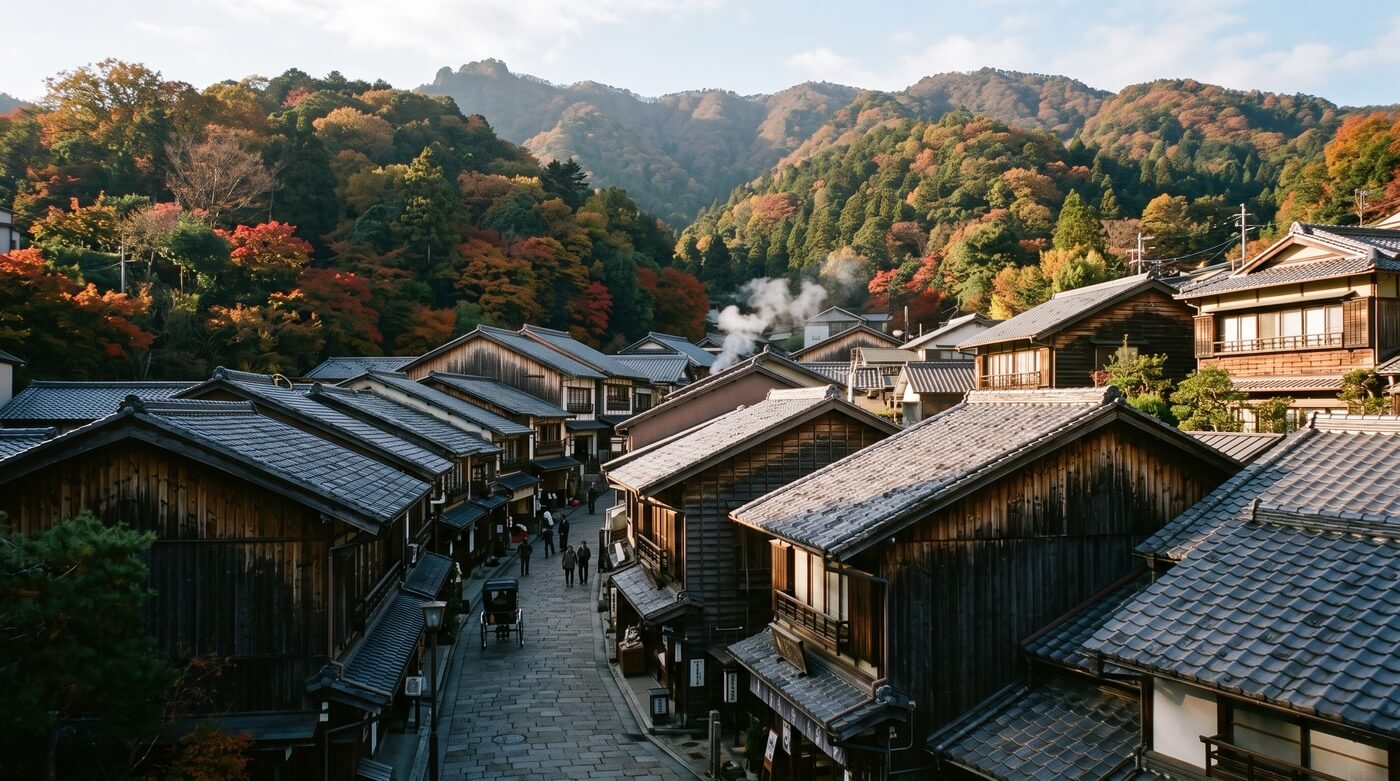
Arima Onsen is the one day trip in easy reach of Osaka where the point of the day is getting into hot water. The Hankyu Kanko Bus runs from Hankyu Osaka-umeda into the middle of town in about 55 minutes with no transfers, and the whole place is walkable. What you get is two mineral waters, two municipal bath houses, and staggered closing days that catch people out.
Getting There (at a glance)
- Hankyu Kanko Bus, Osaka Umeda to Arima Onsen55 min, ¥1,400
- Hankyu Kobe Main Line plus Kobe Municipal Subway plus Kobe Electric Railway, Osaka-umeda to Arima Onsen70 min, ¥1,050
- Hankyu Kanko Bus, Shin-Osaka to Arima Onsen50 min, ¥1,250
Arima Onsen Day Trip Itinerary from Osaka
10:10
Kin no Yu
10:10
Kin no Yu
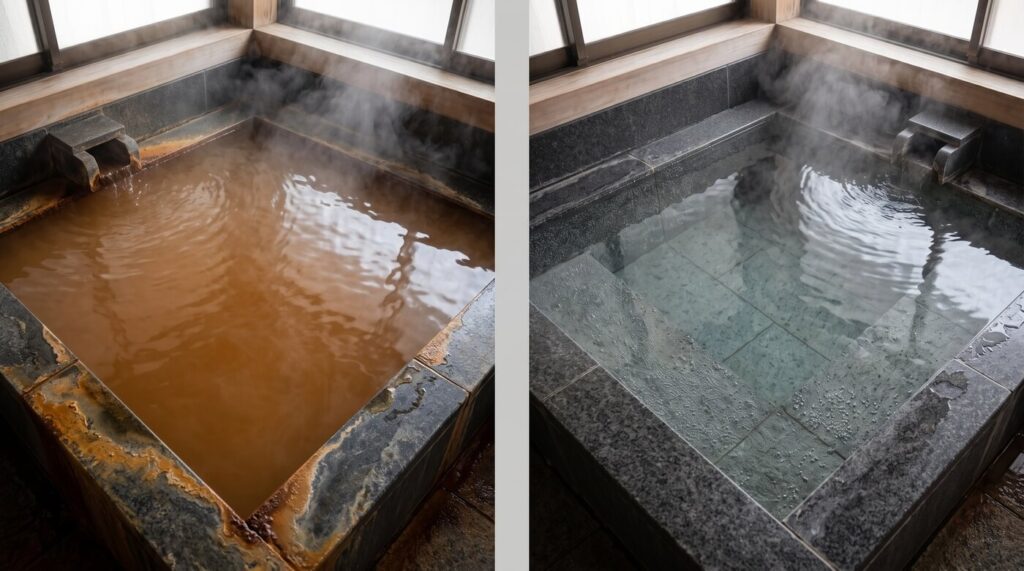
The cheapest way into the kinsen, the iron and salt water that runs clear underground and turns rust brown the moment it meets air. Two indoor pools for each gender, one hot and one hotter, and no outdoor bath. Admission ¥800, or ¥650 on ordinary weekdays outside the New Year, Golden Week and Obon peaks, checked September 2026.
TIP
The ¥1,200 two bath ticket saves ¥300 at weekends and nothing on a weekday, when it only adds a towel.
11:30
Taiko no Yudonokan
11:30
Taiko no Yudonokan
A municipal museum built over the excavated steam bath and rock bath of Hideyoshi's Yuzan palace, found under a temple storehouse after the 1995 earthquake and left sitting in the ground where they were dug out. Thirty minutes covers it. Entry ¥200, open 09:00 to 17:00 with last entry 16:30, checked September 2026.
TIP
Closed the second Wednesday of the month, a different day from either bath house.
13:15
Gin no Yu
13:15
Gin no Yu
The second municipal bath, up in the temple quarter, filled with the colourless ginsen: carbonated and radium water instead of iron, with a steam sauna attached. One large indoor pool for each gender and usually quieter than Kin no Yu. Admission ¥700, or ¥550 on ordinary weekdays, last entry 20:30, checked September 2026.
TIP
Eat before you climb up. The food is all back down the hill on Yumoto-zaka.
14:45
Zuihoji Park
14:45
Zuihoji Park
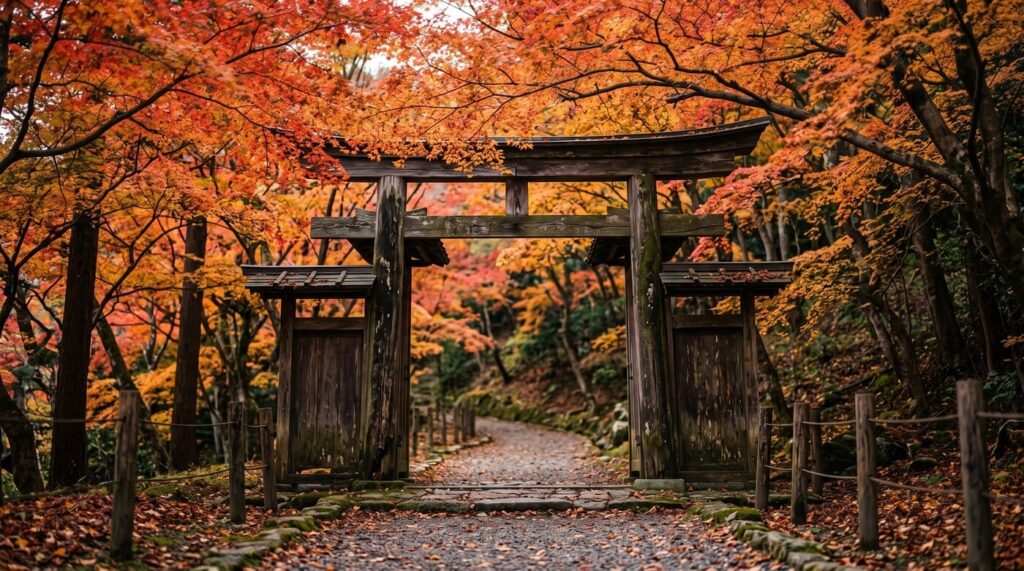
A wooded former temple garden about 15 minutes uphill from the town centre, entered through the old Zuihoji gate moved here from Fushimi Castle. It earns the climb in November, when the maples turn and the Arima tea gathering takes over the grounds. The rest of the year it is a quiet park at the top of a steep road.
TIP
In midsummer, skip it and spend the time and the sweat on a second bath.
16:30
Arima Onsen Station
16:30
Arima Onsen Station
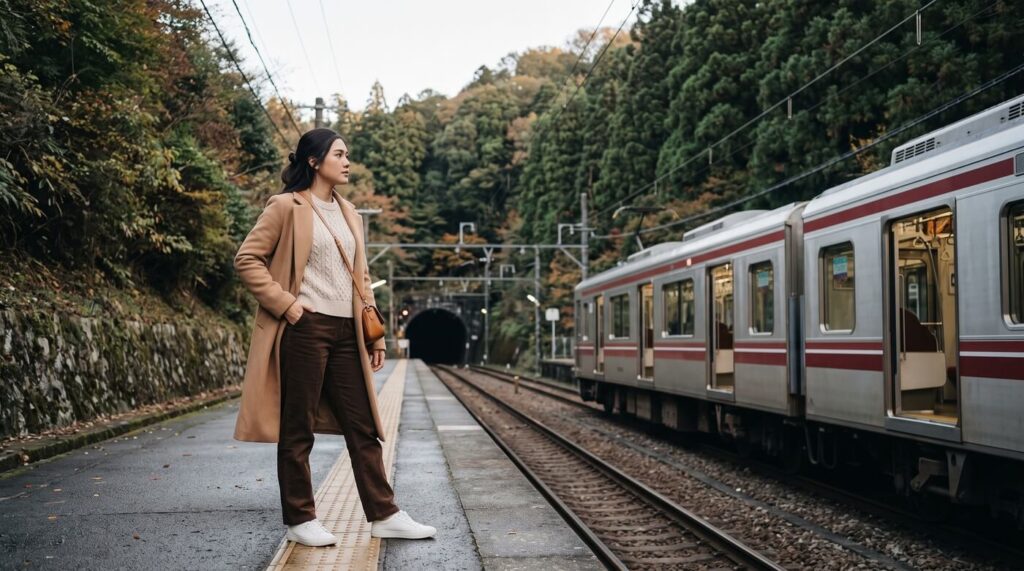
The rail escape route, five minutes downhill from the bath houses and the reason you are not trapped by the bus timetable. Kobe Electric Railway runs a two stop shuttle to Arimaguchi, timed to meet the Sanda and Shinkaichi services, and the Kobe Municipal Subway takes over at Tanigami.
TIP
Last Hankyu Kanko Bus to Umeda leaves Arima Onsen at 17:40, checked September 2026. Trains run far later.
How to Get from Osaka to Arima Onsen
| Route | Line | Duration | Cost | Book |
|---|---|---|---|---|
| Hankyu Kanko Bus (Limited Express) RECOMMENDED | Hankyu Kanko Bus Osaka to Arima Onsen line, from Osaka Umeda (Hankyu Sanbangai) | 55 min | ¥1,400 | |
| Hankyu Kanko Bus (Express) | Hankyu Kanko Bus Osaka to Arima Onsen line, from Shin-Osaka Hankyu Bus Terminal | 50 min | ¥1,250 | |
| Hankyu Kobe Main Line Limited Express, then subway and Kobe Electric Railway | Hankyu Kobe Main Line from Osaka-umeda, Kobe Municipal Subway Seishin-Yamate and Hokushin Lines from Sannomiya, Kobe Electric Railway Arima Line from Tanigami | 70 min | ¥1,050 | |
| JR Special Rapid Service, then subway and Kobe Electric Railway | JR Kobe Line from Osaka Station, Kobe Municipal Subway Seishin-Yamate and Hokushin Lines from Sannomiya, Kobe Electric Railway Arima Line from Tanigami | 65 min | ¥1,140 |
Hankyu Kanko Bus (Limited Express)
RECOMMENDED
Line
Hankyu Kanko Bus Osaka to Arima Onsen line, from Osaka Umeda (Hankyu Sanbangai)
Duration
55 min
Cost
¥1,400
Hankyu Kanko Bus (Express)
Line
Hankyu Kanko Bus Osaka to Arima Onsen line, from Shin-Osaka Hankyu Bus Terminal
Duration
50 min
Cost
¥1,250
Hankyu Kobe Main Line Limited Express, then subway and Kobe Electric Railway
Line
Hankyu Kobe Main Line from Osaka-umeda, Kobe Municipal Subway Seishin-Yamate and Hokushin Lines from Sannomiya, Kobe Electric Railway Arima Line from Tanigami
Duration
70 min
Cost
¥1,050
Day Trip Navigation Map: Osaka → Arima Onsen
All stops on this itinerary pinned for easy reference.
🗺️ Arima Onsen 有馬温泉
5 stops
Arima Onsen Day Trip From Osaka: Two Waters, One Hill – Arima Onsen is the one day trip in easy reach of Osaka where the point of the day is getting into hot water.
The Hankyu Kanko Bus runs from Hankyu Osaka-umeda into the middle of town in about 55 minutes with no transfers, and the whole place is walkable.
What you get is two mineral waters, two municipal bath houses, and staggered closing days that catch people out.
That makes it a different decision from every other day trip on Explore Osaka.
Kyoto, Nara and Himeji all give you something to look at.
Arima gives you somewhere to sit, and the quality of the day depends entirely on whether that is what you wanted.
So treat this one as a threshold rather than a recommendation.
Clear three conditions and Arima is the best short day out from Osaka: you are willing to bathe publicly, you are not arriving on the Tuesday that closes the bath you came for, and you know the last bus back to Umeda leaves at 17:40.
Fail any of them and you have spent ¥2,800 on a return bus ticket to a small town with one shopping street.
Key Highlights
Hide- The Hankyu Kanko Bus runs Hankyu Osaka-umeda to Arima Onsen in 55 minutes for ¥1,400 one way, checked September 2026.
- Every seat on that bus is reserved, so buy the ticket before you travel rather than at the stop.
- The last bus back to Umeda leaves Arima Onsen at 17:40 and arrives at 18:35, checked September 2026.
- Kin no Yu closes the second and fourth Tuesday, Gin no Yu the first and third, so one bath always survives.
- Kin no Yu costs ¥800, or ¥650 on ordinary weekdays; Gin no Yu costs ¥700, or ¥550, checked September 2026.
- No Japan Rail Pass covers any part of this trip, because no JR line reaches Arima Onsen.
- Budget ¥4,000 to ¥7,000 per person for transport, one or two baths, lunch and a snack.
Trip Essentials
Osaka Travel Add-ons
Equip yourself for the ultimate Osaka adventure with the following add-ons, curated just for you.
Flights to Osaka
Powered by Expedia
Airport Transfer
Powered by Klook
ICOCA IC Card
Powered by Klook
Suica IC Card
Powered by Klook
Osaka Tours
Powered by Klook
Luggage Storage
Powered by Radical Storage
Travel Insurance
Powered by VisitorsCoverage
Data Security
Powered by NordVPN

Japan eSIM
Powered by NINJA WiFi
Japan SIM Card
Powered by NINJA WiFi
Pocket WiFi Rental
Powered by NINJA WiFi
Japan eSIM
Powered by Airalo
Who Arima Onsen Beats and Who It Loses To
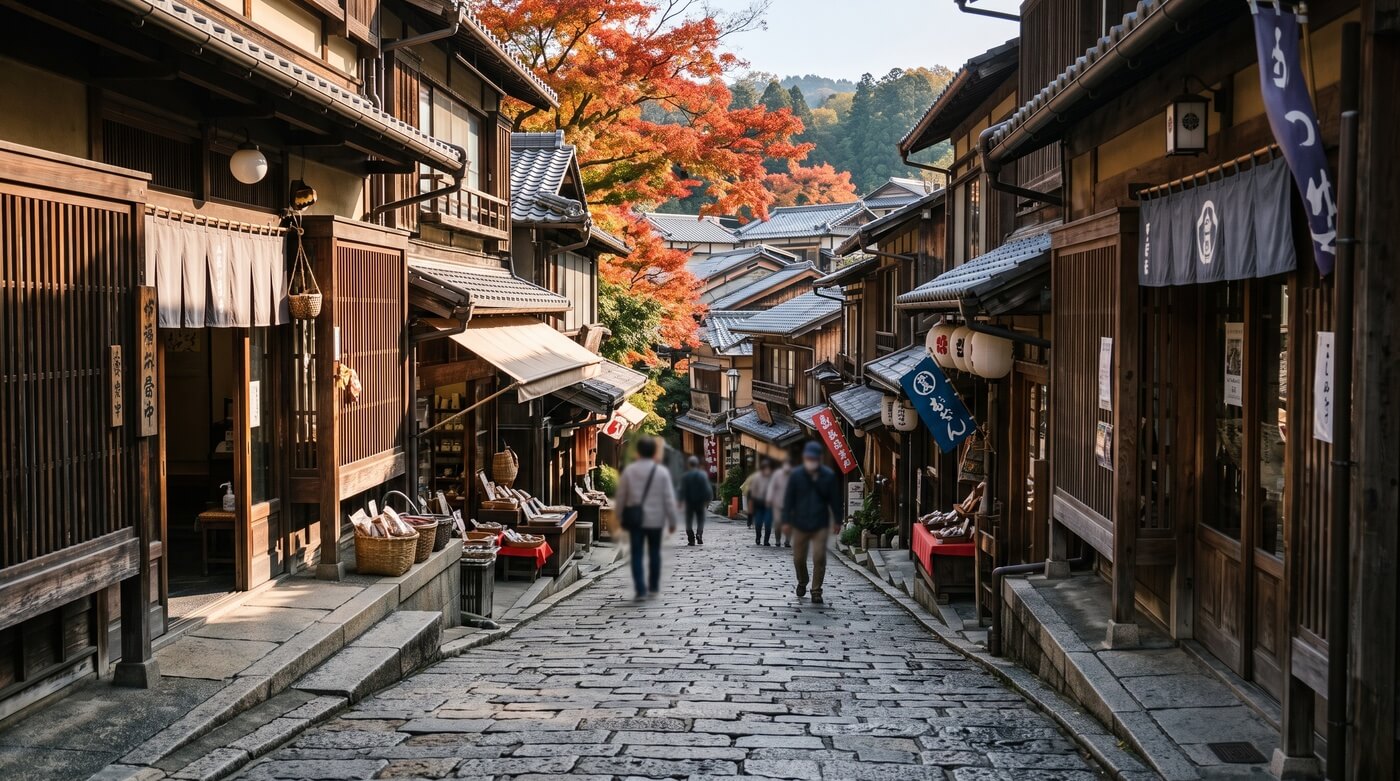
Arima Onsen beats Kobe and Himeji for anyone who wants a slow day, and loses badly to Kyoto and Nara for anyone on a first trip to Japan who has not yet seen a temple.
The trade is concrete.
A day trip to Himeji buys you one of the country’s great buildings and about 90 minutes inside it.
Arima buys you roughly 90 minutes in hot water and a walk between two bath houses.
Both are good days.
They are not the same day.
Against Kobe the comparison is closer, because Arima sits inside Kobe city limits, on the far side of Mount Rokko from the port.
If you want the harbour, the Kitano houses and beef, take the Kobe day trip instead.
If you want the bath, come here, and understand that the two are a full day each rather than a morning and an afternoon.
Skip Arima entirely in three cases.
If you will not undress in front of strangers, the two municipal baths have no private option, and the answer is Taiko no Yu at the top of the town, which does rent private baths.
If you have visible tattoos, check the individual bath’s rule before you buy a bus ticket rather than at the door.
And if this is day two of a five day first trip, the temples in Kyoto will do more for you than the water here.
Must-Do Experiences Around Arima Onsen and Kobe
Cultural experiences
 Observation decks
 Tours
Tours
 Tours
Tours
 Tours
Tours
 Tours
Tours
 Outdoor & sports activities
 Tours
Tours
 Museums
 Tours
Tours
 Tours
Tours
 Attraction passes
 Massages
 Tours
Tours
 Tours
Tours
 Massages
 Tours
Tours
 Tours
Tours
Cultural experiences
 Observation decks
Tours
Observation decks
Tours
Kobe: 3-Hour Sake Breweries Guided Tour with Tastings
Sannomiya, Kobe, Japan
From
$77.39
Book on Klook
Tours
Tours
Osaka Arima Onsen & Mount Rokko Sunset Night View Tour
Sannomiya, Kobe, Japan
From
$58.05
Book on Klook
Tours
Tokushima Awa Dance Festival Full-Day Tour with Special Seating
Kobe, Japan
From
$123.85
Book on Klook
Outdoor & sports activities
All-day twin-tip and snowboard tour to Mount Rokko, Osaka
Mount Rokko, Kobe, Japan
From
$51.70
Book on Klook
Tours
10-Hours Kobe Private Car Tour with Driver (From Osaka)
Sannomiya, Kobe, Japan
From
$386.99
Book on Klook
Museums
Tours
Kobe Nunobiki Herb Gardens & Flower Sea and Art Aquarium / Meriken Park & Mount Maya Night View Day Trip (From Osaka)
Sannomiya, Kobe, Japan
From
$46.45
Book on Klook
Tours
1-Day Walking Tour around Kobe : Mountains, Sea and Sake
Sannomiya, Kobe, Japan
From
$139.30
Book on Klook
Attraction passes
Massages
Private Day Trip Retreat Experience Mt. Rokko | Sauna, Massage
Sannomiya, Kobe, Japan
From
$278.65
Book on Klook
Tours
Premium Kobe Beef Experience and Sake Tasting Culinary Tour
Sannomiya, Kobe, Japan
From
$185.75
Book on Klook
Tours
Kobe Half-Day Private Shinto Shrine and Kobe Beef Tour
Sannomiya, Kobe, Japan
From
$79.25
Book on Klook
Massages
Tours
Kobe Full-Day Private Tour from Osaka with Customizable Itinerary
Sannomiya, Kobe, Japan
From
$371.49
Book on Klook
Tours
The Two Waters of Arima Onsen
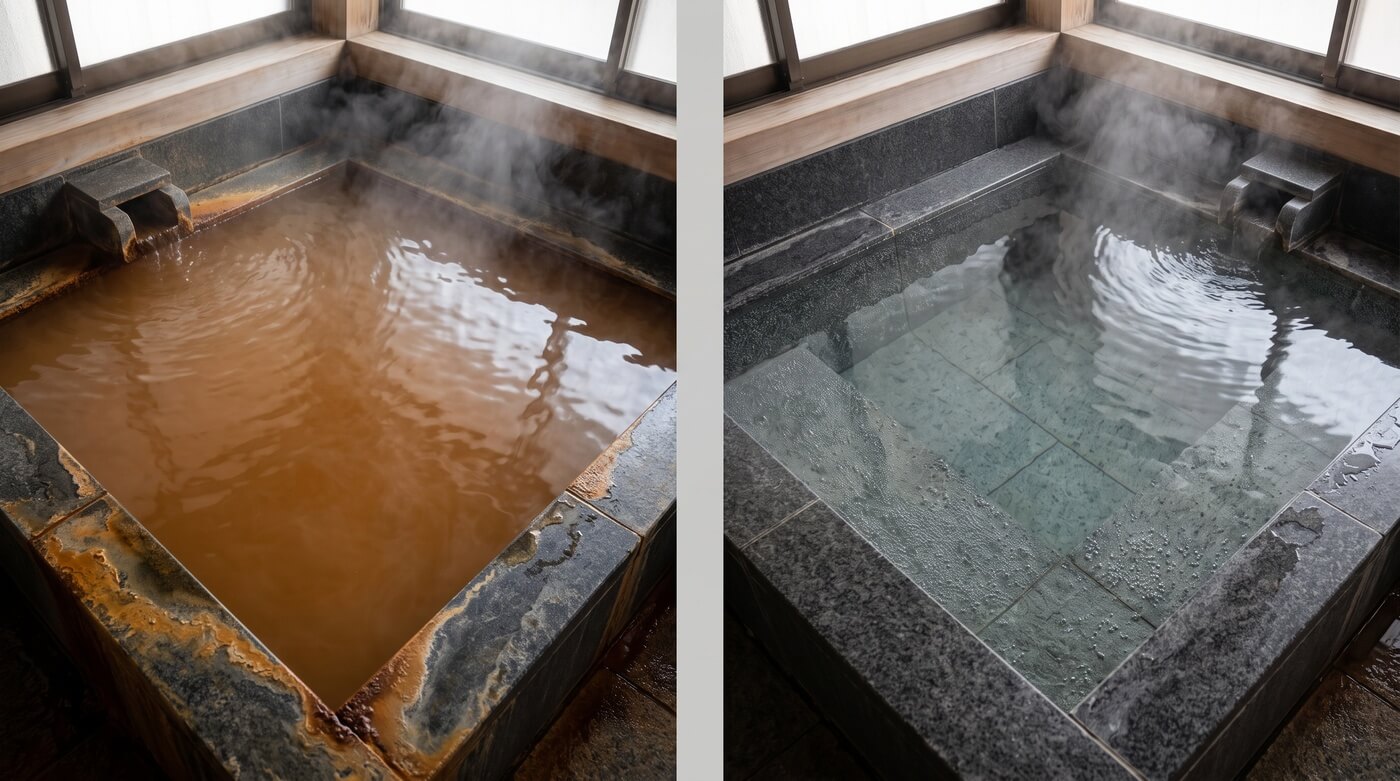
Arima Onsen runs two chemically different waters, and the two municipal bath houses give you one each.
The kinsen, the gold water, is loaded with iron and salt.
It comes out of the ground clear and turns rust brown within minutes of meeting air, which is why the bath looks like the colour has been poured in.
The ginsen, the silver water, mixes carbonated and radium water and stays completely colourless.
Bathing in both is the reason to come, and the town is small enough that doing so costs you one uphill walk of about five minutes.
Buy the combined ticket at whichever bath you reach first.
Kin no Yu and the Gold Water
Kin no Yu is the larger of the two, sits in the middle of town about five minutes on foot from Arima Onsen Station, and opens earliest at 08:00, with last entry at 21:30.
Admission is ¥800, or ¥650 on ordinary weekdays outside the New Year, Golden Week and Obon peaks, checked September 2026.
Inside there are two indoor pools for each gender, one hot and one hotter, and no outdoor bath at all.
One detail worth knowing before you buy: the ¥1,200 two bath ticket saves you ¥300 at the weekend and nothing whatsoever on a weekday, when ¥650 plus ¥550 comes to exactly ¥1,200 and the ticket simply adds a towel.
Buy it for the towel on a weekday, buy it for the money at the weekend.
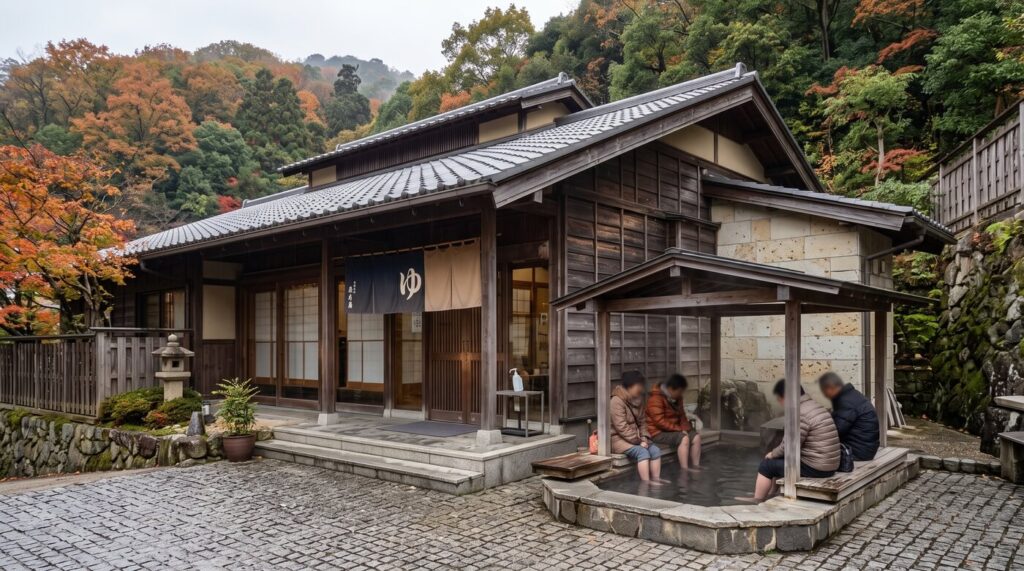
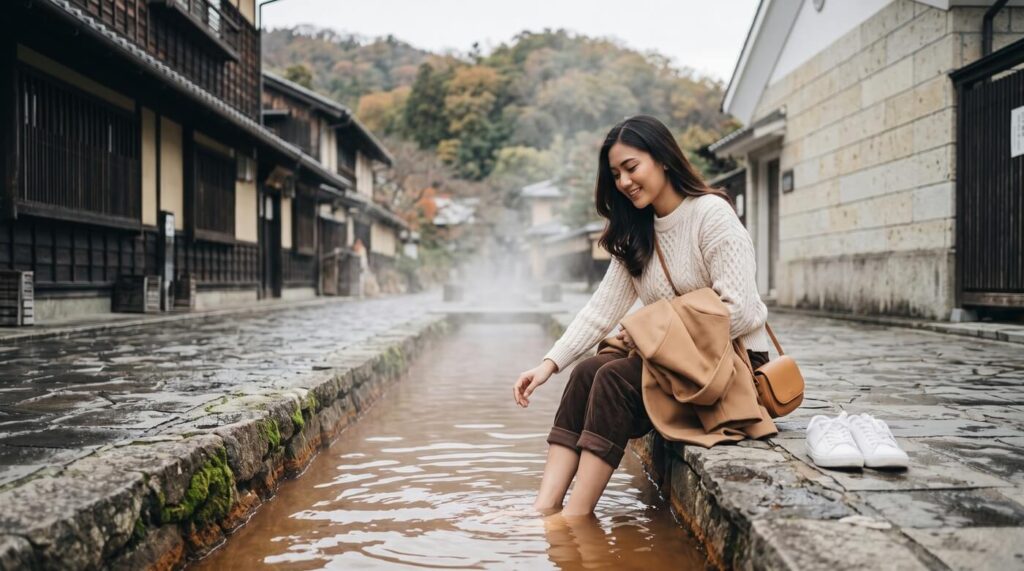
Outside the entrance there is a free foot bath, Taiko no Ashiyu, which needs no ticket.
It reopened in February 2026 after the building works and it is the right place to sit if one of you is not bathing.
Kin no Yu itself was shut from January to mid March 2026 while the tanks, pipes and boilers were replaced, and reopened on 17 March 2026 on normal hours.
Older posts still describing it as closed are out of date.
Gin no Yu and the Clear One
Gin no Yu stands higher up, in the temple quarter, and is the quieter of the two.
Admission is ¥700, or ¥550 on ordinary weekdays, open 09:00 to 21:00 with last entry at 20:30, checked September 2026.
There is one large indoor pool for each gender and a steam sauna, which Kin no Yu does not have.
The walk up is short but genuinely steep, and there is nothing to eat once you are up there.
Eat first.
Two minutes further uphill is the carbonated spring itself, a cold mineral source at about 18 degrees with a tap you can drink from.
It tastes of iron and fizz, and it is the reason Japan’s first cider was bottled here in 1901 and the reason every shop in town sells tansan senbei, the thin carbonated cracker.
Is Arima Onsen Worth It on a Tuesday?
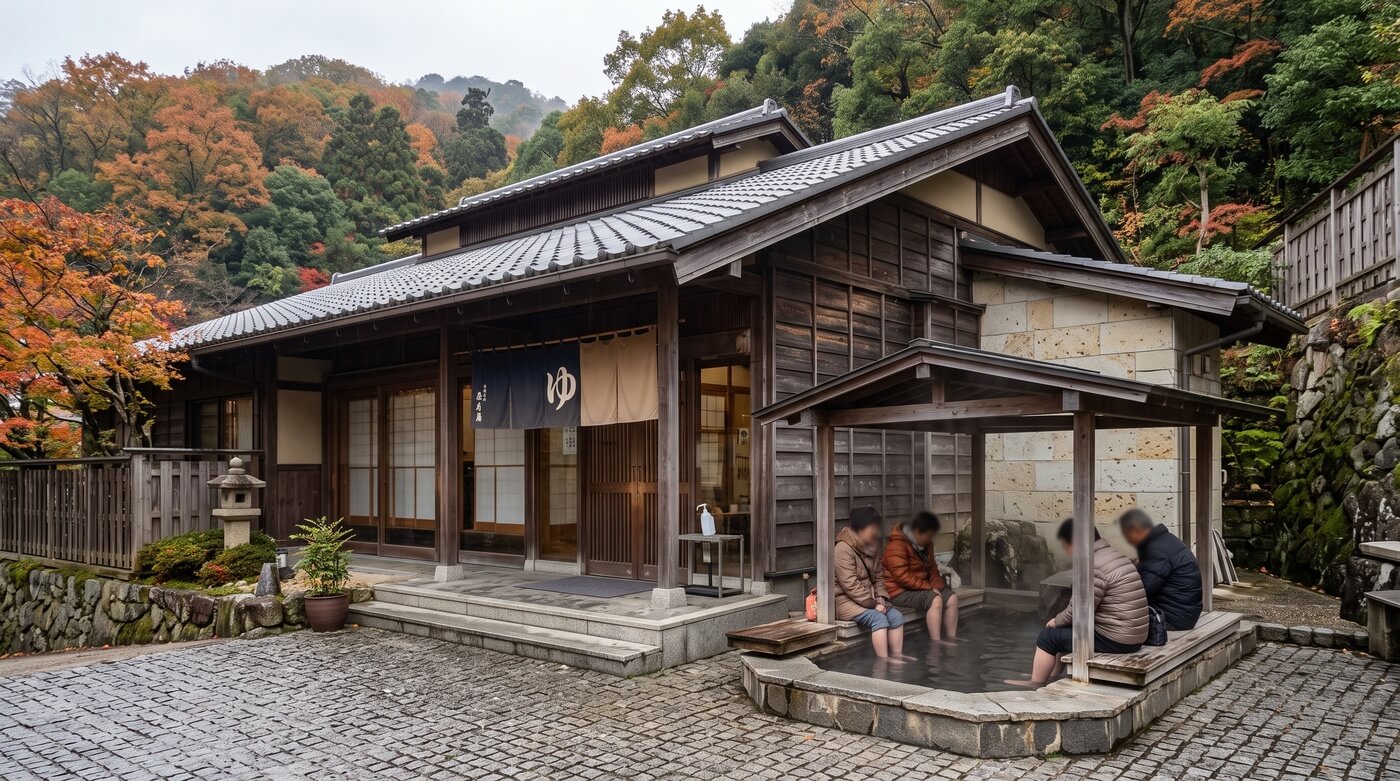
Yes, with one bath instead of two, and which one you lose depends on the week.
Kin no Yu closes the second and fourth Tuesday of the month.
Gin no Yu closes the first and third.
The schedules are staggered deliberately, so on any ordinary Tuesday exactly one of the two is open and you will not arrive to find the town shut.
The exceptions are worth writing down.
If the Tuesday falls on a public holiday, both stay open and the closure moves to the Wednesday.
Both close on 1 January.
A month with five Tuesdays gives you one where both are open.
And Taiko no Yudonokan, the small museum over Hideyoshi’s excavated bath, closes on the second Wednesday instead, which is a different day again.
The practical answer: if you specifically want the gold water, avoid the second and fourth Tuesday.
If you have no preference, come on a Tuesday on purpose.
It is the quietest day of the week in a town whose two bath houses both cap entry when they fill up.
Four Ways In and the One to Book to Go to Arima Onsen
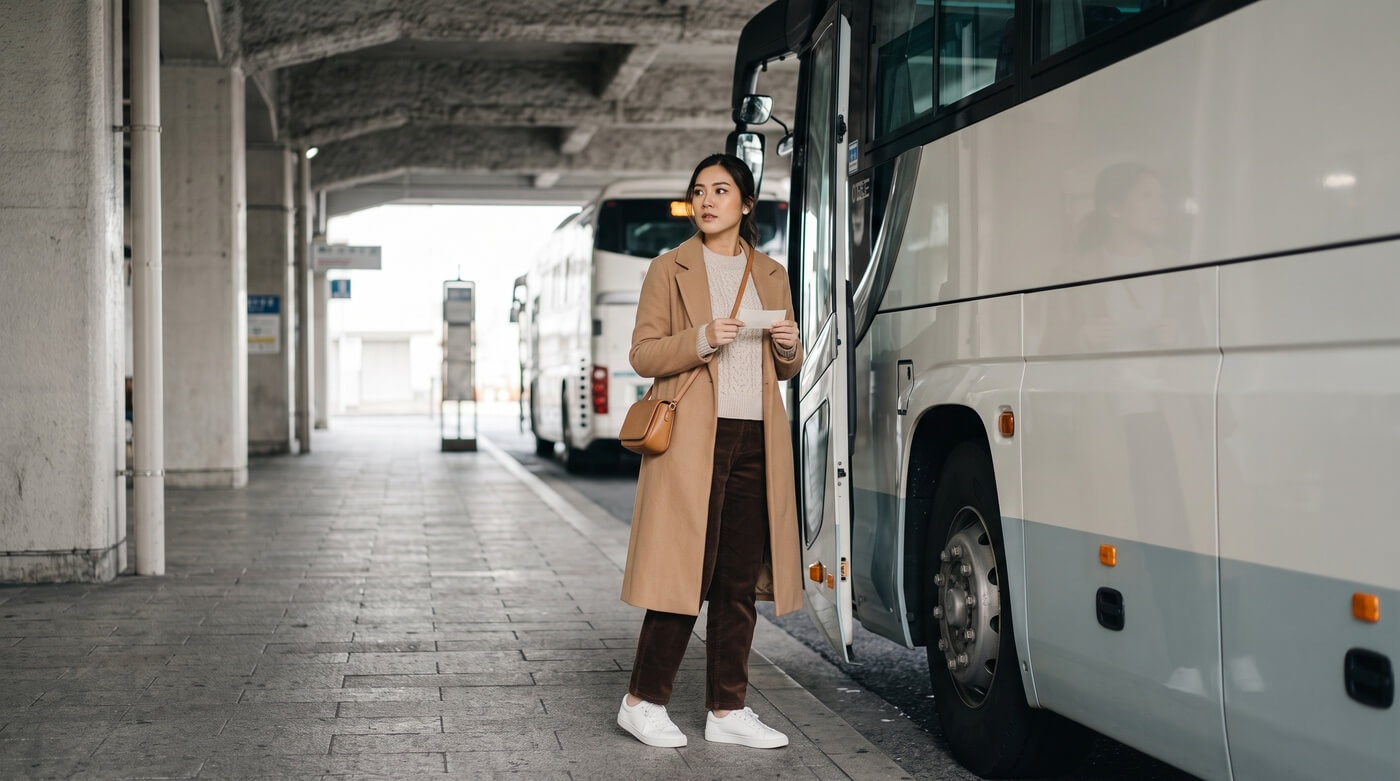
The direct Hankyu Kanko Bus from Hankyu Osaka-umeda is the pick: 55 minutes, ¥1,400 one way, no transfers, and it stops in the middle of town rather than at the station on the edge of it.
Fares and times checked September 2026.
| Route | Operator and line | Departs from | Time | One way | Pass coverage |
|---|---|---|---|---|---|
| Direct bus, limited express | Hankyu Kanko Bus, Osaka to Arima Onsen line | Hankyu Sanbangai, Umeda | 55 min | ¥1,400 | None |
| Direct bus, express | Hankyu Kanko Bus, same line | Shin-Osaka bus terminal | 50 min | ¥1,250 | None |
| Private rail | Hankyu Kobe Main Line, then Kobe Municipal Subway Seishin-Yamate and Hokushin Lines, then Kobe Electric Railway Arima Line | Hankyu Osaka-umeda | 70 min | ¥1,050 | None |
| JR then private rail | JR Kobe Line Special Rapid Service, then the same subway and Kobe Electric Railway | Osaka Station | 65 min | ¥1,140 | JR covers Osaka to Sannomiya only |
Osaka Passes
Essential Osaka Travel Passes
Powered by KlookThe passes worth buying before you land — curated for first-timers.
Top Pick
Osaka Amazing Pass
Unlimited subway + free entry to 40+ attractions. The only pass most visitors actually need.
Top Pick
Osaka e-Pass
Attractions-only digital pass. Pair with a Metro Pass if skipping the Amazing Pass.
Transit
Osaka Metro Pass
1 or 2-day unlimited Metro rides. Best standalone transit value if you already have an attractions pass.
Day Trips
JR West Kansai Area Pass (WEST QR)
Unlimited JR trains for 1 to 4 days. Covers Kyoto, Nara, Kobe, and Himeji from Osaka.
Airport
JR Haruka Express
KIX to Umeda/Shin-Osaka in ~50 min. Best if staying in Umeda or heading straight to Kyoto.
Airport
Nankai Rapi:t Express
KIX to Namba in 34 min, reserved seat. Better if staying in Namba or Shinsaibashi.
The one thing that catches people is the booking.
Every seat on the Hankyu Kanko Bus is reserved, and tickets go on sale from 09:00 on the same date of the previous month, so you buy before you travel rather than joining a queue at Hankyu Sanbangai.
Buses run one to two an hour through the middle of the day.
The first from Umeda leaves at 09:00 and reaches Arima at 10:00; the 09:50 limited express gets in at 10:45.
The last departure back to Umeda leaves Arima Onsen at 17:40 and arrives at 18:35.
That single number shapes the whole day, and it is the main argument for knowing the rail route even if you never use it.
By train from Umeda you take the Hankyu Kobe Main Line to Kobe-sannomiya for ¥330, walk to the Kobe Municipal Subway, ride the Seishin-Yamate and Hokushin Lines through Shin-Kobe to Tanigami, then the Kobe Electric Railway Arima Line onward, for ¥720 from Sannomiya.
The last leg is a two stop shuttle from Arimaguchi timed to meet the through trains with a connection of one to two minutes, so it looks worse on paper than it feels.
Total ¥1,050 and about 70 minutes, no reservation, and trains run far later than the buses.
If you are starting at Osaka Station rather than Umeda, the JR Kobe Line Special Rapid Service reaches Sannomiya in about 22 minutes for ¥420 and joins the same route, which is faster and ¥90 more expensive.
Umeda and Osaka Station are the same hub under two names: JR calls it Osaka Station, while the Hankyu, Hanshin and Osaka Metro stops there are Umeda.
Rent a Car
Equip yourself for the ultimate Osaka road trip with the perfect rental car, curated just for you.
 DiscoverCars
 RentalCars
Why No Rail Pass Covers the Last Leg
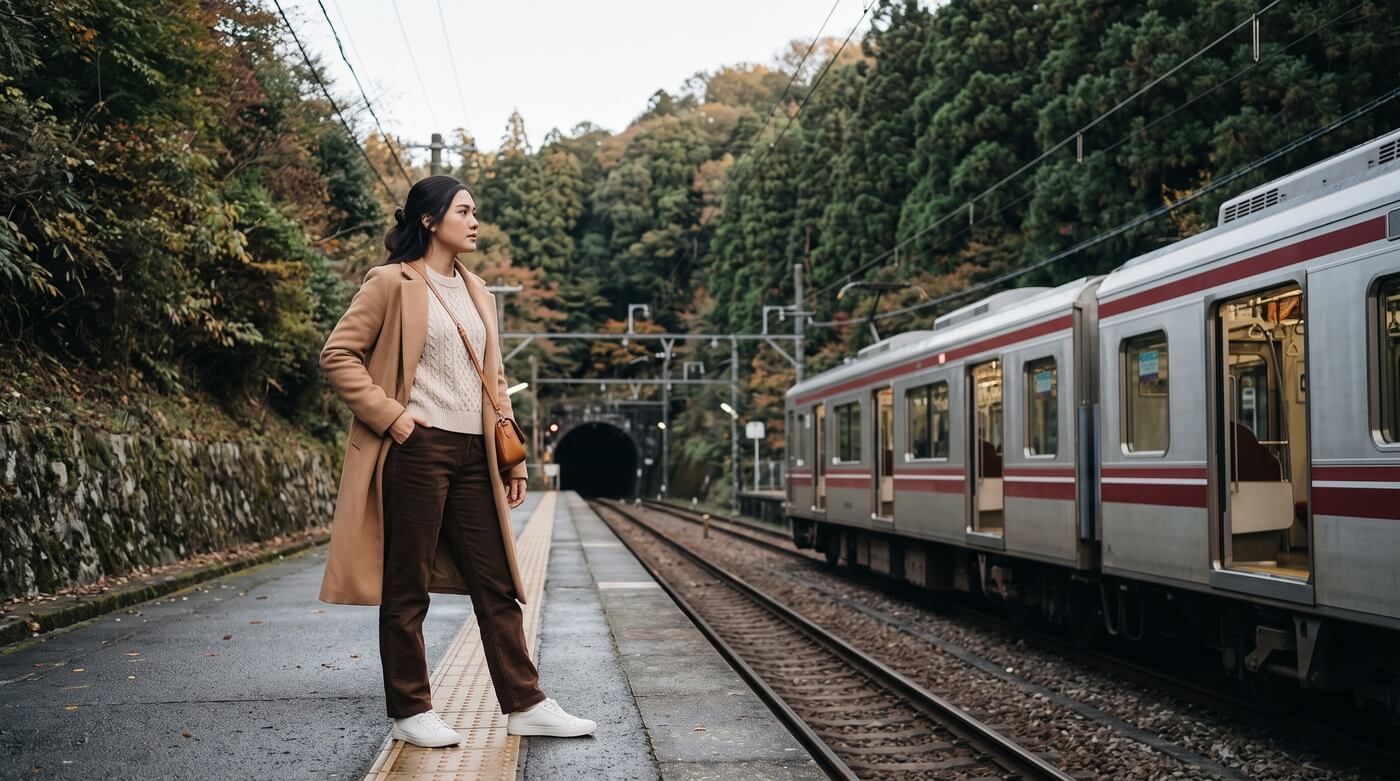
No Japan Rail Pass covers any part of a trip to Arima Onsen, because no JR line reaches the town.
The final stretch belongs to Kobe Electric Railway, the middle belongs to the Kobe Municipal Subway, and both direct buses are private operators.
A JR pass gets you to Sannomiya and stops there.
For a Kansai only trip the national pass is the wrong product anyway; it earns its price when you are crossing the country by shinkansen, not when you are moving between Osaka, Kyoto, Nara, Himeji and Kobe.
The Osaka Amazing Pass is no help either, and it is the one readers most often assume will work.
It costs ¥3,500 for one day and ¥5,000 for two, checked September 2026, and it covers the Osaka Metro, the New Tram, Osaka City Bus and entry to roughly 40 attractions inside Osaka city.
Arima is in Kobe. The pass stops at the city boundary.
The KANSAI RAILWAY PASS LITE, which used to be sold as the Kansai Thru Pass, excludes JR entirely and covers most private railways and subways across the region.
That makes it the more plausible of the two here, but the trip hinges on whether your specific pass covers the Kobe Electric Railway leg, so check the operator list before you buy rather than after.
For a single day out, an ICOCA is enough.
It costs ¥2,000, of which ¥1,500 is travel credit and ¥500 is a refundable deposit, and Suica and PASMO work on the same readers, so a reader arriving from Tokyo does not need a second card.
None of that applies to the bus, which needs its own reserved ticket regardless of what is on your card.
One Day in the Town From 10:10
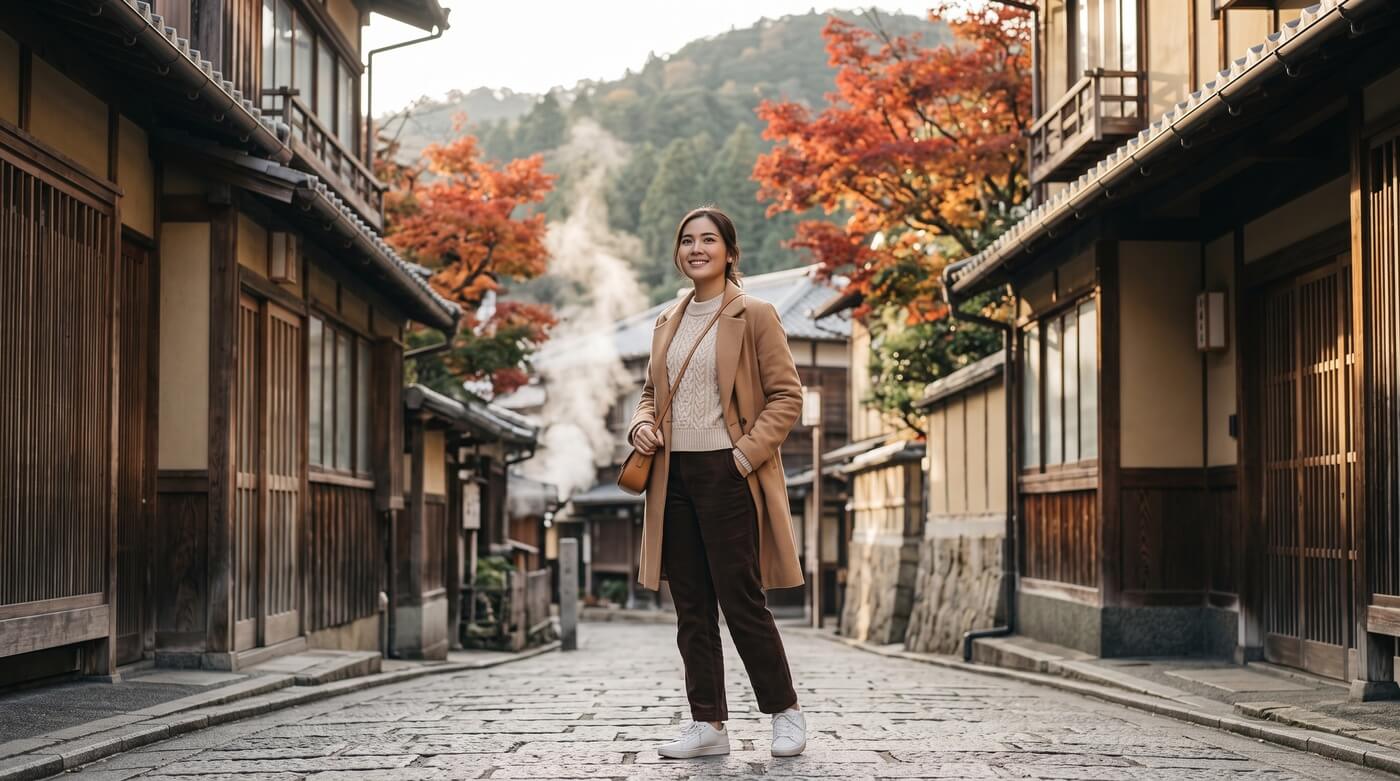
Assume the 09:00 bus and a 10:10 start on the ground.
Walk straight to Kin no Yu and bathe before the day trippers from Kobe arrive, because both bath houses restrict entry when they get full and the gold water is the one people queue for.
Forty five minutes covers undressing, two pools and the recovery you will need afterwards, since the kinsen is salty, heavy and hotter than it looks.
Give yourself until about 11:30, then walk five minutes to Taiko no Yudonokan.
It is a municipal museum built over the excavated steam bath and rock bath of Hideyoshi’s Yuzan palace, found under a temple storehouse after the 1995 earthquake and left sitting in the ground where they were dug out.
Entry is ¥200, open 09:00 to 17:00 with last entry at 16:30, checked September 2026.
Thirty minutes is enough unless you read every panel.
Eat around midday, on the lane rather than in a restaurant, and keep it light, because the second bath is coming.
Then climb to Gin no Yu for about 13:15 and take the clear water and the steam sauna at the quieter end of town.
The carbonated spring is two minutes further up if you want to taste the thing the crackers are named after.
From roughly 14:45 the choice is the hill or another soak.
Zuihoji Park sits about 15 minutes uphill from the centre, entered through the old Zuihoji gate that was moved here from Fushimi Castle, and it earns the climb in November when the maples turn and the Arima tea gathering fills the grounds.
Any other month it is a quiet wooded park at the top of a steep road, and a second bath is the better use of the afternoon.
Be back down by 16:30 at the latest.
Arima Onsen Station is five minutes downhill from the bath houses and it is the reason the bus timetable cannot strand you: trains leave for Arimaguchi as a short shuttle, connect onto the Sanda and Shinkaichi services, and hand you to the Kobe Municipal Subway at Tanigami.
If you are on the bus, the 17:40 is the last one, and the stop is in the middle of town rather than at the station.
Eating Well on Yumoto-zaka
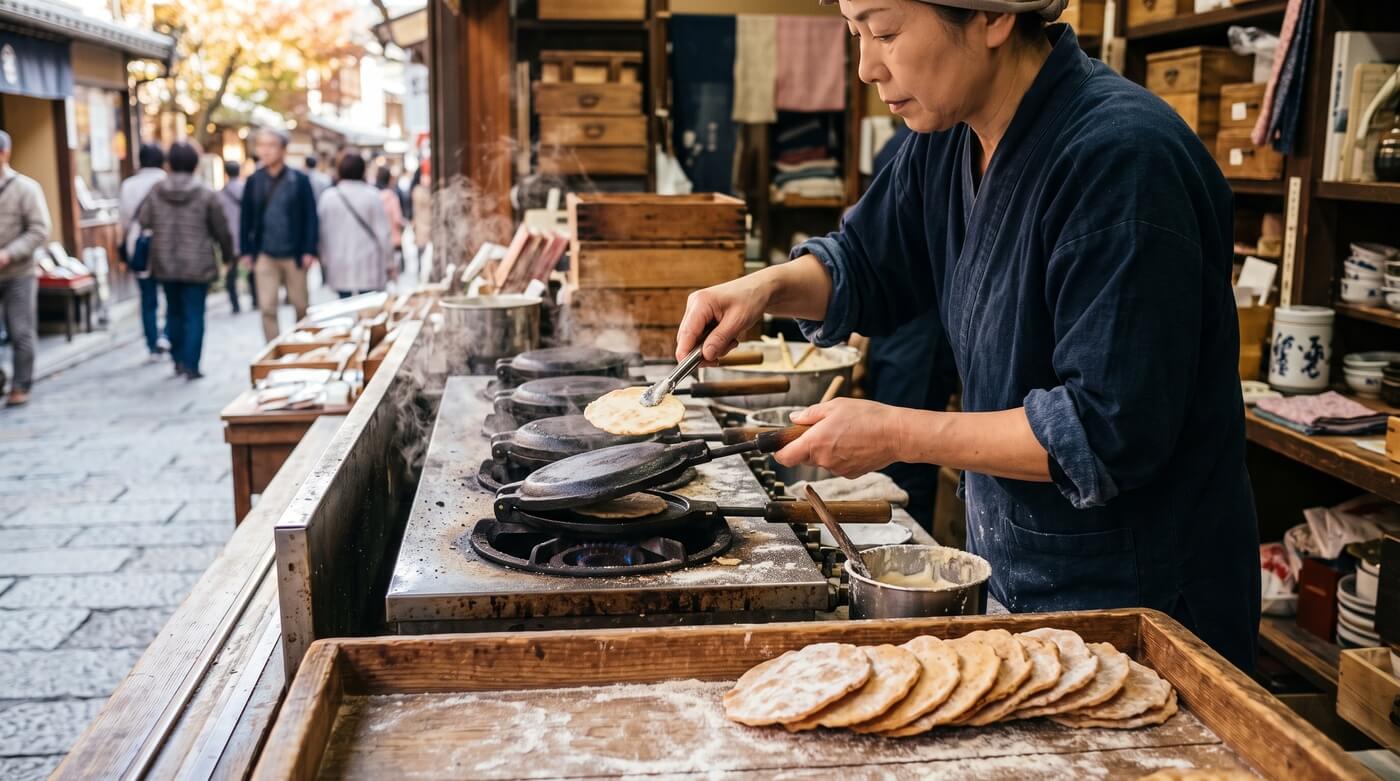
Arima’s food does not beat Osaka’s, and planning a meal around it is the most common way to end the day disappointed.
Osaka gives you takoyaki, kushikatsu and okonomiyaki at a few hundred yen a plate.
Arima gives you a hot croquette on a hill.
The honest plan is to snack here and eat properly back in the city.
Yumoto-zaka, the sloping lane that runs up from the centre, is where all of it happens.
Takenaka Nikuten fries croquettes at a street counter for about ¥150, with a minced beef cutlet around ¥280, listed September 2026.
There is no menu to decipher and no ticket machine: you point, you pay, you eat standing up.
Arrive when it opens and you walk straight in.
Arrive at midday and the queue runs down the lane.
The other thing to eat is tansan senbei, the thin crisp cracker made with water from the carbonated spring, sold along the lane and hand baked at several shops where you can watch the irons work and get handed a hot one.
It is a snack rather than a meal, and it travels well as the only edible souvenir here worth the bag.
One timing detail that costs people their last hour: most of the food shops on Yumoto-zaka run roughly 10:00 to 17:00.
If you were planning to eat before the 17:40 bus, the street will already be closing around you.
Budgeting ¥4,000 to ¥7,000 Per Person
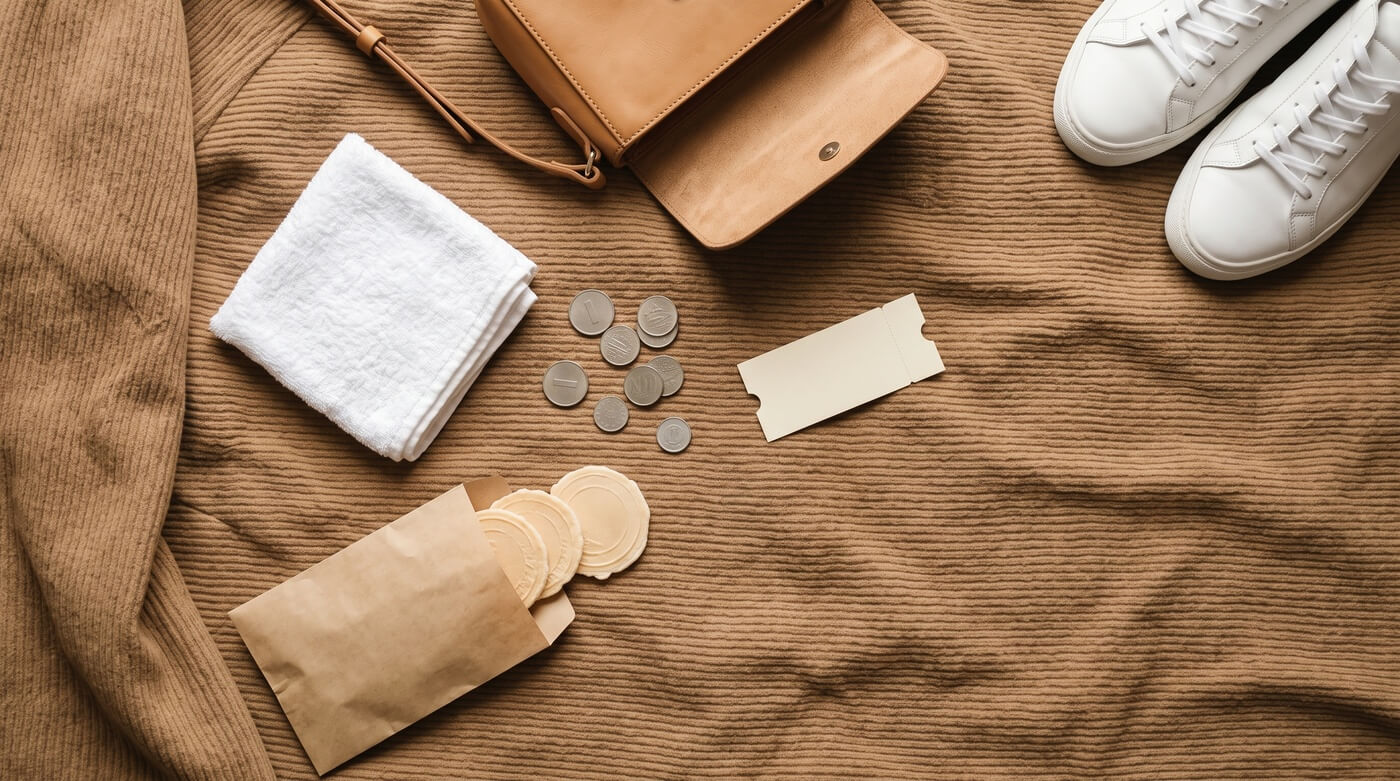
A realistic day in Arima costs ¥4,000 to ¥7,000 per person, and the spread comes almost entirely from how you travel and how many times you bathe.
Transport is ¥2,800 return on the bus or about ¥2,100 return by train from Umeda.
Bathing is ¥650 for one weekday soak, or ¥1,200 for both.
The museum adds ¥200.
Food runs ¥1,200 to ¥2,500 depending on whether you snack or sit down.
The low end, around ¥4,000, is the train, one weekday bath and street food.
The high end, around ¥7,000, is the bus both ways, both baths, the museum, a proper lunch and crackers to take home.
Taiko no Yu changes the arithmetic entirely.
The large private complex at the top of town charges ¥2,750 on weekdays and ¥2,970 at weekends and on public holidays, rising to ¥3,300 on the New Year, Golden Week and mid August peak dates, with a ¥75 bathing tax on top, checked September 2026.
It includes towels and indoor wear, it has 26 baths and private rentals, and it turns a ¥5,000 day into roughly a ¥9,000 one.
Worth it if the municipal baths are not your idea of relaxing.
Wasteful if they are.
For how that compares with a day spent inside the city, the full Osaka cost breakdown puts the same money against food, transport and entries in Namba and Umeda.
November Beats Every Other Month Here
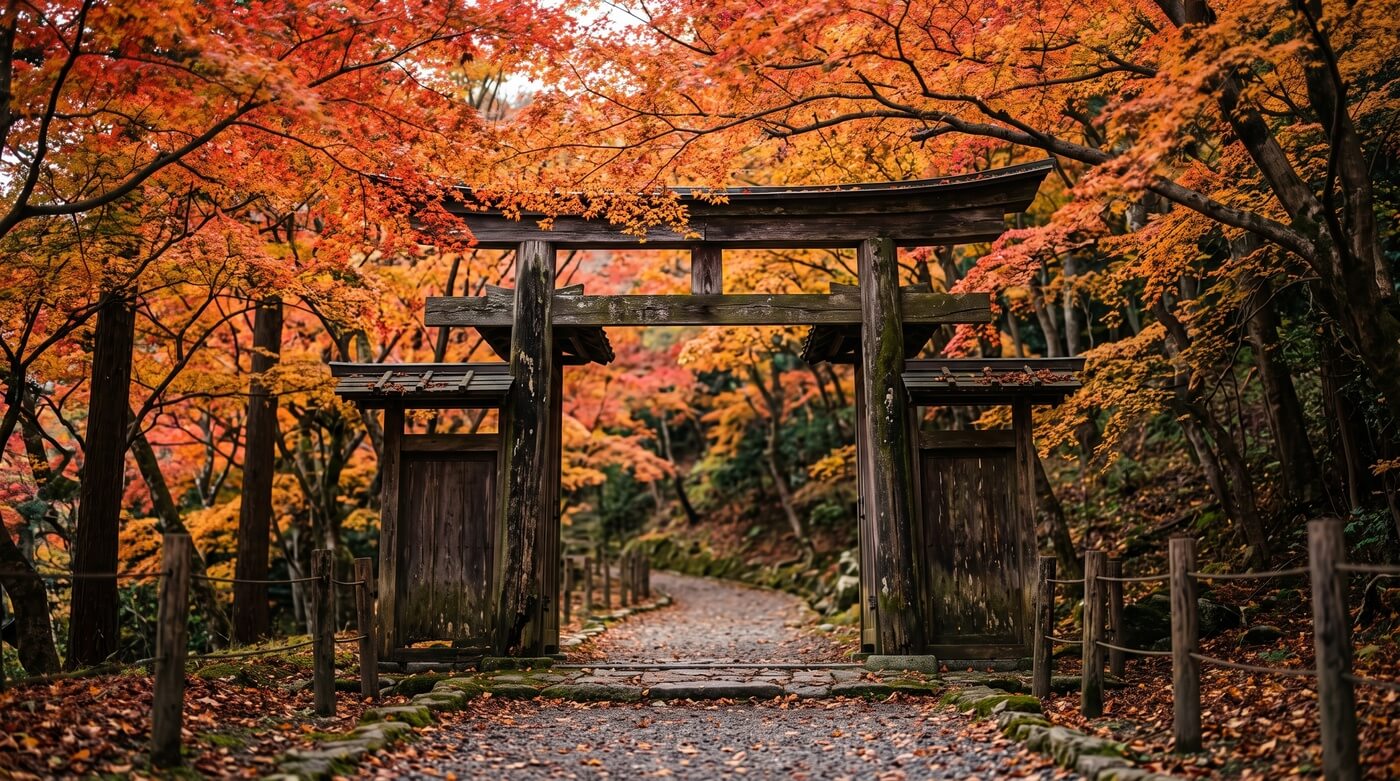
November is the month to come, and the reason is Zuihoji Park rather than the water.
The maples there turn late in the month, the Arima tea gathering runs in the same weeks, and a hot bath after a cold walk is the entire argument for the town.
Winter is the second best season for the same reason: the kinsen is a salt water that holds heat, and it makes more sense in January than in August.
Summer is the weakest case.
The town is built on a slope, the walk between the two bath houses is uphill in both directions depending on where you started, and the appeal of a 44 degree pool drops sharply in humid heat.
If August is your only window, treat Arima as a late afternoon trip rather than a full day, or pick something from the other day trips in range instead.
If you want to arrive over the mountain rather than through the tunnel, the Rokko-Arima Ropeway drops into the top of the town from Rokko Sancho in 12 minutes for ¥1,400 one way or ¥2,520 return, checked September 2026.
It matters mostly for the last departure, which is 17:10 daily through winter, from 1 December to 19 March, and 17:30 on autumn weekdays with 19:10 on autumn holidays.
Asides from Arima Onsen, there are other activities and spots to enjoy Osaka in autumn that we already wrote.
It also shuts for annual maintenance, which in 2026 ran from 1 June to 17 July, so confirm it is running before you build a day around the crossing.
For the wider seasonal picture, the month by month guide to Osaka covers what else is happening when.
Go for the Bath, Skip It for the Sights
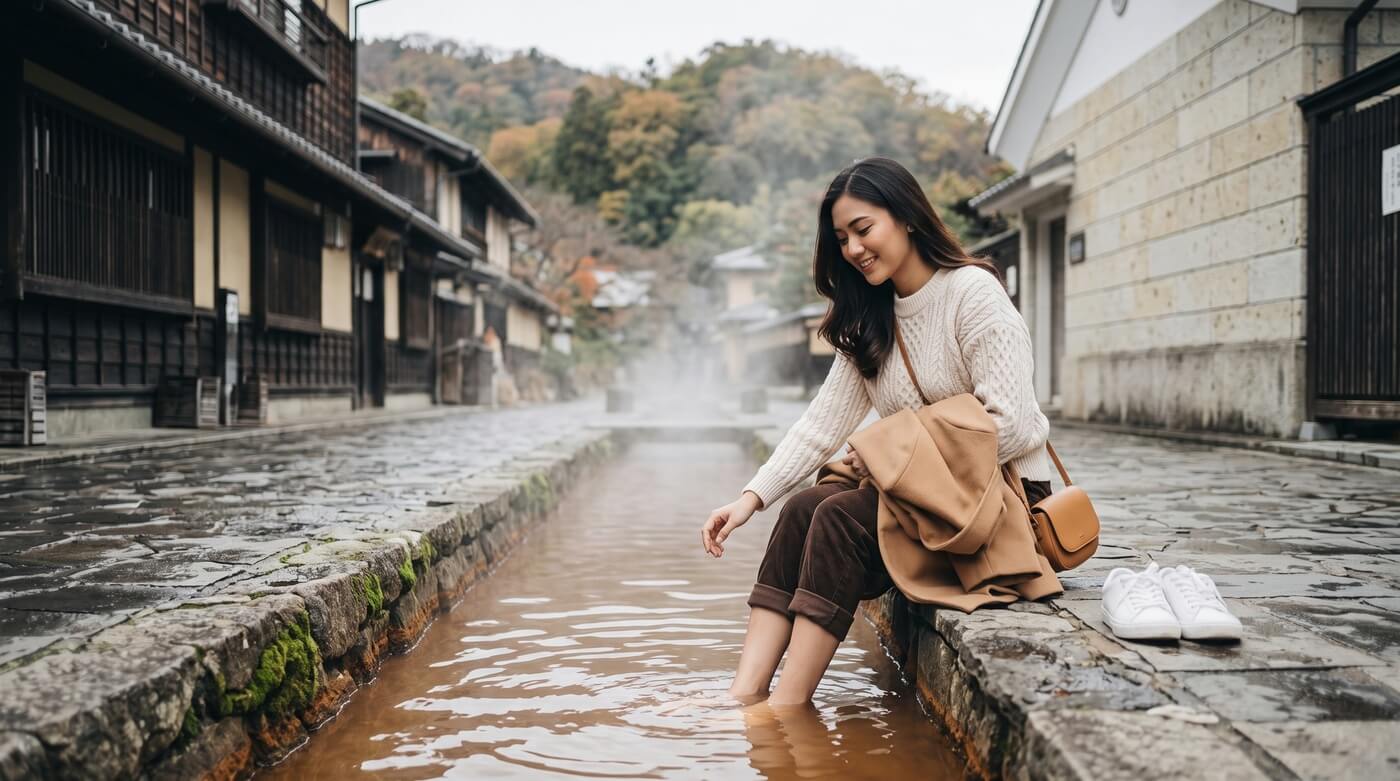
Go if you want to spend a morning and an afternoon in hot water, if you would rather walk one street slowly than cross a city, and if the idea of a public bath house does not put you off.
A day trip to Arima Onsen from Osaka is a bathing trip with a museum and a hill attached, and judged as that it is the best value short day the region offers.
Skip it if you have three days in Osaka and no temple yet, in which case Kyoto or Nara will do more for the trip.
Skip it if you will not bathe publicly and do not want to pay ¥2,750 for a private rental at Taiko no Yu.
Skip it in high summer, when the hill and the heat cancel most of the pleasure.
If you are fitting it into a longer stay, it slots naturally into the third day of a three day Osaka plan, once the city has stopped being confusing and a slow day sounds like a reward rather than a waste.
Book the bus seat the week before, take the 09:00 from Hankyu Sanbangai, and give yourself the 17:40 back rather than the train unless the afternoon runs long.
Handpicked Stays Around Arima Onsen and Kobe
 Hotel
Hotel
 Hotel
Hotel
 Hotel
Hotel
 Hotel
Hotel
 Hotel
Hotel
 Hotel
Hotel
 Hotel
Hotel
 Hotel
Hotel
 Hotel
Hotel
 Hotel
Hotel
 Hotel
Hotel
 Hotel
Hotel
 Hotel
Hotel
 Hotel
Hotel
 Hotel
Hotel
 Hotel
Hotel
 Hotel
Hotel
 Hotel
Hotel
Hotel
Farming Resort San San Villa
Sannomiya, Kobe, Japan
22.4km from Shinkaichi
From
$303.55 /night
Book on Klook
Hotel
Aquaignis Awaji Island TRAILER PARK
Sannomiya, Kobe, Japan
18.2km from Shinkaichi
From
$118.59 /night
Book on Klook
Hotel
Hotel
Hotel
Holiday Inn Kobe Sanda by IHG
Sannomiya, Kobe, Japan
16.5km from Mount Rokkō
From
$58.88 /night
Book on Klook
Hotel
Komachi Hotel Nipponbashi
Sannomiya, Kobe, Japan
28.8km from Sannomiya
From
$35.99 /night
Book on Klook
Hotel
The Lagoon Awajishima
Sannomiya, Kobe, Japan
26.5km from Shinkaichi
From
$292.46 /night
Book on Klook
Hotel
Hotel
HOTEL SETRE KOBE MAIKO
Sannomiya, Kobe, Japan
13.5km from Shinkaichi
From
$252.77 /night
Book on Klook
Hotel
Ever Hotel Harima Kakogawa
Sannomiya, Kobe, Japan
27.8km from Shinkaichi
From
$74.59 /night
Book on Klook
Hotel
Awaji Central Room NC08 <Awajishima>
Sannomiya, Kobe, Japan
24.1km from Shinkaichi
From
$118.09 /night
Book on Klook
Hotel
Grand Chariot Hokutoshichisei 135°
Sannomiya, Kobe, Japan
20.5km from Shinkaichi
From
$348.24 /night
Book on Klook
Hotel
Hotel
Hotel
Hotel
Tabist Hotel Yuan Akashi
Sannomiya, Kobe, Japan
26.7km from Shinkaichi
From
$89.72 /night
Book on Klook
Hotel
APA Hotel Namba Ekihigashi
Sannomiya, Kobe, Japan
25.4km from Mount Rokkō
From
$63.82 /night
Book on Klook
Hotel
Wellis Villa Awaji
Sannomiya, Kobe, Japan
25.1km from Shinkaichi
From
$1,376.39 /night
Book on Klook
Frequently Asked Questions (FAQs)
How long does it take to get to Arima Onsen from Osaka?
About 55 minutes on the Hankyu Kanko Bus from Osaka Umeda, which leaves from the Hankyu Sanbangai terminal on the east side of Osaka Station and runs straight into the middle of the town with no transfers. The fare is ¥1,400 one way, checked September 2026.
By rail it is closer to 70 minutes and two changes: Hankyu Kobe Main Line to Kobe-sannomiya, Kobe Municipal Subway to Tanigami, then the Kobe Electric Railway Arima Line. That route costs about ¥1,050 and needs no reservation, which matters because every seat on the bus is reserved and sold in advance.
Is Arima Onsen worth a day trip from Osaka?
It is worth it if you want to bathe rather than sightsee. Arima is a small hot spring town with two municipal bath houses, a handful of temples and one shopping street, and you can see all of it in five hours, which is exactly what makes it work as a day trip when Kyoto and Nara do not.
If you want temples, castles or a city, pick Kyoto, Himeji or Kobe instead. Arima gives you roughly 90 minutes in hot water and a walk between two of them.
What is the difference between Kin no Yu and Gin no Yu?
Different water, from different sources, in two separate buildings about five minutes apart on foot. Kin no Yu uses the kinsen, heavy in iron and salt, which is clear at the source and oxidises to a rust brown in the bath. Gin no Yu uses the ginsen, a mix of carbonated and radium water that stays colourless, and has a steam sauna.
Kin no Yu opens earlier, at 08:00 against 09:00, and is the busier of the two. The combined ticket for both is ¥1,200, checked September 2026.
Are the Arima Onsen public baths closed on Tuesdays?
Only one at a time, and the schedules are deliberately staggered. Kin no Yu closes on the second and fourth Tuesday of the month, Gin no Yu on the first and third, so any ordinary Tuesday visit loses one bath house and keeps the other. Both close on 1 January, and if the Tuesday is a public holiday the closure moves to the Wednesday.
Taiko no Yudonokan, the small museum, closes on the second Wednesday instead. Check the day before you commit to a combined ticket, and verify on the official site: closures move.
Does the Japan Rail Pass cover Arima Onsen?
No part of the journey is covered. There is no JR line to Arima Onsen at all: the final stretch belongs to Kobe Electric Railway, the middle belongs to the Kobe Municipal Subway, and the direct buses from Umeda and Shin-Kobe are private operators. A JR pass gets you as far as Sannomiya and no further.
The KANSAI RAILWAY PASS LITE excludes JR entirely but does cover private railways and subways across Kansai, so it is the more useful of the two here. The Osaka Amazing Pass covers nothing outside Osaka city and is no help at all for this trip.