

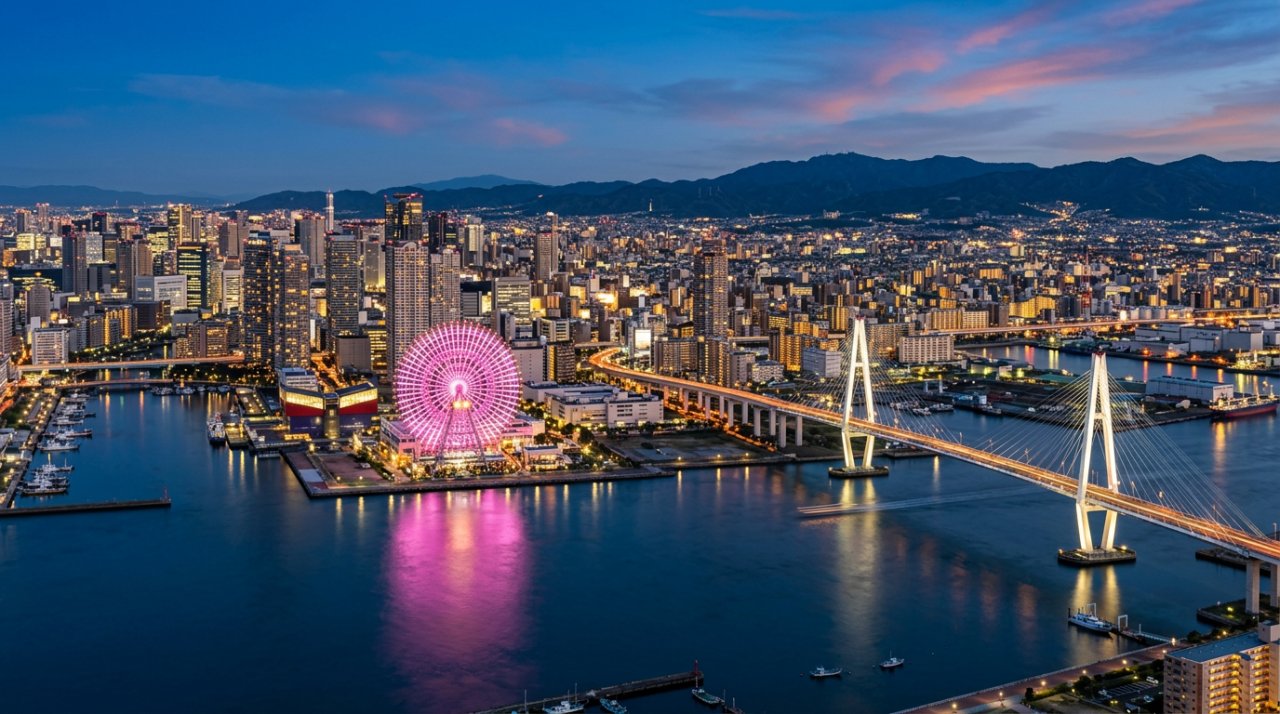
Osaka Bay Area is a waterfront entertainment and commercial district located along the western edge of Osaka, centered around the artificial islands of Sakishima (Cosmosquare) and the Tempozan Harbour Village development in Minato Ward.
The area is home to several of Osaka’s major family-oriented attractions, including Universal Studios Japan (USJ) on the northern shore in Konohana Ward, Osaka Aquarium Kaiyukan at Tempozan, the Tempozan Giant Ferris Wheel, and the Santa Maria harbour cruise.
The district also includes the Intex Osaka convention centre and the ATC (Asia and Pacific Trade Center) complex.
Getting around the Bay Area requires planning, as attractions are spread across a large reclaimed waterfront zone served by the Osaka Metro Chuo Line, the Sakaisuji Line, and water buses running between Tempozan and USJ.
Osaka Bay at a Glance
- Best for: Families, first-time visitors, aquarium lovers, couples looking for a relaxed waterfront half-day or full day
- Nearest stations: Osakako Station (Chuo Line), Cosmosquare Station (Chuo/Nanko Port Town Lines)
- Walkability: High within the Tempozan precinct; moderate between the Bay Area’s outer attractions
- Best time to visit: Weekday mornings year-round; avoid Golden Week (late April to early May) and school holiday weekends
Getting to Know the Osaka Bay Area
The Osaka Bay Area sits roughly 4 kilometers west of Namba, along the reclaimed waterfront of Osaka Port. It’s not a residential neighborhood in the traditional sense — there are no shotengai (covered shopping streets), no centuries-old temples tucked between apartment blocks.
What it is, instead, is a planned leisure district that emerged from the 1990 International Garden and Greenery Exposition, which transformed this stretch of harbor into the attraction hub it remains today.
The centerpiece is Tempozan Harbor Village (天保山ハーバービレッジ), a compact precinct on the waterfront that groups Kaiyukan, the Ferris wheel, the Santa Maria cruise dock, and the Tempozan Marketplace all within a 5-minute walk of each other.
The area has a relaxed, open feel — wide paved esplanades, harbor breezes, and enough space that even on busy weekends it rarely feels claustrophobic.
Kids run ahead between attractions while adults pause at the waterfront railings to look out across Osaka Bay toward the Akashi Kaikyo Bridge on a clear day.
Beyond Tempozan, the broader Bay Area also encompasses Universal Studios Japan (ユニバーサル・スタジオ・ジャパン) to the north and the quieter artificial island of Sakishima (also called Nanko) to the south, home to the Osaka Prefectural Sakishima Building, once proposed as a potential government relocation site.
Most visitors will spend their time at Tempozan, but it’s worth knowing that the Osaka Metro Chuo Line connects all of these points into a single navigable corridor.
Top Things to Do in the Osaka Bay Area
The Bay Area runs on a straightforward logic: Kaiyukan takes the most time, the Ferris wheel takes the least, and everything else slots around those two anchors. Plan your arrival based on when Kaiyukan opens, since queues build quickly after 10:00 AM on weekends.
A well-paced visit to the aquarium, a ride on the Ferris wheel, and a 45-minute harbor cruise can fill an entire day without feeling rushed.
Osaka Aquarium Kaiyukan
Osaka Aquarium Kaiyukan (海遊館) is one of the largest aquariums in the world by water volume, holding approximately 11,000 cubic meters of water across 14 themed tanks.
The building is organized around a central Pacific Ocean tank — 9 meters deep and 34 meters wide — and you descend through it via a spiral walkway, passing through zones representing the Ring of Fire ecosystem: the Aleutian Islands, Monterey Bay, the Ecuador rainforest, the Antarctic, and Japan’s own Seto Inland Sea.
The whale sharks are the headline act, and rightfully so. Kaiyukan is one of only a handful of aquariums outside China that keeps whale sharks in captivity.
They circle the Pacific Ocean tank slowly and visibly from multiple floor levels, which means you’ll encounter them three or four times during a standard visit.
Allow 90 minutes minimum; two hours is more realistic if you want to linger at the touch pools (which feature small sharks and rays) and read the exhibit panels properly.
- Admission: Adults ¥2,700, children (ages 7-15) ¥1,400, small children (ages 4-6) ¥700, under 3 free. A combined “Kaiyukan Night” ticket runs slightly cheaper if you visit after 17:00 on days the aquarium stays open late.
- Hours: Generally 10:00 AM to 8:00 PM, with last entry at 7:00 PM; hours vary seasonally, so confirm at kaiyukan.com before you go.
- Tip: Buy tickets online in advance.
On-site queues at the ticket counter during weekends and school holidays can stretch to 30-40 minutes.
Tempozan Giant Ferris Wheel
The Tempozan Giant Ferris Wheel (天保山大観覧車) opened in 1997 and, at 112.5 meters, was briefly the world’s tallest Ferris wheel. It’s no longer a record-holder, but it remains one of the better viewpoints in western Osaka, with gondola rides that circle the bay at a leisurely pace.
One rotation takes approximately 15 minutes and costs ¥900 for adults and ¥400 for children. Sixteen of the gondolas are fully transparent-floored, so if you want that glass-bottom experience, arrive when crowds are thin to avoid a long wait for a specific gondola.
On a clear day, you can see as far as Akashi and the hills of the Rokko mountain range to the north. The wheel is lit up at night and functions as a giant weather indicator: blue light means clear skies tomorrow, orange means clouds, and red means rain.
Hours: 11:00 AM to 9:00 PM (last ride 8:30 PM); closed periodically for maintenance.
Santa Maria Osaka Bay Cruise
The Santa Maria is a replica of Christopher Columbus’s flagship, operating 45-minute daytime cruises and 60-minute evening cruises around the inner Osaka Bay. It departs from the pier directly adjacent to Kaiyukan, making it a natural add-on after the aquarium.
Daytime cruises depart at 11:00 AM, 1:00 PM, and 3:00 PM (additional departures on weekends and holidays). Fares are ¥1,600 for adults and ¥800 for children during the day; evening cruises run ¥2,100 for adults.
The cruise is pleasant rather than spectacular — you get harbor air, decent views of the Tempozan Bridge, and a relaxed 45 minutes off your feet. It’s best suited to travelers who have already done Kaiyukan and have time to spare rather than those rushing through the area.
Tempozan Marketplace
Tempozan Marketplace is the shopping and dining complex directly attached to the Ferris wheel base. It’s a solid option for lunch or dinner, with a range of restaurants covering ramen, seafood, sushi, and casual Japanese teishoku (set-meal) options.
The marketplace also houses a few souvenir and sundry shops, though the selection is tourism-standard rather than distinctive.
The building connects directly to the Kaiyukan lobby via a covered walkway, which is useful in wet weather. Don’t expect anything resembling local neighborhood character here — it’s designed for tourists and functional as such.
Universal Studios Japan
Universal Studios Japan (ユニバーサル・スタジオ・ジャパン, commonly called USJ) sits about 4 kilometers north of Tempozan along the Bay Area corridor. It’s a full day in itself — the park contains The Wizarding World of Harry Potter, Super Nintendo World, and a rotation of seasonal event zones — and should not be combined with Kaiyukan on the same day unless your energy levels are superhuman.
USJ is accessed via JR Yumesaki Line from Osaka Station (2 stops, about 5 minutes) or by shuttle bus from various city-center points. Day passes start at around ¥9,400 for adults, with express passes sold separately at prices that vary significantly by date and attraction tier.
Where to Eat in the Osaka Bay Area
The Bay Area isn’t Osaka’s food heartland — that title belongs to Dotonbori and Kuromon Market — but the waterfront precinct has enough decent options that you won’t need to leave the area hungry. The key is knowing where to go before you’re already starving at 1:00 PM with a crowd of other tourists.
Tempozan Marketplace Restaurants
The marketplace building holds the densest concentration of sit-down restaurants in the area. Standouts include Kaiyukan no Shokudo, which leans into the aquarium theme with fish-focused teishoku sets at reasonable prices (around ¥900-¥1,500 per meal), and several ramen and tonkatsu counters on the upper floor.
Lunch sets before noon are usually cheaper and the wait times shorter.
Seafood Along the Harbor
A handful of seafood-focused restaurants operate along the waterfront near the Tempozan pier. These tend to be mid-range to slightly pricier than the marketplace options, but the harbor-facing tables are worth the premium if you’re there on a clear afternoon.
Fresh crab and oysters appear on many menus, sourced from the broader Seto Inland Sea region.
Konbini and Grab-and-Go
For budget-conscious visitors or those who’ve simply had enough of sitting down, a 7-Eleven and a Family Mart operate within the Tempozan precinct. Osaka’s best food in Osaka scene is not defined by its konbini, obviously, but grabbing onigiri and canned coffee while sitting on the harbor esplanade has its own low-key appeal.
Pack out your trash — the Bay Area’s open spaces have limited public bins.
Where to Stay in the Osaka Bay Area
Staying in the Bay Area makes the most sense if your Osaka itinerary is heavily weighted toward USJ and Kaiyukan. For most other visitors, where to stay in Osaka is more efficiently answered by basing yourself in Namba or Umeda, where transport links and the city’s food and nightlife scenes are far more accessible.
Hyatt Regency Osaka (Mid-range to upscale, ¥20,000-¥45,000/night): Located on the Osaka Nanko artificial island, about 10 minutes by metro from Kaiyukan. The hotel is large, business-oriented, and well-maintained, with harbor views from higher floors.
It regularly offers weekend leisure packages that bring the rate down meaningfully. The surrounding area on Nanko is quiet — very quiet — so don’t expect to walk out the door and into any street-life buzz.
APA Hotel Osaka Bay Tower (Budget to mid-range, ¥10,000-¥20,000/night): Closer to the core Tempozan area than the Hyatt, the APA chain delivers reliable, compact rooms with consistent standards. Good for USJ-focused travelers who want to maximize mornings without a long commute.
Breakfast sets are available on-site and represent decent value.
Dormy Inn Namba (Mid-range, ¥12,000-¥22,000/night, positioned in Namba): Technically outside the Bay Area, but worth the mention for travelers who want Bay access without Bay isolation. Dormy Inn properties across Japan offer natural hot spring baths (onsen), which is an unusual perk at this price tier.
The Namba location puts you 15 minutes from Kaiyukan by metro and within walking distance of Namba‘s restaurants and bars in the evening.
Getting There and Getting Around
The Osaka Metro Chuo Line is your primary tool in this part of the city. From Honmachi in central Osaka, it’s a direct 10-minute ride to Osakako Station, which deposits you a 5-minute walk from the Kaiyukan entrance.
From Namba, change at Honmachi (or take the Sennichimae Line to Bentencho and transfer) — total journey time around 20-25 minutes. From Umeda, factor in about 30 minutes door to door via the Midosuji and Chuo lines.
Within the Tempozan precinct, everything is walkable. Kaiyukan, the Ferris wheel, the cruise pier, and the Marketplace are all within a 400-meter radius.
Getting to USJ from Tempozan requires backtracking to central Osaka and catching the JR Yumesaki Line — do not attempt this on foot or by taxi if you’re watching the clock.
The Osaka Amazing Pass and the Osaka Kaiyu Ticket are both worth knowing about. The Kaiyu Ticket (¥2,700 adults / ¥1,360 children) bundles unlimited Osaka Metro rides for one day with discounted admission to a list of Bay Area attractions including Kaiyukan (with a discount, not free entry), the Ferris wheel, and the Santa Maria cruise.
Run the numbers against your planned activities before buying — it pays off quickly if you’re hitting three or more attractions in the area.
A water taxi service also connects Tempozan to other bay-side stops, though schedules are irregular and the service is better treated as a scenic detour than a primary transit option.
Practical Tips and Best Time to Visit
The Bay Area works in almost any season, but some times are noticeably better than others. Weekday mornings from September through November and March through early April hit the sweet spot: mild temperatures, lower crowds, and the kind of light on the harbor that makes the whole area look better than it does in August’s heavy humidity.
Summer (July to August) is the busiest and hottest period. Queues at Kaiyukan regularly reach 40-60 minutes at peak times, and the outdoor esplanade becomes genuinely uncomfortable around midday.
If you’re visiting in summer, arrive at Kaiyukan’s 10:00 AM opening time and do the outdoor activities — the Ferris wheel, the cruise — in the late afternoon when the air cools slightly.
Golden Week (late April to early May) is the single most congested period across all Osaka attractions. The Bay Area is not immune.
If your travel dates overlap with Golden Week, buy Kaiyukan tickets online at least several days in advance and get there for opening.
A few practical notes worth flagging:
- The Tempozan Ferris Wheel closes periodically for maintenance without much advance online notice. Check the official site the morning of your visit.
- Kaiyukan has a coin locker area near the entrance — use it. The spiral walkway descent means you’ll be carrying bags for the entire visit, and a backpack gets heavy by the fourth floor.
- The area is stroller and wheelchair accessible throughout. Kaiyukan’s ramp-based layout is genuinely well-suited to prams.
- Cash is widely accepted, but IC cards (Suica, ICOCA, PiTaPa) work at all Metro stations and most vending machines in the area.
For broader trip planning beyond the Bay Area, the Osaka itinerary section of this site covers how to fit Kaiyukan and USJ into a multi-day Osaka trip without doubling back inefficiently.
The Osaka Bay Area doesn’t pretend to be what it isn’t. It’s a purpose-built leisure corridor, thoughtfully organized and genuinely enjoyable, particularly if you’re traveling with kids or want a full day away from the denser energy of the city center.
Kaiyukan alone justifies the trip for most visitors. Everything around it — the Ferris wheel, the harbor, the easy metro connection back to Namba — makes the case for staying longer than you planned.