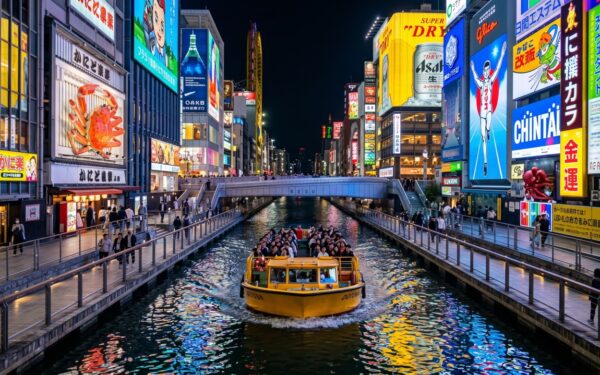
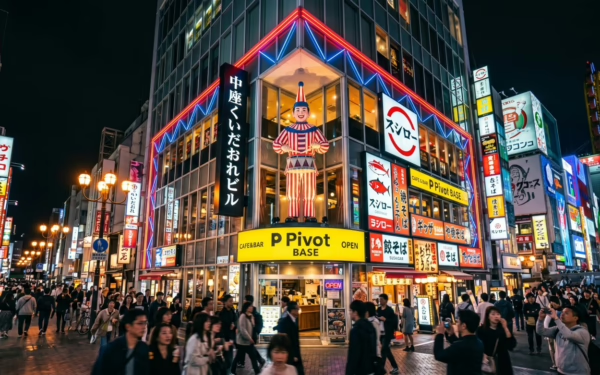


Dotonbori is the beating heart of Osaka’s entertainment district, stretching along the Dotonbori Canal in the Namba area of Chuo Ward.
Famous for the iconic Glico Running Man sign, giant mechanical crab displays, and wall-to-wall street food, it draws millions of visitors every year as Osaka’s most photographed and most visited neighborhood.
The area is equally compelling by day and electric after dark, when its neon reflections light up the canal surface.
Dotonbori sits within easy walking distance of Shinsaibashi shopping arcade and Namba Station, making it the natural base for first-time visitors to Osaka.
Key attractions include the Dotonbori Canal boat cruises, Hozenji Yokocho alley, Namba Yasaka Shrine, and an almost overwhelming density of restaurants ranging from casual takoyaki stalls to sit-down fugu specialists.
Dotonbori (道頓堀) is the loudest, brightest, most food-dense kilometre in Osaka, and this Dotonbori guide will help you make the most of every minute there. The strip sits in Minami (the southern city centre), flanked by Namba to the south and Shinsaibashi to the north, with a canal running straight through it that reflects neon signs back at you in colours that have no business being that saturated. If Osaka has one place that earns every photo you’ve seen of it, this is it — crowds and all.
In this Explore Osaka guide, you’ll find everything laid out practically: the history, the food worth queuing for, where to sleep nearby, how to get there without paying more than you need to, and the timing tricks that locals actually use to sidestep the worst of the crush.
Dotonbori at a Glance
- Best for: First-time visitors, food lovers, night-photography enthusiasts, anyone who wants to understand why Osaka calls itself Japan’s kitchen
- Nearest stations: Namba Station (Osaka Metro Midosuji, Yotsubashi, Sennichimae lines; Kintetsu Osaka Line; Hanshin Namba Line; Nankai Namba), Shinsaibashi Station (Midosuji Line)
- Walking time from Namba Station: 3 to 5 minutes on foot
- Walkability: Excellent — the main strip and surrounding alleys are entirely walkable
- Best time to visit: Weekday mornings before 11:00 AM for empty streets; weekday evenings from 18:00 to 21:00 for the neon atmosphere without the weekend crush
- Worst time to visit: Friday and Saturday evenings, Japanese national holidays, cherry blossom season (late March to mid-April)
Getting to Know the Dotonbori Area in Osaka
Before you can navigate Dotonbori well, it helps to understand what it actually is.
This isn’t a theme park built to look old, and it isn’t a trendy neighbourhood that discovered itself five years ago. It’s a working entertainment district with four centuries of uninterrupted commercial noise behind it.
The canal, the theatres, the food culture, the signage arms race between restaurants — all of it connects back to a single geography that has barely shifted since the 1600s.
A Canal That Started with One Man
The name comes directly from the person who dug it. In 1612, a merchant named Dosaburo Doton (道頓) began excavating the canal that now bears his name. He died during the Osaka Summer Campaign of 1615 before the work was finished, and his cousin completed it. The canal, Dotonborikawa (道頓堀川), opened to commerce in 1615 and quickly became the entertainment spine of Osaka, lined with kabuki theatres, puppet theatres (bunraku), and teahouses.
By the Edo period (1603–1868), the southern bank had five major kabuki theatres operating simultaneously. That theatrical legacy still shows up today: the Osaka Shochikuza Theatre (大阪松竹座) on the main strip has been staging kabuki, musicals, and manzai comedy since 1923 and is one of the few remaining purpose-built theatres in the district.
The Modern Strip
Today, Dotonbori covers roughly 600 metres of canal-side promenade called the Tombori River Walk, with a dense grid of eating streets extending north and south. The main pedestrian road, Dotonbori-dori, runs parallel to the canal on the north bank. The streets get tighter and more residential the further south you push past the canal.
The vibe shifts depending on when you arrive. Daytime Dotonbori is noisy, commercial, and lit with oversized 3D signage: the giant mechanical crab outside Kani Doraku (かに道楽), the fugu (blowfish) lanterns, the oversized bowls of ramen suspended over restaurant entrances. Come back after 19:00 and the neon overwhelms everything else. That’s the version you’ve seen in photos, and it does look like that.
Key Streets Worth Knowing
- Dotonbori-dori: The main drag, north side of the canal. Most of the famous signage and tourist-facing restaurants are here.
- Hozenji Yokocho (法善寺横丁): A narrow stone-paved alley just south of Dotonbori-dori, running beside the moss-covered Fudo Myo-o statue at Hozenji Temple. Quieter, older, and genuinely atmospheric. Restaurants here run ¥1,500 to ¥4,000 per main dish.
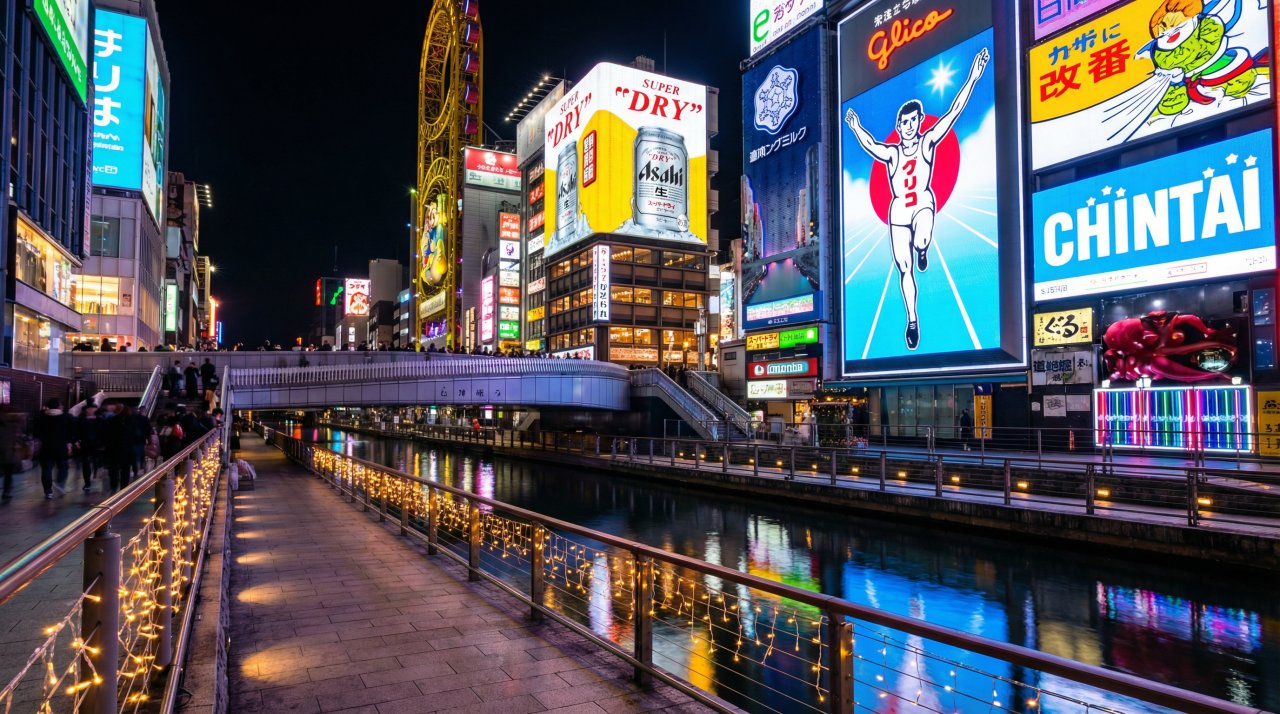
- Ebisubashi (戎橋): The bridge at the centre of the strip, directly in front of the Glico Running Man sign. This is the photo spot, and it is always packed. Go early morning or very late at night if you want the shot without 200 people in it.
- Tombori River Walk: The paved promenade running along both banks of the canal. Calmer than the road above, better for walking slowly, and the canal reflections at night are the real payoff.
Top Things to Do in Dotonbori
Dotonbori is not a museum neighbourhood. There are no admission gates, no timed entries. The whole point is to walk, eat, look at things, and repeat. That said, some stops deserve more of your time than others.
The Glico Running Man Sign
The Glico Man (グリコのネオン) has been in some form on this canal since 1935. The current sixth-generation sign, installed in 2014, stands 20 metres tall on the side of a building at the Ebisubashi intersection. It cycles through six versions representing different parts of Japan. It’s free to look at from the bridge, which is both its appeal and the reason 40,000 people a day end up on that same bridge trying to photograph it.
Worth seeing? Yes. Worth spending 30 minutes waiting for a clear shot? Probably not. Get there before 09:00 on a weekday, or after midnight, and you’ll have the bridge almost to yourself.
Tombori River Walk and Canal Cruise
The Tombori River Walk stretches 1.6 kilometres along the canal banks between Nipponbashi and Shinsaibashi bridges. It’s free to walk at any hour. At night, the neon reflects off the water in a way that justifies every Instagram cliché about Dotonbori.
If you’d prefer to see it from the water, Tombori River Cruise boats run roughly every 20 minutes from around 13:00 to 21:00 (last boat times vary by season). Tickets cost ¥1,000 for adults and ¥500 for children. The ride lasts about 20 minutes and covers a 1.4-kilometre stretch. It’s a decent way to see the signage from a different angle, though the commentary is in Japanese.
Hozenji Temple and Hozenji Yokocho Alley
Hozenji Temple (法善寺) is tiny — the moss-covered stone statue of Fudo Myo-o sits in a courtyard barely 10 metres across — but it’s genuinely moving in the middle of all the commercial noise. Locals and restaurateurs have been splashing the statue with water for centuries, which is why it’s almost entirely covered in vivid green moss. You can visit any time, no admission fee.
Directly adjacent, Hozenji Yokocho is a 150-metre stone alley flanked by low-lit traditional restaurants and sake bars. This is not the tourist version of Dotonbori. The restaurants here tend to be small, old, and excellent — the kind of places that have been making the same three dishes for 40 years.
Osaka Shochikuza Theatre
If you’re in Osaka for more than a day or two and have any interest in traditional performance, the Osaka Shochikuza (大阪松竹座) is worth a look at its schedule. The building itself, a neo-renaissance facade built in 1923, stands out noticeably against the surrounding neon. Ticket prices vary by production, typically ranging from ¥3,000 to ¥16,000. Check the schedule at least two weeks in advance as popular runs sell out.
Kani Doraku’s Giant Mechanical Crab
Yes, it’s a restaurant. But the 2.4-metre moving crab sculpture mounted to the side of the Kani Doraku (かに道楽) main branch has been a landmark since 1960 and qualifies as a sightseeing stop in its own right. If you want to eat here, the full crab course menus start around ¥6,000. For something cheaper, the takeaway window at the entrance sells kani manju (crab meat steamed buns) for ¥700 each — a decent way to engage with the landmark without committing to a sit-down meal.
Nipponbashi and Den Den Town
A 10-minute walk east along the canal brings you to Nipponbashi and Den Den Town (でんでんタウン), Osaka’s answer to Akihabara. Electronics, anime figures, retro game shops, and idol merchandise fill the streets. It’s a distinct contrast from the food theatre of Dotonbori but close enough to add to a half-day loop.
Where to Eat in the Dotonbori Neighborhood
Osaka runs on the philosophy of kuidaore (食い倒れ) — “eat until you drop.” Dotonbori is where that philosophy gets taken literally. The density of food options per square metre here is hard to exaggerate. The challenge isn’t finding something to eat; it’s knowing which queues are worth your time.
For a deeper dive into Osaka’s overall food scene beyond Dotonbori, the Osaka food guide covers everything from market breakfasts to Michelin-listed restaurants across the city.
Takoyaki
Takoyaki (たこ焼き) — octopus-filled batter balls grilled in a cast-iron mould, topped with bonito flakes, aonori seaweed, mayo, and sauce — is the defining food of Osaka. Dotonbori has at least a dozen vendors.
Takoyaki Wanaka (たこ焼きわなか): One of the most consistent spots on the strip. Their ponzu version, topped with a citrus soy dressing instead of the standard sweet sauce, is worth ordering alongside the classic. Expect a 5 to 15-minute queue on weekdays, longer on weekends. A standard order of 6 balls runs around ¥620.
Creo-Ru: Slightly more creative takes, including an onsen egg variant. Tends to have shorter queues than Wanaka.
Kushikatsu
Kushikatsu (串カツ) — breaded and deep-fried skewers of meat, seafood, and vegetables — originated in Osaka’s working-class Shinsekai district but is now synonymous with Dotonbori. The rule is absolute: no double-dipping in the communal sauce. This isn’t a quirky local custom; it’s enforced.
Kushikatsu Daruma (串カツだるま) on Dotonbori is Osaka’s most famous kushikatsu chain, operating since 1929. Individual skewers run ¥120 to ¥300 depending on the ingredient. Queues here can hit 30 to 45 minutes on weekend evenings. Arrive before 17:30 to walk straight in on most weekdays.
Okonomiyaki and Takosuki
Okonomiyaki (お好み焼き), the thick savoury pancake loaded with cabbage, pork, seafood, and egg, is another Osaka staple. Chibo (千房) on Dotonbori-dori is one of the most established names, with a counter where you watch the cooks work. Prices start at around ¥1,200 for a basic pork and cabbage version.
For something less expected, look for takosuki — a hotpot with octopus cooked at the table — in the smaller restaurants south of the canal.
Ramen, Sushi, and the Rest
The Dotonbori area is also thick with ramen shops, conveyor-belt (kaiten) sushi restaurants, and yakiniku (grilled meat) spots competing aggressively for the same customers. Daiki Suisan Kaiten Sushi on Dotonbori-dori offers fresh market-sourced sushi from around ¥165 per plate and is a reasonable choice if you want sushi without a reservation.
For street-side snacks while walking: nikuman (pork buns) from any of the convenience-style stalls, matcha soft-serve from shops along the river walk, and the aforementioned ¥700 crab bun from Kani Doraku all make good walking food.
Eating Smart in Dotonbori
One honest note: a handful of the most prominent restaurants on the main strip are expensive relative to quality. The giant signs and queue management are doing a lot of the work. The smaller restaurants on Hozenji Yokocho, or the side streets running south toward Kuromon Market, will generally serve you better food for the same or lower price.
Where to Stay in the Dotonbori Area
Staying directly in or adjacent to Dotonbori puts you within walking distance of Namba’s transport hub, making day trips across Osaka straightforward. The trade-off is noise — this part of the city doesn’t fully quiet down until past midnight on most nights. If you need eight hours of silence, factor that in. For broader accommodation options across the city, the where to stay in Osaka guide maps every neighbourhood by travel style and budget.
Dotonbori Hotel (Mid-range, ¥8,000–¥15,000/night): Directly on the canal, this is about as close to the strip as you can sleep. Rooms are compact but well-maintained. The location is the product — you’re three minutes from Ebisubashi on foot. Book well in advance for weekend stays.
Cross Hotel Osaka (Mid-range, ¥10,000–¥18,000/night): A five-minute walk north toward Shinsaibashi. Slightly quieter, good room sizing, and sits near the Midosuji Line for easy access to Umeda or Tennoji. Popular with repeat visitors who want Dotonbori access without sleeping inside the noise.
Dormy Inn Premium Namba (Budget-mid, ¥7,000–¥13,000/night): Part of the reliable Dormy Inn chain, which means a rooftop onsen bath, free late-night ramen service, and no surprises. Located a few blocks south of the canal. Good value for solo travellers or couples.
Getting There and Getting Around
Dotonbori’s central position in Osaka is one of its genuine advantages. It sits almost exactly between the city’s two main transport hubs, Namba to the south and Shinsaibashi to the north, and multiple subway lines converge within a five-minute walk of the canal. Getting here from anywhere in Osaka takes under 15 minutes. Getting here from the airport is simpler than most visitors expect.
By Subway
Namba Station is the primary access point. From Osaka’s other major hub at Umeda, take the Midosuji Line (red line) south to Namba, a journey of about 7 minutes costing ¥240. From Tennoji, the same Midosuji Line runs north to Namba in approximately 6 minutes. Use an IC card (ICOCA or Suica) to tap in and out — it’s faster than buying individual tickets.
From Kansai International Airport (KIX), the Nankai Rapi:t express train runs directly to Nankai Namba Station in about 38 minutes for ¥1,790 (reserved seat). The standard Nankai Limited Express takes 45 minutes for ¥1,460.
Shinsaibashi Station (one stop north on the Midosuji Line) is an equally valid arrival point if you’re coming from the north; the walk from Shinsaibashi to Ebisubashi takes about 8 minutes through the covered Shinsaibashi-suji shopping arcade.
On Foot
Once you’re in Dotonbori, you won’t need transport. The core area is compact: the canal strip, Hozenji Yokocho, and the surrounding eating streets can all be covered on foot within 20 to 30 minutes at a casual pace. The Tombori River Walk promenade is entirely flat and accessible.
Avoiding Common Navigation Mistakes
Dotonbori has exits from multiple subway lines and the street layout can disorient first-timers. The simplest approach: exit Namba Station via the South Exit of the Midosuji Line, walk north on Midosuji-dori for two blocks, then turn left (west) at the sign for Ebisubashi. If you reach a canal with neon signs reflected in it, you’re there.
Practical Tips and Best Time to Visit Dotonbory, Osaka
Dotonbori rewards people who show up with a little preparation and punishes those who don’t. The strip itself never closes, prices are mostly fixed, and nothing requires a booking except sit-down restaurants on busy nights. What does require thought is timing. The difference between a pleasant evening and a slow shuffle through a human traffic jam is often just a two-hour window.
Dotonbori Guide to Timing the Crowds
The crowds in Dotonbori are real and they get dense enough on peak evenings to make forward movement genuinely slow. Here’s how to approach it:
- Early morning (07:00–09:00): Streets are almost empty, shops are closed, a few food stalls start setting up. Best window for unobstructed photos and a quiet walk. Not useful if you want to eat anything.
- Mid-morning (10:30–11:30): Shops begin opening. Manageable crowd levels. Decent window for first-timers who want to see the strip with context but not shoulder-to-shoulder density.
- Midday to 14:30: Lunch rush. Queues form at popular spots. Still navigable.
- 14:30–17:30: The best daytime window for eating without a long wait. Queues shorten noticeably. Restaurants are open, the strip is active but not at capacity.
- 17:30 onwards: Crowds build for dinner. Friday and Saturday evenings in peak season (cherry blossom in late March to mid-April, Golden Week in late April to early May, and the Tenjin Matsuri festival in late July) are the most congested periods. Weekday evenings from 18:00 to 21:00 are the practical sweet spot: the neon is on, the atmosphere is at its best, but it’s not yet the weekend crush.
- After 23:00: Thins out considerably. Late-night ramen and some izakaya remain open until 02:00 or later.
Practical Logistics
- Cash vs card: Most street food stalls are cash only. Bring at least ¥3,000 to ¥5,000 in yen for a solid walk-and-eat session. Sit-down restaurants increasingly accept cards, but don’t assume.
- IC card: Essential for getting around Osaka efficiently. Pick up an ICOCA card at any JR station vending machine or Kansai Airport upon arrival.
- Shoes: You will walk more than you expect. Skip the fashion footwear.
- Bags: Keep valuables in front-facing bags or zipped inner pockets. Pickpocketing is rare in Osaka but the crowd density in Dotonbori is higher than almost anywhere else in the city.
- Rubbish bins: Largely nonexistent in Japan’s public spaces, including Dotonbori. If you buy food to walk with, carry a small plastic bag for wrappers. Most food vendors will have a small bin at the point of sale.
Combining Dotonbori with Other Areas
Dotonbori sits in the middle of Osaka’s most walkable zone.
Shinsaibashi is a 10-minute walk north through a covered shopping arcade. Kuromon Market, Osaka’s famous food market, is a 12-minute walk east.
Shinsekai, with its retro post-war atmosphere and the original kushikatsu neighbourhood, is about 20 minutes south on foot or one subway stop from Namba to Ebisuchō.
If you’re building out a full day or multi-day itinerary, the Osaka itinerary section maps logical routes that connect Dotonbori with the rest of the city without doubling back.
Dotonbori is not subtle, and it wasn’t designed to be. It’s a place that has been performing for visitors since the 1600s and has simply swapped the kabuki audience for one with smartphones. That’s not a criticism.
Go in with a clear idea of what you want to eat, a loose plan for where to walk, and a preference for arriving either early or late.
The rest sorts itself out. If you’re still mapping out the wider city, the things to do in Osaka archive has everything beyond this one canal.