Nakaza Kuidaore Building
Dotonbori's seven-floor food entertainment complex and home of the iconic Kuidaore Taro.
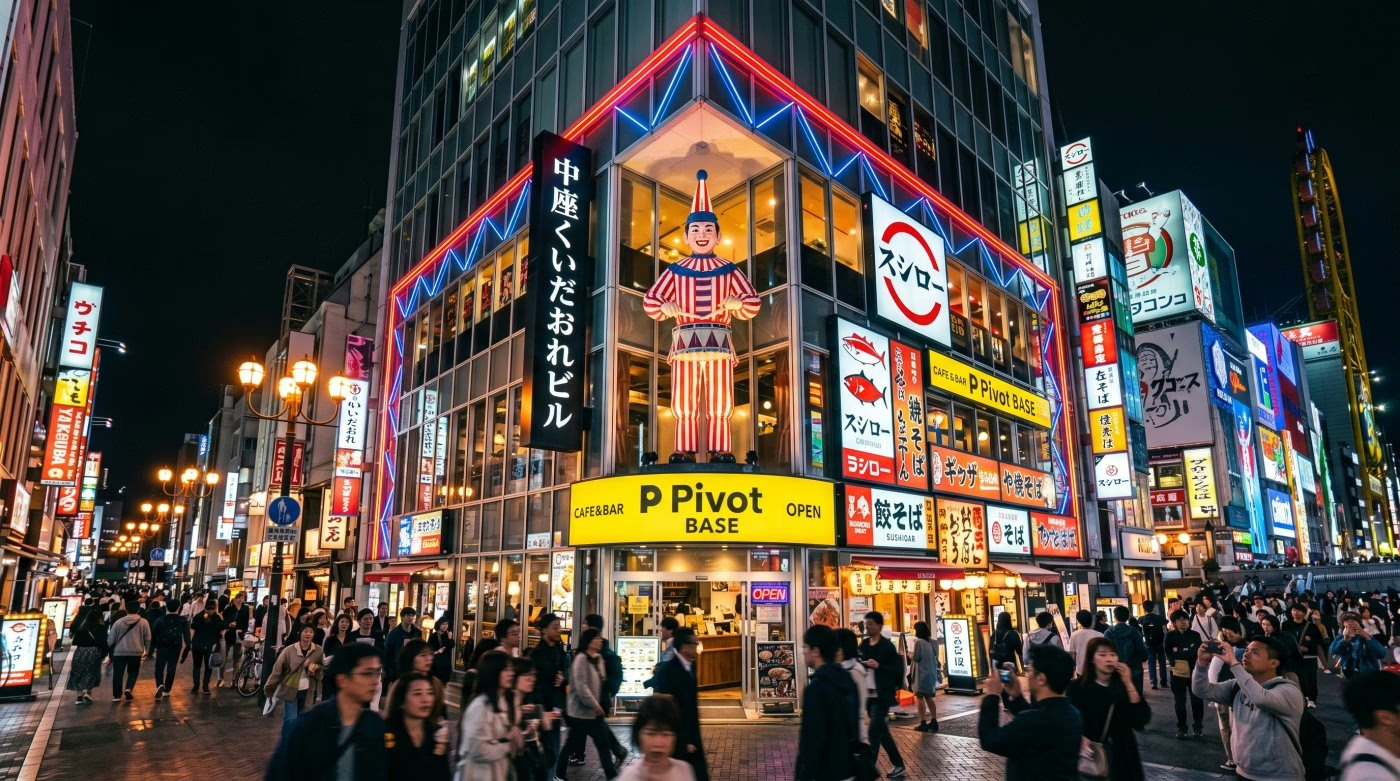





The Nakaza Kuidaore Building (中座くいだおれビル) is one of Dotonbori’s most recognisable landmarks, standing at 1-7-21 Dotonbori in Osaka’s Chuo Ward.
Its name is a nod to the old Osaka proverb kuidaore — eating yourself into ruin — and the building leans hard into that identity, stacking restaurants, souvenir shops, live entertainment, and a karaoke bar across seven floors.
It reopened in March 2025 after a full renovation that transformed it into a dedicated “Food Entertainment Building.”
At street level, you’re greeted immediately by Kuidaore Taro, the drum-playing mechanical clown who has been a Dotonbori fixture for decades and now stands in front of a boldly redesigned 6-metre 3D facade.
The first three floors each carry a distinct concept: the 1st floor celebrates Kuidaore Taro World with an Osaka souvenir store and casual dining; the 2nd floor houses popular chains like Sushiro and Gyukatsu Kyoto KatsuGyu; and the 3rd floor recreates the atmosphere of an old playhouse tea shop, with kushikatsu, okonomiyaki, and monjayaki restaurants beneath neon lanterns.
The 4th floor is dedicated to Karaoke Manekineko, while B1 hosts live comedy by young Osaka performers at the Dotonbori ZAZA venue.
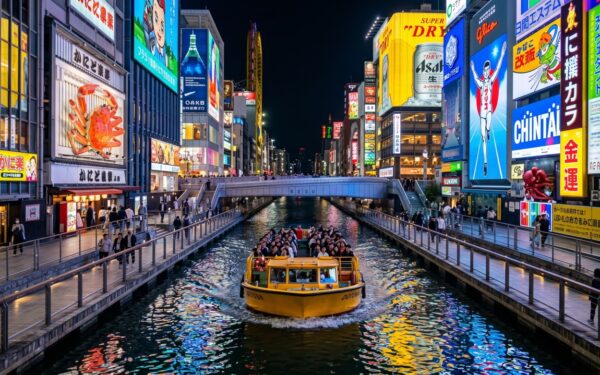
The building sits directly on the Dotonbori canal strip, which means the evening neon reflections off the water and the constant hum of the street are very much part of the experience.
Entry to the building itself is free, so you can wander the floors without committing to a meal.
If you’re coming for dinner, weekday evenings are noticeably calmer than the weekend crush — and the 3rd floor’s retro lantern atmosphere is worth seeking out specifically.
The Nakaza Kuidaore Building is one of Dotonbori’s most recognisable addresses, and it earned that status long before the major renovation that reopened it in March 2025.
Standing at 1-7-21 Dotonbori in Chuo Ward, the building stacks restaurants, a karaoke bar, live comedy, a rooftop terrace, and one of Osaka’s best souvenir shops across seven floors, all anchored by the iconic Kuidaore Taro figure at street level.
In this Explore Osaka guide, you’ll get a floor-by-floor breakdown of what’s inside, honest advice on what’s worth your time, and everything you need to plan your visit.
The name itself is a cultural cue worth understanding. Kuidaore (くいだおれ) is an old Osaka expression meaning to spend yourself into ruin through eating, a concept the city has always worn as a badge of pride.
The building’s history runs even deeper: this site hosted the Nakaza playhouse from 1661 to 1999, one of the great stages of Kamigata performing arts.
What stands here now carries that theatrical spirit forward, just with a lot more tonkatsu involved.
Nakaza Kuidaore Building at a Glance
Hide- Address: 1-7-21 Dotonbori, Chuo Ward, Osaka 542-0071
- Entry price: Free (individual restaurants and shows charge separately)
- Price range: Free entry; dining from approx. ¥800 per person
- Opening hours: Varies by tenant; building accessible during business hours daily
- Nearest station: Namba Station (Osaka Metro Midosuji, Yotsubashi, Sennichimae Lines), 5-minute walk
- Time needed: 1 to 3 hours depending on dining and shows
- Best season: Year-round
- Official website: nakaza-cuidaore.com/en/
Why Visit Nakaza Kuidaore Building
Dotonbori is the kind of street that can feel overwhelming fast: giant mechanical crabs, neon everything, and roughly a thousand places competing for your attention within a two-block stretch.
The Nakaza Kuidaore Building cuts through that noise by putting a coherent lineup of good food and genuine entertainment under one roof.
The honest case for visiting is simple.
You get free entry, a choice of well-regarded restaurants without having to wander the street comparing menus in the rain, live comedy happening right below your feet, and a mechanical drumming clown who has been making people stop and take photos since 1950.
That last detail matters more than it sounds: Kuidaore Taro is genuinely part of Osaka’s cultural identity, not just a prop.
The Kuidaore Taro Story
Kuidaore Taro first appeared in Dotonbori in 1950 as the mascot of a restaurant called Osaka Meibutsu Kuidaore.
He stood outside in his red and white striped outfit, round glasses, and blue hat, beating his drum to draw in diners for nearly six decades.
When that restaurant closed in 2008, the city of Osaka treated the news like a minor public crisis, with thousands turning out to say goodbye.
The mascot was eventually rehomed at the Nakaza building, and the 2025 renovation went one step further: a 6-metre three-dimensional Taro figure now juts out from the building’s facade, visible from well down the street. He is, objectively, a mechanical clown.
But he’s also one of the few things in Dotonbori that actually belongs here historically, and that makes him worth more than a quick snap.
What to See and Do at Nakaza Kuidaore Building
The post-renovation building operates on a clear concept: each floor has its own identity, so you’re not wandering through a generic food court.
Here’s how the floors break down.
Ground Floor: Kuidaore Taro World
The 1st floor sets the tone immediately.
Naniwa Specialty Ichibirian, the Osaka souvenir shop, takes up a significant portion of the ground level and sells the full range of Kuidaore Taro merchandise, from the famous Taro pudding to figurines, stationery, and snacks you won’t find anywhere else.
The Glico-ya store, operated by the candy maker behind Pocky and the famous Glico sign just down the canal, also occupies part of this floor.
It’s a solid first stop for edible souvenirs before you commit to a meal upstairs.
Second Floor: Crowd-Pleasing Restaurant Chains
Floor 2 houses two restaurants that are popular for good reason.
Sushiro, one of Japan’s most respected kaiten-zushi (conveyor belt sushi) chains, keeps quality high while keeping prices low, with plates typically starting around ¥110.
Gyukatsu Kyoto KatsuGyu brings its signature beef cutlet menu to Dotonbori: the thin-sliced wagyu is served medium-rare and finished tableside on a small hot stone, which is a noticeably different experience from the standard breaded pork cutlet you find elsewhere.
Queues at both form early on weekends, so aim for a 17:00 sitting if you want to avoid a 30-minute wait.
Third Floor: Old Osaka Atmosphere
This floor is the most atmospheric in the building and the one worth prioritising if you can only pick one level.
The design recreates the feel of a pre-war Osaka playhouse tea shop, complete with hanging lanterns, retro signage, and the kind of warm, low-lit interior that makes you want to sit for a second round.
Restaurants here cover kushikatsu (deep-fried skewers served with dipping sauce), okonomiyaki (Osaka’s savoury cabbage pancake), and monjayaki (the runnier Tokyo cousin of okonomiyaki).
Bonkuraya Plus, the teppan-yaki and okonomiyaki restaurant on this floor, has a strong reputation and fills up on weekend evenings.
Basement Floor: Dotonbori ZAZA Comedy Club
The basement is where things get genuinely interesting. Dotonbori ZAZA is a live comedy venue with two spaces: HOUSE (150 seats) and POCKET’S (80 seats).
The POCKET’S stage runs manzai (double-act stand-up comedy) five times daily at 11:30, 12:30, 13:30, 14:30, and 15:30, with each show running about 30 minutes and tickets priced at ¥800.
The performers are young comedians building their careers, which means the energy is raw and enthusiastic rather than polished and predictable.
Yoshimoto English Comedy Night
The 6th floor hosts Yoshimoto Dotonbori Theater, where English-language comedy shows run approximately four times a month on weekend evenings, typically 19:00 to 20:00 or 20:00 to 21:00.
The exact schedule shifts monthly, so check yoshimoto-comedy-night.com before you visit.
For first-time visitors to Japan who want a window into Osaka’s comedy culture without needing Japanese, this is one of the more accessible options in the city.
Upper Floors: Rooftop Terrace and Entertainment
The 5th floor houses GIRAFFE Japan, a venue that combines a cafe and bar with XR (extended reality) games and a performance area running Japanese traditional culture content.
The format shifts between daytime cultural programming and evening entertainment, making it worth checking the schedule in advance.
There is also a rooftop terrace on the 5th floor, open 11:00 to 18:00, with seating for large groups and a view over the Dotonbori streetscape.
The 4th floor is Karaoke Manekineko, a well-regarded chain where rooms rent by the hour and the song catalogue covers English and Japanese tracks in depth.
Getting to Nakaza Kuidaore Building
Getting here requires almost no effort from anywhere in central Osaka, which is either a feature or the reason it gets so crowded, depending on your perspective.
The closest stations are all variations of Namba.
From Namba Station on the Osaka Metro Midosuji, Yotsubashi, or Sennichimae Lines, the walk takes about 5 minutes using Exit 14, heading south toward the canal.
From Osaka-Namba Station on the Kintetsu lines, allow 6 minutes.
From Namba Station on the Nankai Railway, it’s a 7-minute walk.
The building sits on the south side of Dotonbori canal, on Sennichimae Street, with Kuidaore Taro’s oversized facade making it impossible to miss.
Getting There from Osaka’s Main Hubs
From Namba, you’re already there in under 10 minutes on foot.
From Umeda, take the Midosuji Line south to Namba (4 minutes) and walk from there.
From Shin-Osaka, it’s the Midosuji Line all the way south to Namba, about 16 minutes total.
There is no parking at the building, and the Dotonbori area is not somewhere you want to navigate by car in the evening.
Practical Tips
A few things that will make your visit smoother, because the building gets genuinely busy and some of that is avoidable.
- Timing matters more on weekends. Weekday evenings between 17:00 and 19:00 are the sweet spot: restaurants are filling up but not yet at capacity, Kuidaore Taro is lit against the darkening sky, and the comedy club is running its afternoon shows. Weekend evenings from 18:00 onward can mean 30-minute queues for the popular restaurants on floors 2 and 3.
- Book the English comedy show in advance. The Yoshimoto English Night shows sell out. Check the schedule at the beginning of the month and book online before you arrive in Osaka, not when you’re standing outside the building.
- The ¥800 ZAZA comedy show is one of the best value experiences in Dotonbori. Thirty minutes, a small basement venue, young comedians giving it everything: it’s the kind of spontaneous Osaka moment that costs less than a coffee elsewhere.
- Payment is mostly cashless but not universally so. The souvenir shop and larger restaurant chains accept IC cards and credit cards. Some smaller counters operate cash only, so carry a few thousand yen as backup.
- The rooftop terrace closes at 18:00, which means you need to plan that visit for the afternoon rather than layering it into an evening out. If you want the terrace view and a dinner, do the terrace first, then head downstairs.
If you’re working out how to fit this into a broader day, the best things to do in Osaka guide covers the full picture across the city’s neighbourhoods and helps you sequence stops that make geographic sense.
Nearby Attractions
The Nakaza Kuidaore Building sits in one of the densest concentration of sights in all of Osaka.
Within a five-minute walk you have enough to fill a full day.
- Dotonbori Glico Sign is the billboard that has anchored Dotonbori photographs since 1935. It stands about 300 metres east along the canal at 1-10-4 Dotonbori, it lights up daily from 18:00 to midnight, and it’s free to view from the Ebisu Bridge. The current sixth-generation sign measures 20 metres tall and 10.4 metres wide.
- Hozenji Temple is a quiet contrast to the canal strip, sitting two minutes south of the building on a stone-paved lane off Dotonbori. The small temple is famous for its moss-covered Fudo Myo-o statue, which visitors ladle water over when making wishes. It’s open around the clock and entry is free.
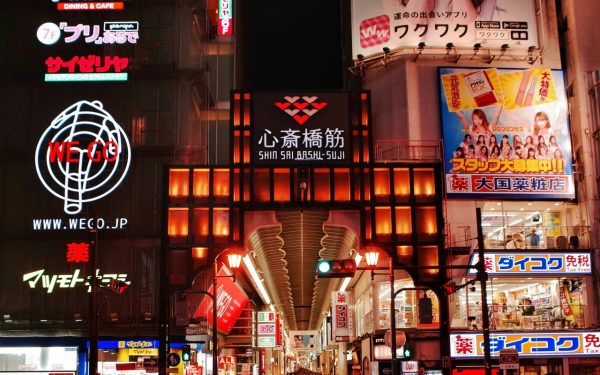
- Shinsaibashi Shopping Arcade runs north from the Dotonbori area and stretches about 580 metres through covered shopping streets filled with everything from fast fashion to department stores. Shinsaibashi is a 10-minute walk from the building or one stop north on the Midosuji Line.
- Kuromon Ichiba Market sits about 10 minutes east on foot at Nihonbashi. Kuromon is Osaka’s covered market, open most mornings from around 08:00, with stalls selling fresh seafood, tamagoyaki (rolled omelette), and grilled skewers. The lunch hour crowd is lively and the produce is genuinely excellent.
The Nakaza Kuidaore Building works best when you treat it as a full evening rather than a quick stop.
Arrive by 17:00, catch the last ZAZA comedy show at 15:30 if timing allows, eat on the 3rd floor while the lanterns come on, then step outside to see Kuidaore Taro lit up against the neon-soaked street.
If you want to build a full day around this part of the city, the Osaka itineraries section has structured day plans that pair Dotonbori with the surrounding neighbourhoods and make the most of your time.
What's Available
Frequently Asked Questions
Entry to the Nakaza Kuidaore Building is completely free. You can walk through all the floors, browse the souvenir shop on the 1st floor, and take photos with Kuidaore Taro at no cost. You only pay when you sit down to eat, order drinks, or book a karaoke session on the 4th floor.
No. The current structure dates from 1931 and is a ferroconcrete reconstruction, not the original Toyotomi-era castle.
The original was destroyed during Japan’s feudal conflicts.
The reconstruction is historically detailed and houses a genuine museum, but it is not a surviving historic structure in the way that, for example, Himeji Castle is.
If original castle architecture matters to you, the day trip to Himeji from Osaka is worth adding to your itinerary.
The building is about a 5-minute walk from Namba Station on the Osaka Metro Midosuji, Yotsubashi, and Sennichimae Lines — use Exit 14 and head toward the Dotonbori canal.
If you’re coming from Kintetsu Namba Station, it’s a 6-minute walk, and from Nankai Namba Station allow around 7 minutes.
The building sits directly on the main Dotonbori strip, so once you see the giant crab and neon signs, you’re already close.
Editor's Review
As a free-entry building in the middle of Dotonbori, the Nakaza Kuidaore Building punches above its weight.
The 2025 renovation gave it a visual identity that actually earns its famous street address — the 6-metre Kuidaore Taro figure is genuinely impressive at night, and the floor theming adds coherence to what used to feel like a random stack of restaurants.
You’re not coming here for a quiet dinner; you’re coming because this is Osaka eating culture compressed into seven floors.
The tenant mix after the renovation is solid: Sushiro for conveyor belt sushi on a budget, Gyukatsu Kyoto KatsuGyu for something more memorable, and the 3rd floor okonomiyaki and kushikatsu options for visitors who want the full Osaka trifecta.
The basement comedy venue is easy to overlook but genuinely worth an evening if you can catch a show.
One honest caveat: hours vary by tenant and the building can feel chaotic on weekend evenings.
Go on a Tuesday, eat on the 3rd floor, and catch Taro at dusk when the neon comes on.
Related Attractions
Shinsaibashi-suji Shopping Arcade
Miracle World Osaka
Tombori River Cruise
teamLab Botanical Garden Osaka
Legoland Discovery Center Osaka
Universal Studios Japan
Kids Plaza Osaka
Den Den Town