Ganso Kushikatsu Daruma Shinsekai Sohonten
 Find a Table on byFood
  Read the Reviews



Restaurant Info
About Ganso Kushikatsu Daruma Shinsekai Sohonten
Ganso Kushikatsu Daruma Shinsekai Sohonten is the founding location of one of Osaka’s most recognisable kushikatsu (deep-fried skewers on bamboo sticks) chains, sitting in the heart of Shinsekai, the retro working-class district south of Tennoji.
The restaurant has been serving Osaka’s signature fried-skewer cuisine since 1929, and the Sohonten — meaning “main founding branch” — is the one that started it all.
You’re here for the beef (gyuniku) and prawn (ebi) skewers, the communal dipping sauce with its iron-clad no-double-dipping rule, and a room loud enough that you forget it’s 11am.
It suits first-time visitors who want the real-deal Osaka eating experience, not a sanitised version of it — as long as you’re comfortable with queues and communal seating.
Highlights
Hide- Cuisine: Kushikatsu (deep-fried skewers), Japanese street food
- Neighborhood: Shinsekai, Naniwa Ward
- Address: 2-3-9 Ebisuhigashi, Naniwa-ku, Osaka, 556-0002
- Nearest Station: Shin-Imamiya Station (JR Osaka Loop Line / Nankai Main Line), 5-minute walk; or Dobutsuen-mae Station (Osaka Metro Midosuji / Sakaisuji Line), 3-minute walk
- Opening Hours: See hours below
- Price Range: ¥¥ — approx. ¥1,500–¥3,000 per person
- Reservations: Walk-in only
- Phone: +81-6-6645-7056
- Rating: 3.6 / 5 — Tabelog (1,000+ reviews); 4.0 / 5 — TripAdvisor (2,000+ reviews)
- Best For: Solo diners, couples, first-time Japan visitors
What Is Ganso Kushikatsu Daruma?
Not every restaurant earns the right to call itself the original. Ganso Kushikatsu Daruma does.
The chain traces its roots to 1929, when it first began feeding the blue-collar workers and day labourers of Shinsekai — then, as now, one of Osaka’s most characterful and unpolished districts.
The Sohonten (sohonten means founding main store) on Ebisuhigashi is that original location, and while Daruma has since expanded to over a dozen branches across Osaka, this is the one with the history on the walls and the Daruma-face signage that everyone photographs.
Ganso Kushikatsu Daruma Shinsekai Sohonten is a long-running kushikatsu restaurant in Osaka’s Shinsekai district, operating since 1929. It serves deep-fried skewers of meat, seafood, and vegetables coated in a fine panko breadcrumb batter, paired with a communal dipping sauce. It is widely considered the benchmark for kushikatsu in Osaka and the restaurant most associated with establishing the cuisine’s identity.
Unlike the tourist-heavy kushikatsu joints clustered around Dotonbori, this Shinsekai spot retains a genuinely local atmosphere — the clientele skews older, the room is noisier, and the menus on the wall are in Japanese with illustrated pictures doing most of the translation work.
The Daruma brand is everywhere in Osaka, but the Sohonten is the one that matters if you care about context. If you’re putting together your Osaka itinerary and you only have time for one kushikatsu stop, this is the address.
What to Order at Ganso Kushikatsu Daruma
The menu is built around individual skewers priced between ¥130 and ¥380 each, depending on the ingredient.
The format is straightforward: you pick, they fry, you dip once — and only once — into the communal sosu (sauce) pot. Most diners end up ordering 8 to 14 skewers per visit. A typical meal for one lands at ¥1,500–¥2,500 including a drink.
The Skewers Worth Ordering
Gyuniku (Beef) — approx. ¥220–¥260 per skewer
The original and still the best reason to come. A single cube of lightly seasoned beef wrapped in fine panko, fried to a crackling shell with a pink, juicy centre. It’s the skewer that built this restaurant’s reputation across nearly a century, and it holds up. Order at least two.
Ebi (Prawn) — approx. ¥250–¥300 per skewer
Whole prawn, shell-off, with a coating that crunches without masking the sweetness of the seafood underneath. One of the most-ordered items and one of the most consistently executed. If you order nothing else from the seafood column, order this.
Tamanegi (Onion) — approx. ¥130–¥160 per skewer
Don’t skip the vegetables. Onion caramelises inside the batter during frying and comes out sweet and soft while the exterior stays crisp. It’s the best argument for the fact that kushikatsu is not just a meat dish.
Uzura tamago (Quail egg) — approx. ¥140–¥180 per skewer
A whole quail egg, fried whole. Creamy, rich, and gone in one bite. Addictive in the way that very simple things sometimes are.
Renkon (Lotus root) — approx. ¥150–¥180 per skewer
Crunchy, slightly starchy, and a good textural contrast between the meatier skewers. Underrated and consistently available.
Skip This, Order That Instead
The restaurant offers a set menu that looks like good value but often pushes you toward mid-tier skewers. If you’re comfortable ordering à la carte, do that — you’ll eat better.
Skip the cheese skewers if you’re trying to understand what Daruma does well.
They exist because tourists expect novelty; the house does not excel at them. Order a second round of gyuniku instead.
The Dining Experience at Ganso Kushikatsu Daruma Shinsekai Sohonten
The Sohonten is a two-storey space that seats around 60–70 people across a ground-floor counter, small tables, and an upper floor.
The counter seating on the ground floor is where you want to be: you watch the frying, the pace of service is faster, and there’s something satisfying about eating at a counter that’s been in use since your grandparents were in school.
Tables upstairs are quieter and better for groups of three or more.
The room is loud on weekends, and not quietly loud — the combination of sizzling oil, Japanese TV playing at volume, and a full house makes conversation with strangers across the table essentially impossible.
That’s not a complaint. It’s the atmosphere. Service is efficient rather than warm; staff move fast and expect you to be ready to order when they arrive. Point at the wall menu if your Japanese is limited. The illustrated skewer diagrams do the job.
Weekdays before noon or after 2pm are noticeably calmer. Weekend lunches (11:30am–1:30pm) and Friday evenings are when the queues form outside.
Expect to wait 15–30 minutes on a busy weekend afternoon. The queue moves quickly once the restaurant starts turning tables. Solo diners are almost always seated faster, typically at the counter, which is genuinely the better seat anyway.
Getting There and Practical Information
The Sohonten sits on the eastern edge of Shinsekai, a short walk from two stations. From Dobutsuen-mae Station (Osaka Metro Midosuji Line, Exit 1 or 3), it’s a 3-minute walk north through the Shinsekai shopping arcade.
From Shin-Imamiya Station (JR Osaka Loop Line or Nankai Main Line), it’s a 5-minute walk east through the same arcade. The large Daruma-face facade on the building is impossible to miss once you’re in the right block.
- Payment: Cash only at the Sohonten — bring yen. Several nearby convenience stores (Family Mart, Lawson) are within a 3-minute walk if you need to withdraw.
- Reservations: Walk-in only. No online booking, no phone reservations.
- English menu: Picture menus are available; full English text menus are not guaranteed — confirm on arrival.
- Language: Some staff speak basic English. Point-and-order works reliably.
- Queue: Join the line outside. Staff will take your party size and seat you when space opens.
- Dress code: None. This is a kushikatsu counter, not a kaiseki restaurant.
Full address in Japanese (for showing to a taxi driver or Google Maps):
大阪府大阪市浪速区恵美須東2丁目3-9
If you’re spending the day in the south of the city and want to understand how Osaka eats and lives beyond the tourist circuit, the Osaka food guide has a solid rundown of the neighbourhood-by-neighbourhood dining breakdown that pairs well with a Shinsekai afternoon.
Opening Hours
| Day | Hours |
|---|---|
| Monday | 11:00 AM – 10:30 PM |
| Tuesday | 11:00 AM – 10:30 PM |
| Wednesday | 11:00 AM – 10:30 PM |
| Thursday | 11:00 AM – 10:30 PM |
| Friday | 11:00 AM – 10:30 PM |
| Saturday | 11:00 AM – 10:30 PM |
| Sunday | 11:00 AM – 10:30 PM |
Note: Hours can vary on Japanese public holidays. Confirm current hours directly via phone (+81-6-6645-7056) or on Google Maps before visiting.
Last order is typically 30 minutes before closing.
Peak hours are 12:00–1:30 PM and 6:00–8:00 PM; if you want a seat without a wait, aim for 2:30–5:00 PM on a weekday.
Is Ganso Kushikatsu Daruma Worth Visiting?
Yes, with conditions. If you’re visiting Osaka and you want to eat something that is genuinely local — not repackaged for a tourist audience — then Daruma Sohonten earns its reputation.
The beef skewer is as good as its legend suggests. The atmosphere is authentically Shinsekai: rough, loud, and completely unpretentious.
The price-per-skewer is fair, the frying is consistent, and the experience of eating at that counter while the kitchen runs at full speed is the kind of thing you’ll describe when you get home.
The honest con: Daruma is no longer a secret, and the Sohonten knows it.
On a busy Saturday, the queue and the tourist volume are real. The food remains the same as it always was, but eating surrounded by tour groups photographing their sosu cups is not the same as it was ten years ago.
If the crowd bothers you, visit on a weekday afternoon — the restaurant genuinely transforms.
For anyone deciding between this and one of the Daruma branches in Namba, the Sohonten wins on atmosphere every time, even if the food is identical. The address matters here.
Nearby Restaurants and What to Do After
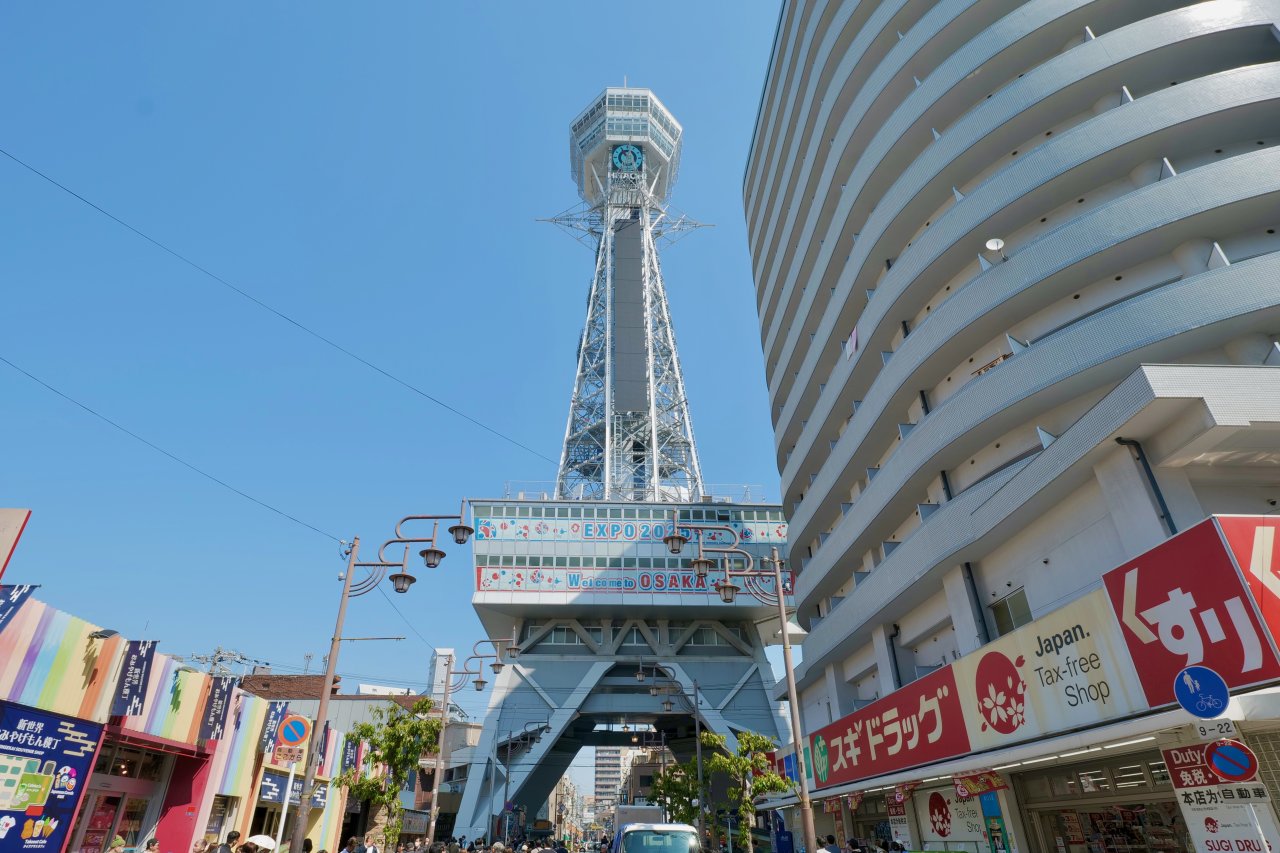
Shinsekai is a dense, walkable neighbourhood with more to eat and see within a five-minute radius than most parts of Osaka. After your skewers, here are three things worth your time:
- Tsurukame Shokudo — A classic Shinsekai diner a few blocks away, serving old-school teishoku (set meals) that are the antidote to tourist menus. Great for a quiet lunch if Daruma has a long queue.
- Tsutenkaku Tower — The retro broadcast tower that defines Shinsekai’s skyline is a 3-minute walk from Daruma. Worth the ¥900 entry for the view and the Billiken statue on the 5th floor.
- Jan Jan Yokocho — A narrow covered shopping street running south from Dobutsuen-mae, full of standing bars, old pachinko halls, and locals-only izakayas. Worth a slow walk, especially after dinner.
If you’re building out a full day in this part of the city, the things to do in Osaka guide covers the Tennoji and Shinsekai area in detail, and the where to stay in Osaka guide flags which accommodation areas put you closest to the south-side food scene.
Ganso Kushikatsu Daruma Shinsekai Sohonten is not the most refined meal you will eat in Osaka. It is not trying to be.
What it does — frying skewers of beef, prawn, and vegetables in a thin, crackling panko crust and serving them at a loud communal counter in a retro district that has barely changed since the Showa era — it does with a consistency that nearly a century of practice tends to produce.
The beef skewer remains the reason to visit: properly seasoned, correctly sized, with a batter-to-meat ratio that holds up through the first dip of sauce.
The setting does real work here too — there are technically better kushikatsu restaurants in Osaka, but none of them come with Shinsekai’s atmosphere included in the price.
The honest caveat is that Daruma’s fame has caught up with it at the Sohonten.
Weekend afternoons bring tour groups and selfie sticks alongside the local regulars, and the no-double-dipping rule is now announced in four languages on laminated signs.
None of this changes the food quality, but it does change the texture of the experience.
Visit on a Tuesday afternoon, sit at the counter, and it becomes exactly what it should be: an Osaka institution doing what it has always done, for anyone sensible enough to show up and let it.
Frequently Asked Questions (FAQs)
No reservations are accepted at the Sohonten — it’s walk-in only. On weekdays outside of lunch and dinner rush (roughly 2:00–5:00 PM), you’ll typically be seated within a few minutes. On weekends, expect a queue of 15–30 minutes. Solo diners are usually seated fastest, often at the counter.
No. The current structure dates from 1931 and is a ferroconcrete reconstruction, not the original Toyotomi-era castle.
The original was destroyed during Japan’s feudal conflicts.
The reconstruction is historically detailed and houses a genuine museum, but it is not a surviving historic structure in the way that, for example, Himeji Castle is.
If original castle architecture matters to you, the day trip to Himeji from Osaka is worth adding to your itinerary.
The easiest route is via Dobutsuen-mae Station on the Osaka Metro Midosuji or Sakaisuji Line — take Exit 1 or 3 and walk north for about 3 minutes through the Shinsekai arcade.
From Shin-Imamiya Station on the JR Osaka Loop Line, it’s a 5-minute walk east. The building is marked with a large, unmissable Daruma-face sign at 2-3-9 Ebisuhigashi, Naniwa-ku.
Both, with caveats. Solo diners are seated quickly at the counter, which is actually the best seat in the house. Groups of two to four fit comfortably at tables on the ground floor or upstairs.
Larger groups (six or more) may be split across tables or face a longer wait — the restaurant does not hold seating for partial parties.
The food at every Daruma branch is made to the same recipe and standard, so the skewers themselves are identical.
What makes the Sohonten different is location and atmosphere: it’s the original 1929 branch, sits in the heart of Shinsekai’s old-Osaka streetscape, and attracts a more local crowd than the Namba or Dotonbori-area branches.
If you want the full Daruma experience with the right surroundings, the Sohonten is the one to visit.
Restaurant details including opening hours, menus, and prices can change without notice. Always confirm directly with the restaurant before visiting. We may earn a commission if you book through our links - this helps keep Explore Osaka free.