Kuromon Ichiba Market
Osaka's legendary 580-metre covered food market serving locals and visitors since 1822.
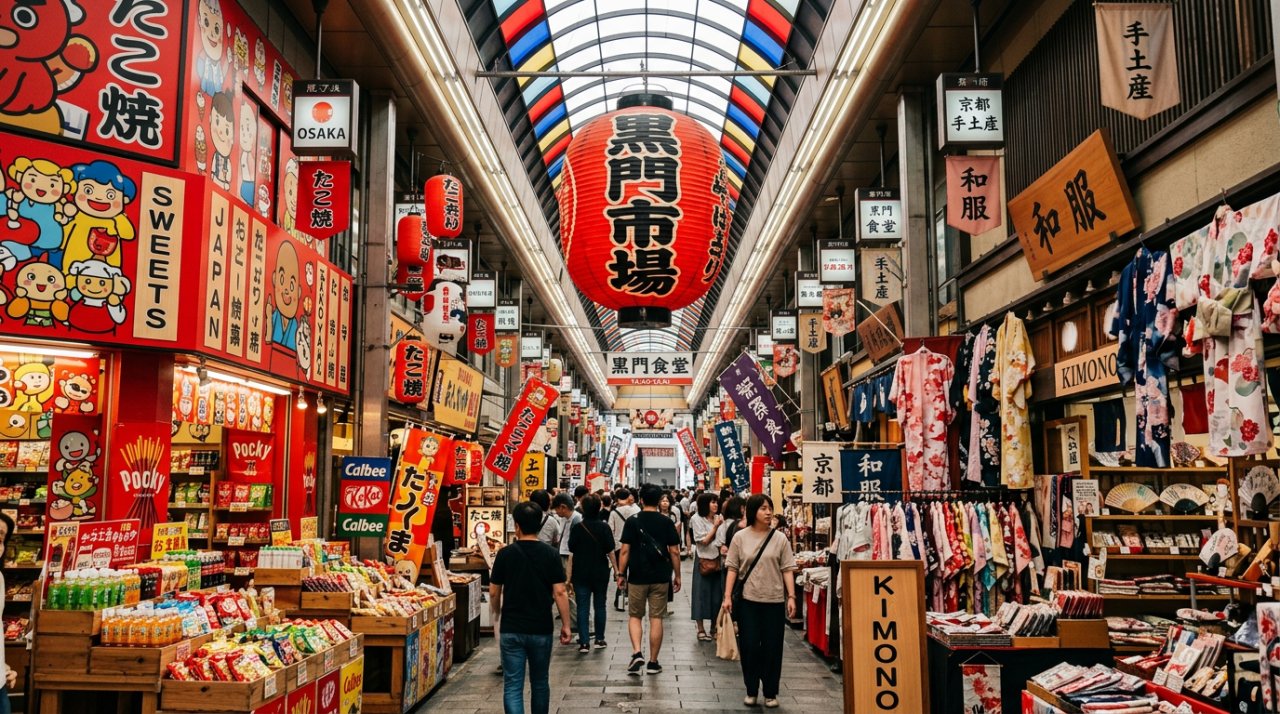
Kuromon Ichiba Market — 黒門市場 in Japanese — is a covered shopping arcade stretching roughly 580 metres through the Minami district of Osaka.
With around 150 specialist stalls, it earned the nickname ‘Osaka’s Kitchen’ by supplying the city’s chefs and home cooks with the freshest fish, wagyu beef, seasonal produce, and pickles money can buy.
The market traces its roots back to 1822, when fish vendors first gathered near the gates of Emmeiji Temple — the ‘black gate’ (黒門) giving the market its name.Walking through, your senses take the lead: the sharp brine of tuna toro laid out on ice, the sizzle of butter-glazed scallops grilled to order, the vivid orange of sea urchin scooped straight from the shell.
About a quarter of stalls focus on seafood, while the rest cover meat, fruit, sweets, dried goods, and prepared foods you can eat standing at the counter.
It’s a working market, not a theme park — professional chefs shop here alongside tourists, and that tells you everything about the quality.The best window for your visit is between 9:00 and 14:00, when produce is freshest and the atmosphere peaks.
Many stalls close by 16:30, so an afternoon arrival risks a frustrating ghost-town experience.
Aim for a weekday if crowds concern you — weekends attract heavier tourist traffic, particularly around the southern entrance.
The market’s southern information centre (open 9:00–18:00) offers free Wi-Fi, coin lockers, and a foreign currency exchange machine if you need to regroup mid-wander.
Kuromon Ichiba Market Guide: What to Eat, When to Go, How to Get There
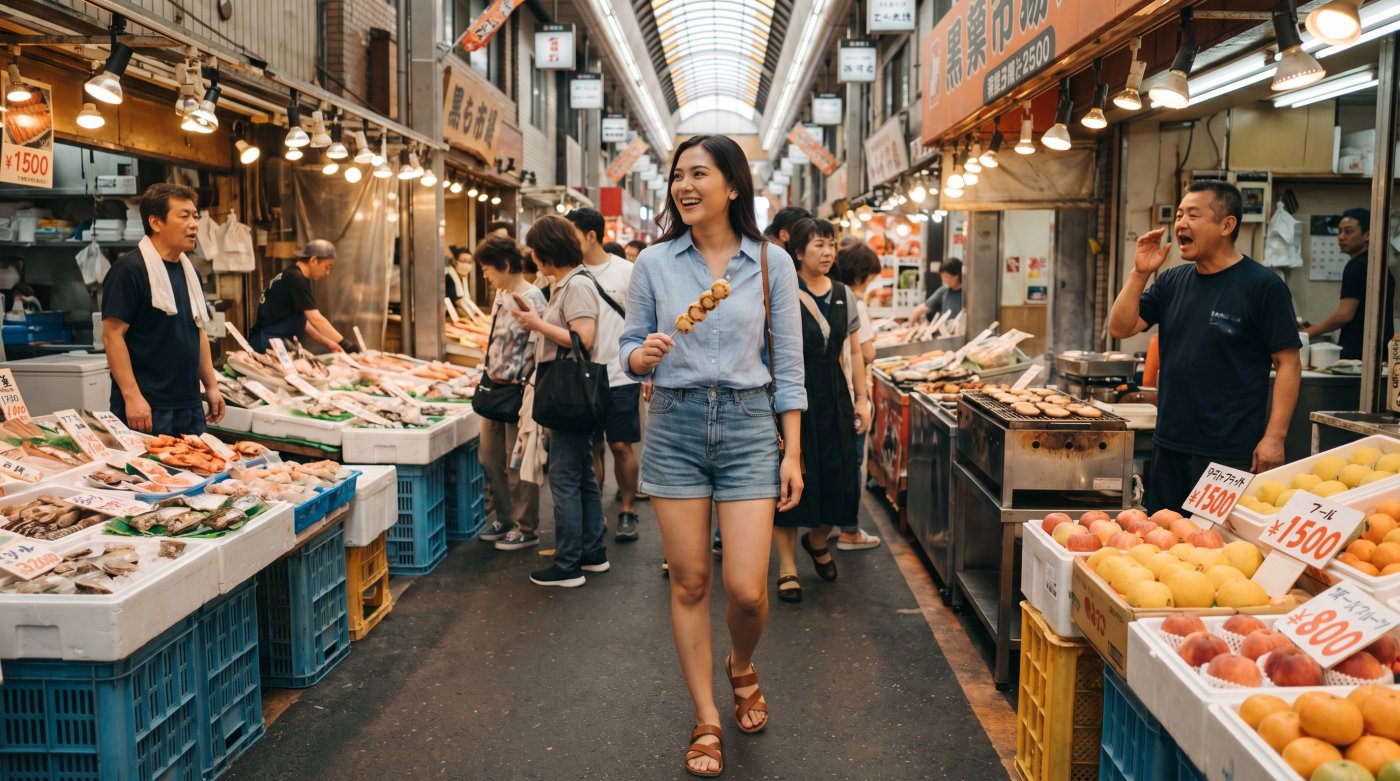
Kuromon has earned its ‘Osaka’s Kitchen’ reputation over more than two centuries of daily trading. The market traces its origin to 1822, when fish vendors began gathering near the black-gated temple Emmeiji in what is now Chuo Ward, the temple’s kuro (black) mon (gate) lending the market its name.
Professional chefs from Osaka’s top restaurants still shop here every morning, which tells you more about the quality than any review score could.
This isn’t a sanitised food hall built for tourists. The stalls are narrow, the vendors are direct, and the smell of charcoal-grilled shellfish hits you before you’ve even found the entrance.
If you’re putting together a picture of what to eat in Osaka, this market fills in more flavour than a dozen restaurant meals could.
What sets Kuromon apart from Osaka’s other markets is the density of specialists. A single vendor might sell nothing but tuna, offering five cuts at different price points displayed on hand-written signs.
Another handles only fugu (pufferfish), licensed and sliced with ceremonial precision. That level of focus is increasingly rare, and it’s the reason the market remains relevant despite decades of tourist traffic.
A Living Market, Not a Performance
About a quarter of the 150-plus stalls focus specifically on seafood, with the remainder covering Kobe and wagyu beef, fresh fruit, traditional sweets, pickles, dried goods, and prepared foods. The arcade is covered year-round, which means rain is never a reason to skip it.
Weekday mornings, you’ll share the space with restaurant buyers loading up cool boxes, elderly locals debating the price of persimmons, and the occasional chef in whites who can’t be bothered to remove their apron. That mix of commerce and community is exactly what makes it worth your time.
Quick facts
Hide- Official name: Kuromon Ichiba Market (黒門市場)
- Address: 2-4-1 Nipponbashi, Chuo Ward, Osaka City, 542-0073
- Opening hours: Most stalls 08:00-18:00 daily (many seafood stalls close by 16:30; some restaurants stay open until 20:00)
- Admission: Free to enter
- Nearest station: Nippombashi Station (Osaka Metro Sennichimae / Sakaisuji Lines), 2-3 min walk; Namba Station, 10 min walk
- Time needed: 1 to 2 hours for a thorough wander with stops to eat
- Best season: Year-round; autumn and winter bring the best seafood variety
- Official website: kuromon.com
What to Eat at Kuromon Ichiba Market
Kuromon rewards visitors who come with an appetite and no fixed plan. The approach that works best is to walk the full length of the arcade first, about 580 metres from north to south, note what catches your eye, then circle back and commit.
Don’t buy the first grilled scallop you see; there are three vendors selling the same thing and the quality varies.
Seafood: The Market’s Strongest Suit
Tuna is the anchor product. You’ll find whole loins on display at multiple stalls, with vendors slicing off cuts to order in front of you. Toro
(fatty tuna belly) is available at premium prices, typically ¥1,500-¥3,000 for a small plate, and the quality justifies it if seafood is your priority. Sea urchin (uni) cups have become the market’s most-photographed item, scooped fresh from the shell and served over a small bowl of rice for around ¥1,000-¥2,000 depending on variety and season.
Grilled butter scallops are another reliable choice, a classic Kuromon snack cooked over charcoal at open counters while you wait. A single large scallop costs around ¥500-¥800.
Oysters are available shucked to order and eaten raw at the counter, octopus appears in multiple forms including grilled whole legs, and fugu is on offer at specialist vendors if you want to try Japan’s most notorious fish in a setting that takes it seriously.
What to Skip
The king crab legs on sticks are photogenic but expensive (¥1,500-¥3,000 per stick) and aimed squarely at visitors with cameras. The crab itself is usually imported and the value isn’t there compared to the tuna or shellfish.
Snow crab is a better bet if crustaceans are what you’re after.
Wagyu Beef and Everything Else
Several dedicated butchers offer grilled Kobe beef and wagyu skewers for around ¥1,000-¥2,000 each. The beef here is the real thing, sourced from certified producers, and eating it standing at a counter while the vendor fans the charcoal is one of those Osaka experiences that sticks.
Beyond protein, you’ll find extraordinary seasonal fruit (Japanese melon slices in summer, tangerines in winter), tamagoyaki (sweet rolled omelette) made fresh in rectangular pans, and a broad selection of tsukemono (pickled vegetables) sold by weight. These make excellent and practical souvenirs.
Prices: What to Expect
Kuromon sits between a local market and a tourist destination in terms of pricing. Everyday items like fish, produce, and pickles are priced competitively.
The items marketed most aggressively toward visitors, primarily uni cups, king crab, and wagyu skewers, carry a premium. Budget around ¥2,000-¥4,000 per person for a satisfying eat-as-you-go lunch, more if you go deep on toro or uni.
Cash is king here. Many stalls do not accept credit cards, and IC card payment is limited to a handful of shops. There’s a foreign currency exchange machine at the information centre near the southern entrance on Nipponbashi-suji Avenue, alongside coin lockers (¥500 per use) and free Wi-Fi.
Getting to Kuromon Ichiba Market
The market’s location in Chuo Ward puts it within easy reach of Osaka’s main transport hubs. The Kuromon district sits roughly between Namba and Den-Den Town (Nipponbashi’s electronics district), making it a natural stop on a southern Osaka day.
By Train
Nippombashi Station is your best bet. Both the Osaka Metro Sennichimae Line and the Sakaisuji Line stop here, and Exit 10 puts you about 2-3 minutes on foot from the market’s southern entrance.
The large multicoloured sign over the arcade entrance is visible from the street.
From Namba Station (served by the Midosuji, Yotsubashi, and Sennichimae Lines, plus JR and Kintetsu), it’s a 10-minute walk east along Sennichimae-dori. If you’re staying in Namba or Dotonbori, this is a perfectly walkable distance.
Kintetsu Nippombashi Station on the Kintetsu Nara Line also provides access via a 3-minute walk.
By Bus
Osaka City Bus stops at Nippombashi on multiple routes along Nipponbashi-suji Avenue, a 3-minute walk from the southern entrance. If you’re coming from Tennoji or further south, bus is a reasonable option.
From Namba, the train is faster.
Getting Around Once You’re There
The arcade runs roughly north-south. Most visitors enter from the south (Nipponbashi-suji side), which is where the information centre, coin lockers, and most of the visitor-facing stalls concentrate.
The northern end is quieter and more heavily skewed toward professional buyers. Both entrances are open; there’s no admission gate because there’s no admission fee.
Practical Tips for Visiting Kuromon Market
Kuromon’s main weakness is timing. Arrive too late and you’ll encounter a thinning market where stalls are packing up, refrigerator cases are half-empty, and the atmosphere drops off considerably.
Here’s how to time it right and make the most of what the market offers.
Best Time to Visit
The sweet spot is 9:00 to 13:00 on a weekday. At this hour, produce is at its freshest, professional buyers are still active (which keeps vendors on their best behaviour), and the crowds are manageable.
By 14:00, the energy starts to fade. After 16:30, a significant number of seafood and produce stalls close entirely, and you’re left with primarily restaurants and a few dry goods shops.
Weekends draw noticeably heavier tourist traffic, particularly Saturday mornings in spring and autumn. The market doesn’t become unpleasant, but navigating with a large backpack or a group becomes more of a negotiation.
If your schedule forces a weekend visit, arrive at opening (8:00) to get ahead of the mid-morning surge.
What to Bring
Bring cash. ¥5,000-¥10,000 is plenty for a full visit with eating.
Carry a small bag or tote for any produce or packaged goods you pick up. A cooler bag is useful if you’re buying fresh fish to prepare later, and several stalls sell light insulated bags at reasonable prices.
Leave the large rolling suitcase at your hotel or in a station locker; the arcade is navigable but narrow, and peak hours make oversized luggage genuinely disruptive to other shoppers.
Language
English signage exists at most visitor-facing stalls, and many vendors near the southern entrance have laminated price menus in English, Chinese, and Korean. Pointing, nodding, and holding up fingers works perfectly well for quantities.
A few words of Japanese (kore for “this one,” hitotsu for “one”) go a long way and are received warmly.
Accessibility
The market arcade has a flat, covered floor throughout its length, and both entrances are at street level. Wheelchairs and pushchairs can navigate the main corridor comfortably during off-peak hours.
During busy weekend mornings, the crowd density can make it tighter but not impossible.
Nearby Attractions
Kuromon Ichiba sits in a particularly useful part of southern Osaka. Within 10-15 minutes on foot, you have several genuinely distinct experiences on offer.
- Den-Den Town (Nipponbashi Electronics District) is immediately north of the market, Osaka’s answer to Tokyo’s Akihabara. The strip runs along Sakaisuji Avenue and covers electronics, anime merchandise, retro video games, and hobby supplies across dozens of specialist shops. It’s a sharp contrast in atmosphere from the market and worth an hour if that’s your world.
- Dotonbori is roughly 10 minutes northwest on foot. The iconic covered entertainment and food district has a completely different energy from Kuromon: louder, neon-lit, more performance-oriented. If you want to follow a Kuromon morning with an afternoon walk along the Dotonbori canal, the geography supports it naturally.
- Shinsaibashi Shopping Arcade sits about 15 minutes northwest and offers Osaka’s most comprehensive covered shopping street, running from Dotonbori north to Nagahori-dori. It covers everything from ¥100 shops to international fashion brands.
- Namba Parks is a 12-minute walk southwest, a mid-range shopping mall with a rooftop garden built over the old Namba Baseball Stadium site. It’s useful for practical shopping (pharmacy, grocery, electronics) if you need to stock up after the market.
For a well-structured day that connects Kuromon with the rest of southern Osaka, the Osaka itinerary section covers practical route options that work for both first-timers and repeat visitors. The market pairs naturally with an afternoon in Dotonbori or a southward drift toward Shinsekai, Osaka’s retro neighbourhood built around the original 1903 World Exposition site.
What's Available
Frequently Asked Questions
The market arcade itself is a public space with no set entry hours, but individual stalls typically operate between 8:00 and 18:00, with many seafood and produce vendors closing as early as 16:30.
Restaurants inside the market tend to stay open until 20:00 or later.
To catch the full market in action, plan to arrive by 9:30 and wrap up your browsing before 14:00 for the widest selection.
The market’s strengths are firmly in fresh seafood — sea urchin (uni) on rice, tuna sashimi, grilled butter scallops, and fugu (blowfish) are all available from specialist stalls.
Wagyu beef skewers and Kobe beef cuts have become popular with visitors too, and you’ll find excellent fruit stands, traditional sweets, and tamagoyaki (rolled omelette) to round out a proper wander.
Most vendors let you eat at a small counter right there on the spot, so treat the whole thing like a progressive tasting menu on foot.
From Namba Station, Kuromon Ichiba is about a 10-minute walk east, crossing Sakaisuji Avenue — look for the large multicoloured market sign to confirm you’ve found the right arcade entrance.
Alternatively, take the Osaka Metro Sennichimae Line or Sakaisuji Line one stop to Nippombashi Station and exit at Exit 10 for a 2–3 minute walk directly to the market’s southern entrance.
Nippombashi is the cleaner option if you’re carrying bags or want to save your legs for the eating.
Kuromon Market is about a 10-minute walk from both Dotonbori canal and Namba Station, making it an easy add-on to any itinerary based in Osaka’s Minami district.
The most direct walking route from Namba takes you east along Sennichimae-dori.
Nipponbashi Station on the Osaka Metro Sakaisuji Line is the closest station if you’re coming from further afield, with the market entrance just a few minutes’ walk from the exit.
Editor's Review
Kuromon Ichiba genuinely delivers on the food side — the quality of raw seafood here is exceptional, and watching a vendor slice tuna or flame-sear a scallop right in front of you is one of those quietly satisfying Osaka moments.
The atmosphere is authentic enough to still feel like a working market rather than a curated tourist experience, which is increasingly rare in this part of the city.That said, prices at some stalls have crept up noticeably over the past few years, particularly for the photogenic items like uni cups and wagyu skewers.
It’s still worth it, but go in with eyes open.
The sweet spot is arriving around 9:30 on a weekday morning: the produce is at its freshest, the professional chefs are doing their shopping, and you’ll have elbow room to actually browse rather than shuffle through a crowd.