

Umeda is the primary commercial and business district of northern Osaka, located in Kita Ward and centered around the interconnected station complex of Osaka Station (JR), Umeda Station (Osaka Metro Midosuji Line), and the private rail terminals of Hankyu Umeda and Hanshin Umeda.
Together these form one of the busiest transit nodes in Japan, handling millions of passengers daily and connecting Osaka to Kyoto, Kobe, Nara, and Kansai International Airport.
The district is dominated by major department store complexes including Daimaru, Hankyu, Hanshin, and the LUCUA and LUCUA 1100 towers integrated into Osaka Station itself.
Underground, an extensive network of shopping arcades including Whity Umeda, Diamor Osaka, and HEP Five connects the various station exits and retail zones.
Above ground, the Umeda Sky Building in Fukushima Ward stands as the district’s architectural landmark, housing the Floating Garden Observatory on its rooftop at 173 metres.
Umeda is the natural base for visitors arriving by Shinkansen from Tokyo and serves as the northern counterpoint to Namba in Osaka’s dual-core city structure.
Umeda Neighborhood Guide: Osaka’s Modern North Explained
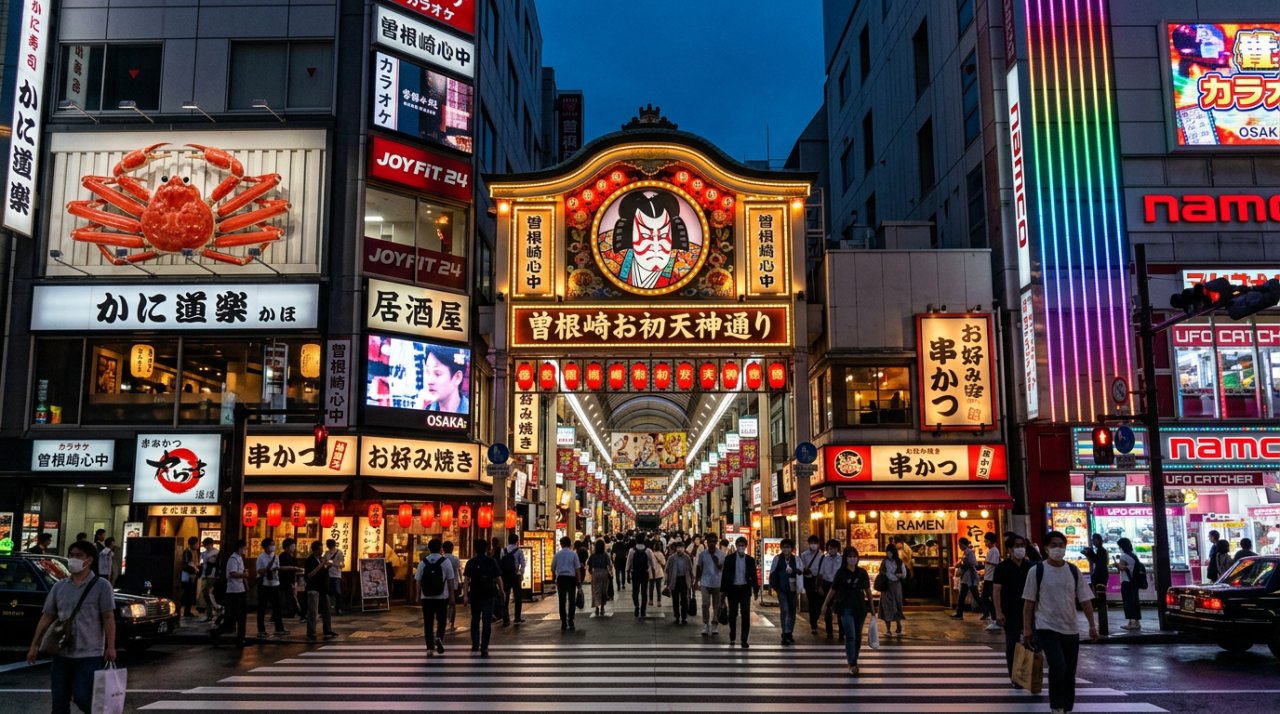
Umeda is Osaka’s commercial engine and its most connected transit hub, packed into the northern ward of Kita-ku.
This Umeda Guide covers the underground shopping labyrinths, the skyscraper observatory, the standing ramen bars, and the hotels that put you within walking distance of Osaka Station — one of the busiest rail intersections in Japan.
If you’ve been planning a trip to Osaka and haven’t decided where to base yourself, start here.
Umeda at a Glance
- Best for: First-time visitors, business travelers, shoppers, transit-oriented itineraries
- Nearest stations: Osaka Station (JR), Umeda Station (Osaka Metro Midosuji Line), Higashi-Umeda Station (Tanimachi Line), Nishi-Umeda Station (Yotsubashi Line)
- Walkability: 9/10 — the core area is very compact and flat
- Best time to visit: Year-round; spring (March to May) for comfortable weather; December for illuminations; avoid Golden Week (late April to early May) if crowds bother you
Getting to Know Umeda
Umeda sits at the northern edge of central Osaka, roughly 3 kilometers from Namba and about 15 minutes by subway from the southern entertainment districts.
The name Umeda (梅田) loosely translates to “plum field” — a nod to the marshy, agricultural land this area was before the Meiji era transformed it into a rail terminus.
The modern Umeda you walk through today is largely a post-war construction, rebuilt and repeatedly expanded around Osaka Station since the 1950s.
The defining feature of Umeda is scale.
The station complex connects directly to more than 16 kilometers of underground shopping passages, a figure that baffles most first-time visitors and delights anyone who enjoys getting slightly lost among boutiques and ramen counters.
Above ground, the skyline is defined by Osaka Station City’s twin towers, the distinctive linked arches of the Umeda Sky Building, and a cluster of department stores — Daimaru, Lucua, Hankyu Umeda — that generate foot traffic figures comparable to some airports.
The vibe leans corporate during weekday mornings, but shifts sharply in the evenings and on weekends when the underground bars of Sonezaki Shinchi and the neon-lit streets around HEP Five fill with a very different crowd.
Umeda is one of those rare neighborhoods that genuinely serves multiple audiences at once without feeling incoherent.
Key Streets and Districts Within Umeda
The neighborhood breaks naturally into a few zones. Osaka Station City
is the immediate bubble around the JR station — all gleaming retail and food floors. Grand Front Osaka
sits just north of the station, a large mixed-use development that opened in 2013 and houses shops, restaurants, a hotel, and a knowledge creation hub called Umeda Innovation Hub. Sonezaki
and Sonezaki Shinchi (北新地, Kitashinchi) are the entertainment and nightlife strips to the east, with hundreds of izakaya, cocktail bars, and the kind of counter-seat restaurants where regulars come three times a week.
Kitashinchi in particular is one of Osaka’s more upscale dining corridors — worth a detour even if you’re not spending big.
Top Things to Do in Umeda
Umeda’s top attractions skew toward the urban and modern rather than the historical, which makes it a genuinely different experience from the temple and castle trail.
That said, there’s real depth here — you could spend a full day without running out of interesting stops.
If you want a broader list of things to do in Osaka beyond this neighborhood, that page covers the whole city.
Umeda Sky Building and the Floating Garden Observatory
The Umeda Sky Building (梅田スカイビル) is the one sight in this neighborhood that warrants a detour for its architecture alone.
Completed in 1993 and designed by Hiroshi Hara, the building consists of two towers connected at the top by a circular observation deck called the Kuchu Teien (空中庭園), literally “floating garden.” The crossing between the towers is done via a glass-floored escalator tunnel — not recommended if heights unsettle you.
The observatory sits at 170 meters and offers an unobstructed 360-degree view of Osaka that on clear days extends to the mountains of Nara and Hyogo.
Admission is ¥1,500 for adults (as of 2025), and the deck is open daily from 10:00 to 22:30, with last entry at 22:00.
Come at dusk if you can manage it — the city shifts from flat grey to amber and then hard neon over about 40 minutes, which is more interesting to watch than most sunsets.
The basement of the building also houses Takimi-koji, a recreation of a 1920s Osaka street with a cluster of restaurants worth a look even if you skip the deck.
HEP Five Ferris Wheel
Mounted on the roof of the HEP Five shopping complex on Kakudacho, the red Ferris wheel is one of Umeda’s more recognizable skyline fixtures.
It runs 15 minutes per cycle, reaches 106 meters, and costs ¥600 per person.
Operating hours are roughly 11:00 to 22:45 (last boarding at 22:30), though the complex can close the wheel in strong wind.
The view isn’t as dramatic as the Sky Building, but the ride itself is a more casual and affordable experience — good for an evening when you don’t want to commit to a full observatory visit.
HEP Five’s retail floors are also solid for mid-range Japanese fashion if you’re shopping.
Grand Front Osaka
Grand Front Osaka (グランフロント大阪) opened in 2013 directly north of Osaka Station and represents the most significant redevelopment in the Umekita (梅北) project that has been reshaping this part of the city since the late 2000s.
The complex is split into a South Building and North Building connected by a plaza, and it holds more than 260 shops and restaurants across multiple floors.
The North Building houses the Umeda Innovation Hub, where technology companies and research institutions share space with retail — an unusual combination that gives the building a slightly different atmosphere from a standard mall.
For food, the sixth-floor restaurant zone is strong on variety and tends to have shorter queues than the department stores nearby.
Osaka Station City and the Underground Mall Network
Osaka Station itself is worth at least an orientation walk-through.
The station’s large glass atrium with its dramatic steel roof structure, completed in 2011, is a genuine piece of infrastructure architecture.
The surrounding complex connects directly to Daimaru Osaka, Lucua, Lucua 1100, and the underground Whity Umeda and Diamor Osaka mall passages.
Together, these form an air-conditioned, rain-proof city within the city.
Navigation takes a few visits to feel natural — download the station map before you go, or accept that you’ll accidentally end up in a different exit than you intended.
Everyone does.
Sonezaki Shrine (露天神社)
A short walk east of the station, Sonezaki Shrine (Tsuyu no Tenjinja) is one of the older religious sites in this otherwise relentlessly modern district.
The shrine gained national fame as the setting of Chikamatsu Monzaemon’s 1703 puppet play Sonezaki Shinju (The Love Suicides at Sonezaki), which is still performed in Japan’s bunraku tradition.
The grounds are compact but atmospheric, particularly in the early morning before the surrounding streets wake up.
It’s free to enter and open year-round.
Where to Eat in Umeda
Umeda competes with Namba and Dotonbori for the depth of its food scene, but it does so at a slightly higher average price point and with noticeably less tourist-facing packaging.
The restaurants here are largely built for Osaka’s working population — which means fast service, honest portions, and kitchens that have been doing the same thing well for decades.
For a deeper dive into the city’s food culture, the Osaka food guide covers everything from street snacks to kaiseki.
Ramen and Noodles
Umeda has a solid concentration of ramen shops, many operating on a stand-and-eat or counter-seat model that suits a quick lunch or late-night bowl.
The basement and upper floors of Lucua 1100 hold several ramen specialists, and the Shin-Umeda Food Building (新梅田食道街), a narrow covered alley running northeast from Osaka Station, packs more than 100 small restaurants and bars into a single block — including several long-running ramen and udon counters that feel entirely disconnected from the polished retail above ground.
The Shin-Umeda Food Building is open from around noon and runs until midnight or later for most spots.
Okonomiyaki and Osaka Classics
Okonomiyaki (お好み焼き), the thick savory pancake that Osaka treats as a point of civic pride, is well-represented in Umeda.
Several restaurants around Sonezaki and inside the Grand Front Osaka food floor specialize in the Osaka-style version (Osaka-yaki), where all ingredients are mixed into the batter rather than layered as in the Hiroshima style.
Expect to pay ¥1,000 to ¥1,800 for a standard okonomiyaki at a sit-down restaurant. Takoyaki
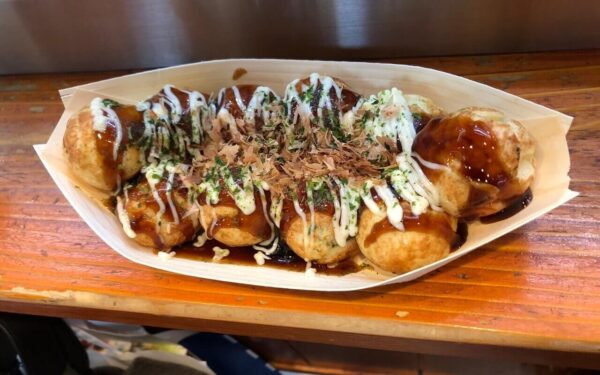
(octopus balls) are available at multiple stalls throughout the underground mall network — budget ¥500 to ¥700 for a tray of eight.
Kitashinchi and Izakaya Dining
Kitashinchi (北新地), the upscale dining and entertainment strip just east of Umeda proper, is where Osaka’s food scene stops performing for tourists and starts serving the city’s actual regulars.
The streets here hold small counter restaurants serving high-quality yakitori, sashimi, and seasonal Japanese cooking at prices that reflect the real estate.
You’ll spend ¥3,000 to ¥8,000 per person at a mid-range Kitashinchi izakaya, more at the quieter counter omakase spots.
Reservations are advisable for anything with fewer than ten seats.
The area is also easy to navigate on foot and feels safe and lively until well after midnight.
Department Store Food Halls
Osaka takes its depachika (デパ地下 — department store basement food halls) seriously, and Umeda has some of the best in the city.
The basement floors of Hankyu Umeda, Hanshin Osaka, and Daimaru Osaka each stock hundreds of prepared foods, pastries, wagashi (Japanese confections), and regional specialties.
These aren’t just convenience stops — they’re legitimate destinations for a meal, a gift box to take home, or an hour of slow grazing.
Hankyu’s basement floor in particular is frequently cited as one of the finest depachika in the Kansai region.
Where to Stay in Umeda
Umeda is the most practical base in Osaka for travelers who plan to take day trips to Kyoto, Kobe, or Nara, given the direct JR and Hankyu rail connections from Osaka Station.
For a full breakdown by budget and style, the where to stay in Osaka guide covers every neighborhood in detail.
Conrad Osaka (luxury, from around ¥40,000/night) occupies the upper floors of the Nakanoshima Festival Tower West, roughly 10 minutes on foot from Osaka Station.
The rooms above the 33rd floor have views over the Dojima River and Osaka Bay on clear days.
It’s polished, well-staffed, and positioned slightly away from the station crowds — which either appeals to you or doesn’t, depending on how much you want to walk.
Cross Hotel Osaka (mid-range, from around ¥10,000 to ¥15,000/night) sits almost directly between Umeda and the Sonezaki Shrine, a genuinely useful location that puts you within ten minutes’ walk of both the JR station and the izakaya strips.
Rooms are compact but well-designed, and the hotel has a design aesthetic that makes it feel less generic than the business hotels in the same price bracket.
APA Hotel Umeda Ekimae (budget, from around ¥6,000 to ¥9,000/night) is the utilitarian option — small rooms, reasonable rates, and a location close enough to Osaka Station to be genuinely convenient.
APA is a national chain and the rooms reflect that standardization, but the beds are comfortable and the price holds even during peak season better than most competitors in the area.
Getting There and Getting Around
Osaka Station and Umeda Station are physically interconnected despite belonging to different rail operators (JR and Osaka Metro respectively), which means arrivals from most directions land you in the same walkable zone.
From Kansai International Airport (KIX), the fastest option is the JR Haruka express, which takes about 60 minutes and arrives directly at Osaka Station.
The Nankai Railway to Namba followed by a 3-stop subway ride is cheaper but takes around 75 to 90 minutes total.
Within Umeda, you’ll walk almost everywhere.
The neighborhood’s core — Sky Building to Grand Front to the underground malls to Sonezaki — is contained within roughly a 20-minute walking radius, and most of it is flat.
The subway is useful for longer crosstown trips: the Midosuji Line from Umeda Station connects directly south to Shinsaibashi, Namba, and eventually Tennoji in about 12 to 15 minutes.
IC cards (ICOCA or Suica) work across all metro, JR, and Hankyu lines in the area and are the easiest way to pay for transit without managing paper tickets.
Taxis are available outside Osaka Station’s north and south exits around the clock, though they’re rarely the fastest option during rush hour (7:30 to 9:00 and 17:30 to 19:30).
Cycling is possible but the underground mall network makes it largely redundant for most visitors.
Practical Tips and Best Time to Visit
Spring (late March to early May) is the most popular window to visit Osaka, and Umeda holds up well in this season — the Nakanoshima Park area just south of the district has cherry blossom viewing along the river, and the weather is consistently comfortable at 15 to 22°C.
Autumn (October to November) is a close second for pleasant temperatures and thinner crowds.
Summer (July to September) in Umeda is genuinely hot and humid, with temperatures regularly reaching 33 to 36°C and high humidity.
The underground mall network is air-conditioned and actually becomes an asset in this season — you can move between points entirely underground during the worst heat.
December brings the Osaka Hikari Renaissance illuminations to Nakanoshima, drawing large crowds but turning the riverside area into one of the more attractive nighttime spaces in the city.
A few practical notes worth keeping in mind:
- The underground mall system is confusing the first few times. Download an offline map (Google Maps works reasonably well) before entering, and note which station exit you need.
- Most convenience stores (konbini) in Umeda — FamilyMart, Lawson, 7-Eleven — accept international credit cards. Smaller bars and old-school restaurants in Shin-Umeda Food Building may be cash only, so carry some yen.
- The Sky Building area is a 10-minute walk west from Osaka Station through a slightly underwhelming stretch of road. It’s easy to underestimate how long it takes the first time — leave earlier than you think you need to for sunset.
- Luggage storage is available at multiple coin locker banks inside Osaka Station and at the tourist information desk near the central exit. Rates start at ¥400 per day for small lockers.
- Peak crowds in the underground malls hit hardest on Saturday afternoons between 13:00 and 17:00. If you dislike packed spaces, weekday mornings are measurably calmer.
Umeda isn’t Osaka’s most atmospheric neighborhood — that argument belongs to the south — but it’s the most functional, and there’s a version of functional here that tips into genuinely interesting. The architecture is worth paying attention to, the food scene rewards exploration beyond the obvious, and the rail connections make it a logical anchor for any [Osaka itinerary](https://explore.osaka/itineraries/) that includes day trips. Give it more than a transfer stop’s worth of attention and it tends to surprise people.