Sanchan-Ya
 Find a Table on byFood
  Read the Reviews





Restaurant Info
About Sanchan-Ya
Sanchan-Ya: Osaka’s Most Legendary Takoyaki Yatai (2026) – Sanchan-Ya is a yatai (outdoor street food stall) in the Nakatsu neighbourhood of Osaka’s Kita Ward, operating from a patched plastic-and-steel tent beside Nakatsu Station for over 40 years.
The owner — San-chan himself — makes one thing: takoyaki (octopus-filled batter balls), and he makes them exceptionally well.
Order the standard tako set, eat them fresh off the iron plate with Worcester sauce, mayonnaise, or soy sauce, and wash it all down with a canned beer from the icebox.
If you want a genuine, zero-pretence Osaka street food experience — not the Instagram-friendly tourist version — this is it.
Sanchan-Ya at a Glance
Hide- Cuisine: Takoyaki, Street Food
- Neighborhood: Nakatsu, Kita Ward
- Address: 1-11-30 Nakatsu, Kita-Ku, Osaka 531-0071 Osaka Prefecture
- Nearest Station: Nakatsu Station (Osaka Metro Midosuji Line), 14-metre walk (Exit 1)
- Opening Hours: Monday–Saturday 18:00–00:00 | Sunday & Public Holidays: Closed
- Price Range: ¥ — approximately ¥1,000–¥2,000 per person
- Reservations: Walk-in only (no reservations accepted)
- Phone: +81 6-6359-5252
- Rating: 4.2 / 5 — Google Maps (117 reviews)
- Best For: Solo diners, local food seekers, late-night eats
What Is Sanchan-Ya?
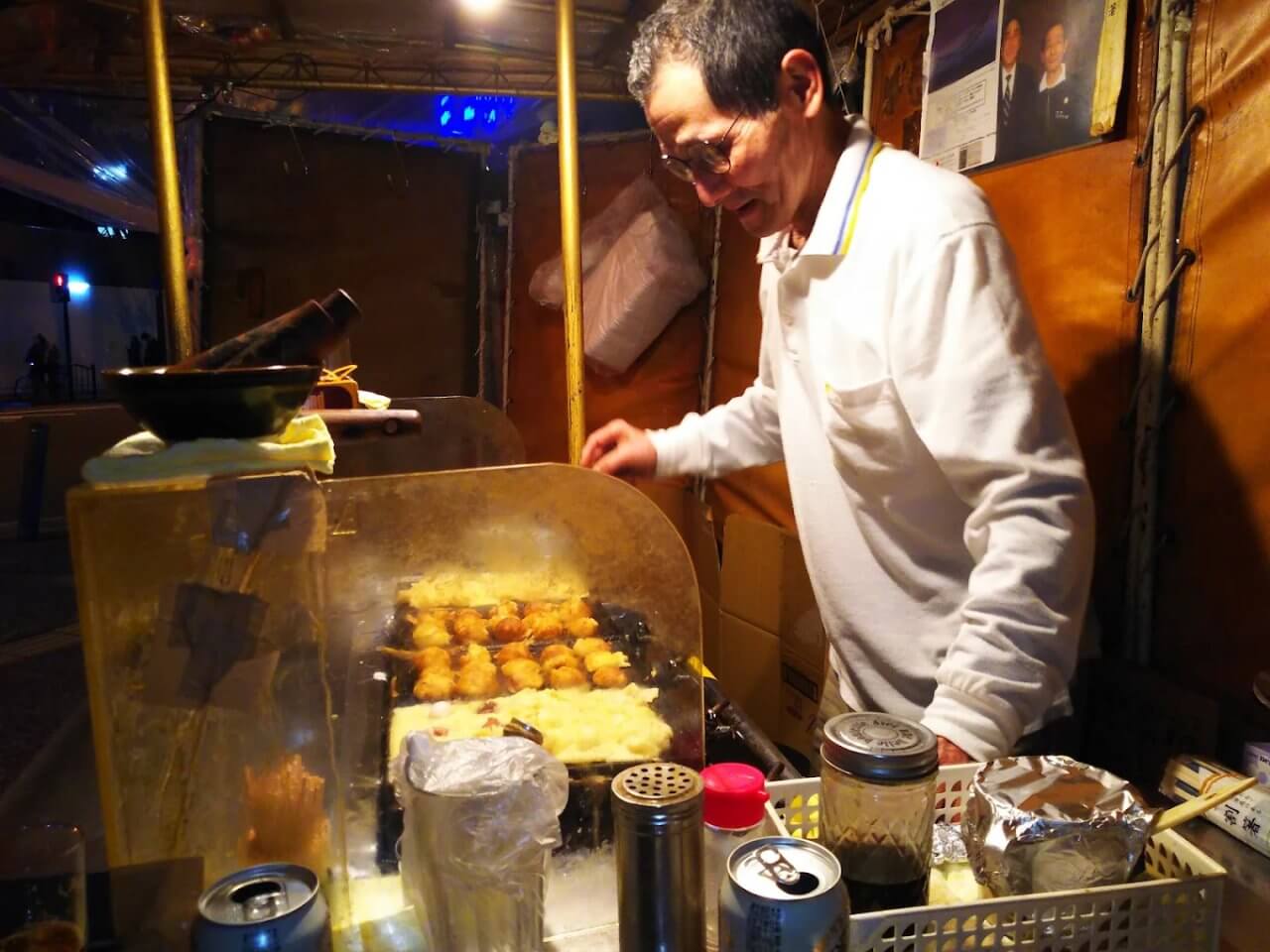
Sanchan-Ya is not a restaurant in any conventional sense.
There are no walls, no printed menu on the table, and no host to seat you.
It’s a yatai — a semi-permanent street food stall — squeezed into a covered space at the entrance to an alleyway directly outside Nakatsu Station’s Exit 1.
You grab a plastic stool, order takoyaki, and that’s the whole transaction.
Simple, fast, and completely uninterested in your Yelp review.
Sanchan-Ya is a takoyaki yatai in the Nakatsu district of Osaka, open Monday through Saturday from 6pm to midnight. It seats approximately 10 people, serves takoyaki at around ¥1,000–¥2,000 per person, and accepts cash only. It is one of the few remaining traditional yatai in Osaka, featured on the Japanese television programme Kodoku no Gurume (Solitary Gourmet), and has been run by the same owner for over four decades.
The stall gained national attention after being featured on Kodoku no Gurume (孤独のグルメ) — the beloved Japanese TV drama about a lone businessman who eats his way through local restaurants across Japan.
That exposure brought visitors from Tokyo and beyond, but it didn’t change anything about the operation.
San-chan still makes the same takoyaki, on the same iron plates, with the same blunt hospitality.
Unlike the tourist-facing takoyaki chains in Dotonbori that pump out a thousand balls an hour, this is a one-man show in a neighbourhood that has very little interest in being a tourist attraction.
That’s exactly what makes it worth visiting.
For anyone putting together their Osaka food guide itinerary, Nakatsu sits just north of Umeda — it’s a five-minute subway ride from the main tourist hub, but it feels genuinely local in a way that most of central Osaka no longer does.
What to Order at Sanchan-Ya
The menu at Sanchan-Ya is, in practical terms, one item: takoyaki.
That is either a problem or a relief depending on your appetite for decision-making.
Takoyaki — たこ焼き
Price: approximately ¥500–¥700 for a standard portion (confirm exact price on arrival — pricing is not published online).
San-chan’s takoyaki differ from the soft, yielding balls you’ll find at most Osaka stalls.
These have a properly seared crust — oil-crisped on the outside, giving an audible crunch before the batter collapses into a fluffy middle layer, which in turn gives way to a hot, gooey core packed with a noticeably large chunk of octopus.
The three-texture contrast is something most commercial Osaka takoyaki operations have stopped bothering with.
Here it’s the whole point.
Topping options are the standard lineup: Worcester-based otafuku sauce and mayonnaise (the classic), soy sauce (cleaner, lets the batter speak), or salt (minimalist, good if you trust the cook, which at this point you probably should).
Dried bonito flakes (katsuobushi) and seaweed powder (aonori) come on top as standard.
Drinks
The drinks situation is an icebox of canned beer and soft drinks.
There’s sake (Nihonshu) and shochu (Japanese distilled spirit) available too.
The beer-and-takoyaki pairing is not accidental — it’s the reason a lot of the regulars are here.
What to Skip
There’s nothing to skip.
But if you’re hoping for a full meal, temper expectations: this is a snack-and-drink stop, not a dinner replacement.
Come after dinner elsewhere, or embrace the Japanese habit of eating takoyaki as the meal itself.
The Dining Experience
Ten seats. A plastic tarp overhead. Aluminium stools.
A red lantern with さんちゃん屋 written on it swaying near the entrance.
The entire footprint of the operation could fit inside a minivan.
You are, genuinely, sitting on the street — or in the covered alleyway just off it — watching San-chan work the iron plates two metres in front of you.
The crowd at Sanchan-Ya skews local and mixed-age: salarymen unwinding after work, couples on a casual night out, university students with nowhere to be, the occasional tourist who found this place and looks quietly delighted about it.
The atmosphere is social in the way that small Japanese street food spots often are — strangers end up talking because there’s no physical space to avoid each other, and San-chan’s running commentary helps.
Weeknight evenings from around 18:30–20:00 tend to be the easiest window — you’ll get a stool quickly and have time to eat without feeling rushed.
Later on Fridays and Saturdays, expect to wait.
There’s no reservation system and no queue management, so the drill is simply: arrive, see if there’s a stool, and either sit or come back in 20 minutes.
Smoking is permitted (this is an outdoor stall, technically), which is worth knowing if that’s a dealbreaker for you.
Getting There and Practical Information
Sanchan-Ya is 14 metres from Nakatsu Station Exit 1 on the Osaka Metro Midosuji Line — which is about as close as a restaurant can be to a subway station without technically being inside it.
From Umeda, it’s one stop south (two minutes).
From Namba, it’s a direct Midosuji Line ride of about 12 minutes.
Directions from Nakatsu Station Exit 1:
- Take Exit 1 (the Seven-Eleven side)
- Turn left immediately out of the exit
- The red lantern is visible from the top of the stairs on the north side of the road opposite the Ramada Hotel Osaka
Full address in Japanese (for showing to a taxi driver or Google Maps):
大阪府大阪市北区中津1-11-30 ラマダホテル大阪前の道路挟んで北側
Practical notes:
- Payment: Cash only — no credit cards, no IC card payment, no QR code payment. Bring yen.
- Reservations: Not accepted. Walk-in only.
- Language: No English menu. The menu is verbal or posted in Japanese. The ordering process is simple enough that this is rarely an obstacle — point at what others are eating and you’ll be fine.
- Phone: +81 6-6359-5252 (for general enquiries only — the stall doesn’t take bookings by phone)
- Nearest convenience store: Seven-Eleven is directly at the station exit — ATM available if you need cash.
Essential Osaka Travel Passes
Powered by KlookThe passes worth buying before you land — curated for first-timers.
Osaka Amazing Pass
Unlimited subway + free entry to 40+ attractions. The only pass most visitors actually need.
Osaka e-Pass
Attractions-only digital pass. Pair with a Metro Pass if skipping the Amazing Pass.
Osaka Metro Pass
1 or 2-day unlimited Metro rides. Best standalone transit value if you already have an attractions pass.
JR West Kansai Area Pass
Unlimited JR trains for 1–4 days. Covers Kyoto, Nara, Kobe, and Himeji from Osaka.
JR Haruka Express
KIX to Umeda/Shin-Osaka in ~50 min. Best if staying in Umeda or heading straight to Kyoto.
Nankai Rapi:t Express
KIX to Namba in 34 min, reserved seat. Better if staying in Namba or Shinsaibashi.
Opening Hours
| Day | Hours |
|---|---|
| Monday | 18:00 – 00:00 |
| Tuesday | 18:00 – 00:00 |
| Wednesday | 18:00 – 00:00 |
| Thursday | 18:00 – 00:00 |
| Friday | 18:00 – 00:00 |
| Saturday | 18:00 – 00:00 |
| Sunday | Closed |
| Public Holidays | Closed |
Hours are evening-only — no lunch service.
The stall opens at 18:00 and runs until around midnight, though supply occasionally runs out before then on busy nights.
The safest window is 18:00–21:00; arriving after 22:00 on a weekend is a gamble.
Hours can change without notice — call ahead or check Tabelog before a special trip.
Is Sanchan-Ya Worth Visiting?
For the right kind of traveller, yes — without hesitation.
If you want to understand why Osaka locals talk about takoyaki with a reverence that seems disproportionate to what is technically a ball of batter and octopus, San-chan’s version will explain it.
The texture, the freshness, the no-fuss setting, the fact that you’re eating standing distance from where the food was made thirty seconds ago — these things stack up into something that the tourist-strip stalls simply don’t deliver.
At roughly ¥1,000–¥2,000 per person including a drink, it’s also one of the best-value food experiences in the city.
The honest caveat: if you’re travelling with someone who needs a full sit-down dinner in a climate-controlled room with an English menu, this isn’t the spot.
The seating is limited, the environment is loud and smoky on busy nights, and the food options are not plural.
Some people find the whole thing delightful.
Others find 10 minutes on a plastic stool on a Japanese side street is enough.
Know which type you are before making the trip a centrepiece of an evening.
If you’re planning your Osaka itinerary and want one genuinely local food experience outside the tourist belt, put this on the list.
Nearby Restaurants and What to Do After
Nakatsu is an underrated neighbourhood for a food crawl — compact, walkable, and full of places that don’t appear in travel magazines.
After Sanchan-Ya, consider:
- Izakaya hopping along Nakatsu’s shotengai — the covered shopping arcade around the station has several small izakaya (Japanese gastropubs) where a post-takoyaki round of drinks is entirely reasonable.
- Walk to Umeda (15 minutes on foot) — if you want to extend the evening, the Umeda bar and restaurant district is close enough to walk to, and it has a very different energy: bigger, brighter, and busier. Good for a nightcap at one of the high-floor bars overlooking the city.
- Osaka food scene beyond Nakatsu — if this sparked an interest in more local eating spots across the city, the Osaka food guide covers everything from ramen districts to covered market streets. There’s more to the city’s eating culture than what fits inside the tourist loop.
For anyone wondering where to base yourself to make evenings like this easy, a hotel in Kita Ward puts Nakatsu, Umeda, and the Midosuji Line all within 15 minutes.
The where to stay in Osaka guide breaks down the options by neighbourhood and budget if you haven’t locked in accommodation yet.
Sanchan-Ya earns its reputation the honest way — not through atmosphere, branding, or a story manufactured for travel media, but through the quality of a single product made the same way for four decades.
The takoyaki here have a textural integrity that most of the city’s stalls have quietly abandoned in favour of speed: a properly crisped outer shell, a steamed-soft interior layer, and a gooey, octopus-heavy core that hits the palate with a burst of heat and savoury depth.
Eating them on a plastic stool in a patched tent beside a subway station, with a cold can of Asahi in hand, is one of those experiences that makes Osaka’s food culture make complete sense.
The single point deduction is a practical one. Sanchan-Ya is a speciality operation with no flexibility — no English menu, no reservations, cash only, ten seats, one dish, closed on Sundays.
For the solo traveller or the adventurous pair, these constraints add to the charm.
For anyone travelling with dietary restrictions, limited Japanese, or a group of more than three or four, the logistics get genuinely difficult.
That’s not a criticism of San-chan — it’s a yatai, and a yatai plays by its own rules.
But it does mean this is a 4.5 rather than a perfect score, because not every visitor who wants to go will have an easy time of it.
Frequently Asked Questions (FAQs)
Sanchan-Ya (3ちゃん屋) is a traditional yatai (street food stall) in the Nakatsu neighbourhood of Kita Ward, Osaka, located 14 metres from Nakatsu Station Exit 1 on the Osaka Metro Midosuji Line.
It specialises exclusively in takoyaki (octopus balls) and has been run by the same owner, known as San-chan, for over 40 years.
The address is 1-11-30 Nakatsu, Kita-Ku, Osaka 531-0071.
No. The current structure dates from 1931 and is a ferroconcrete reconstruction, not the original Toyotomi-era castle.
The original was destroyed during Japan’s feudal conflicts.
The reconstruction is historically detailed and houses a genuine museum, but it is not a surviving historic structure in the way that, for example, Himeji Castle is.
If original castle architecture matters to you, the day trip to Himeji from Osaka is worth adding to your itinerary.
No reservations are accepted — it’s walk-in only.
The stall seats around 10 people, so during peak hours (Friday and Saturday after 20:00), you may need to wait for a stool.
Arriving between 18:00 and 20:00 on weekdays is generally the easiest option.
There’s no formal queue system; just wait nearby and a spot will open up.
No — takoyaki contains octopus as its core ingredient, and the stall serves only this one dish.
Sanchan-Ya is not suitable for vegetarians, vegans, or anyone with a seafood allergy.
The batter itself also contains egg.
There are no alternative options available.
The takoyaki in Dotonbori is made for tourist volume — consistent, photogenic, and perfectly decent.
Sanchan-Ya operates at a completely different scale: one person, one iron plate, 10 seats, and a product that prioritises texture and freshness over throughput.
The setting is rougher, the experience is more social, and the takoyaki — particularly the crisp exterior — is meaningfully better than most of what you’ll find in the tourist corridor.
Restaurant details including opening hours, menus, and prices can change without notice. Always confirm directly with the restaurant before visiting. We may earn a commission if you book through our links - this helps keep Explore Osaka free.